 Netwrck
Speculative Fiction.
The First Mark
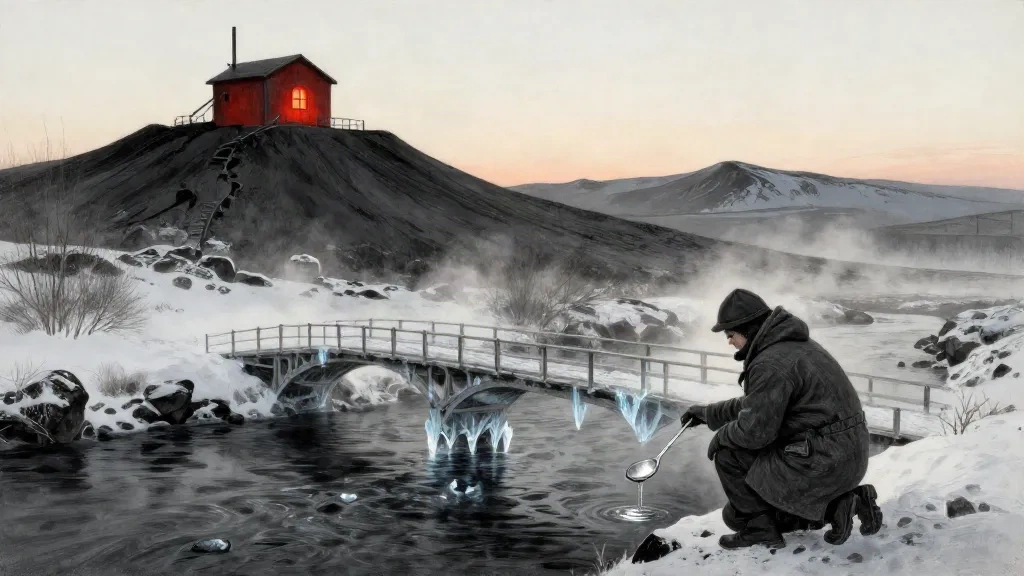
Mara woke at the hour the observatory had not yet finished becoming light. Below her the mountain breathed its slow furnace breath, and the river ran under a skin of ice thin enough to read the current through, the way a page reads through onionskin. She went down the stair with the brass compass, the oilcloth notebook, and the silver spoon her mother had polished for forty years so that the bowl held no smear of anything.
She had been the valley's river surveyor for six years. Officially she measured stages, gradients, and the safe spans of the footbridges the valley still needed. Unofficially she went down at first light, knelt on the charcoal bank, and touched the spoon's bowl to the water, and took what came.
Grief arrived as a cold green pulse that struck below the knee. Anger came through as red gravel, sharp, sorted, easy to name. Joy was clear water over pale stones. Fear was a wide brown sheet with no stones in it at all. She wrote the coordinates and the color in the oilcloth book, and at the end of every entry she drew the same small figure: two short strokes and a long one, the old surveyor's mark for a load that had been deliberately left off the manifest.
It was not superstition. The river moved a half-yard and a quarter-inch a second at her mark, and she had measured that for six winters, and the river was the most honest thing in the valley. The observatory's telescope was a liar with excellent glass. The survey office in the capital was a liar with excellent handwriting. The river only ever repeated.
Eleven years ago the valley council had closed the lower footbridge and taken its timber money for the mill levy. The office had sent Mara's supervisor with a soundness report, and Mara, then nineteen and holding her mother's last prescription in her coat pocket, had checked the numbers herself at eleven in the evening by lamplight and signed beneath him. She had checked them properly. That was the part she had never been able to turn over. The bridge was sound. Two winters later the mill sluice failed in the spring melt and took a boy named Nesk Vey with it.
That shape was in her book. She felt it every morning and she never wrote it in full. It came through the spoon with a particular weight, low, closed, like a fist under water.
That morning the river gave it to her anyway.
What the Water Held
The surface lifted at the third mark of her station, and what rose was not light. It was a bridge: dark planks, each seam sealed with rust-red iron, an arch low enough that the ice above it groaned in sympathy. Faces moved beneath the arches, lit from underneath. A woman in a red coat walking through snow with a salt jar against her chest. Two builders setting the third span and arguing over the keystone. Children crossing at noon, taking the bridge's shadow for a game. A man coming back from the war with his coat empty and nothing in it but a paper.
Mara counted the spans. Eleven. Every bridge the valley had ever raised, including the two the flood had taken and the county maps had quietly subtracted, all of them standing at once in the same reach of water like a chord struck across nine octaves of the same instrument.
She opened the cabinet at the foot of the bank and took out the pale salt. The ritual had three pinches and she had never once done it out of order. One on the tongue, for courage, because what the spoon brings up is not a report but a weight and the body must be steadied before it is asked to hold anything. One on the map, to keep a feeling from spreading past the person who felt it, which was the only law she had ever kept perfectly. One to the river, asking the water to forget, so that the feeling would not be a place someone could walk to.
She put the first pinch on her tongue. Salt, blood, the copper taste of fear.
She put the second on the charcoal line where the water had said where it was.
Then she knelt and offered the third, and the river did not take it. The salt sat on the ice, white, and stayed white, and the bridge burned brighter, and every face beneath it turned up toward her at once.
On the bank above her, someone made a small sound. Nesk Vey's sister, eleven years old, in a coat that had been cut down twice.
"It heard you," the girl said. "You always ask it to forget and this time it didn't."
"No," Mara said. "It didn't."
The Soundings
The astronomer came down at nine with the lantern and did not pretend he had been sleeping. Sever was sixty-one and had spent the winter coughing into his sleeve, and he carried the lantern because the observatory's last heat lived in it: a flame that burned without fuel, so that the mountain's heat could be measured by what it could not warm.
"Eleven spans," he said, looking at the water. "Your bridge is showing eleven."
"You counted."
"I counted in 1904, when the old one went down over the lava channel. The county struck it from the sheet in the spring. I kept the soundings." He turned the lantern up out of the wind. "Duplicate set, same night as your report. I never filed mine. There were two of us who could read a foundation, and the other one needed to be paid, so I filed nothing and let the silence do the work."
"You let mine do the work."
"I let the money do the work. I was the one who owned the shape of it." He coughed, and held his hand flat, waiting. "You are going to open the cabinet."
"I am going to."
"Then know what you are opening. It is not a secret. A secret is a thing with one owner. What you have is a witness, and you are about to make it speak in a room full of the accused." He looked up the slope, where the first smoke from the lower houses was beginning to show. "I will bring the lantern. There is going to be a great deal of darkness to get across, and my light is the only one here that does not warn anybody first."
The Public Shape
By noon the observatory floor held a hundred and six people, which was more than the valley had ever gathered in one place that was not a funeral. Farmers off the lower slopes with the fronts of them red from the wind. Oren and Pell, the mechanics, with soot-blackened hands and the stillness of men who have already decided what they think and would like to be argued out of it. Old Yos came down from the upper terrace with his right sleeve pinned at the cuff and the hook of it swinging when he walked, and Mila the cook brought copper pots and a jar of salt that her grandmother had carried across this river in a red coat and did not come back with.
They waited while Mara opened the cabinet.
"These are not public records," she said.
The bridge in the river answered with a sound like timber splitting, and everyone in the room felt the floor of it come up through their boots.
"They are records of what the river carries. And today it has brought back the bridges we thought we had lost."
She spread the oilcloth across the observatory floor and weighted the corners with instruments. Where the water had moved there was a second sheet of marks under the first, and the marks were not lines but pressure: charcoal for the ordinary griefs, rust red for the angers, and a pale winter light for what people had carried so long they no longer had any name for it. The whole valley lay under it in overlapping shapes, most of them small, one of them the size of a house standing in the exact place of the mill sluice.
The crowd bent close. No one touched the paper.
Then the silence broke the way ice breaks, all at once and mostly downward, and people began to say things. Yos said, in a voice nobody had heard him use, that he had voted to close the bridge, that he had been a councillor for thirty years, and that he had told himself the timber would have rotted anyway. Somebody's mother said his name back to him from the back of the room. Pell the mechanic said that his brother had cut the ropes on the lower span for salvage the week before the flood, and that the council had called it good husbandry, and that he had never once said so in daylight.
Mila knelt at the edge of the map and put one finger, wet with salt, on a slow blue shape that ran beneath the dome, and said: "That one's mine. That has been mine since the day of the sluice. I married into it."
And Nesk Vey's sister put both hands flat on a closed shape at the river's edge, the low fist-under-water one, and looked up at Mara without asking permission to, which was how the whole room understood the rest of it.
Mara took the silver spoon and the salt jar and knelt on the floor in front of everyone, and said: "That one is mine. Eleven years. I signed the soundness myself, at a lamp, with the numbers correct in front of me, and I signed because I had forty silver of my mother's prescription waiting at the dispensary and I could not do the arithmetic about both." The room made no sound. "I have felt it every morning. I never wrote it down. I thought the not writing was a kind of keeping."
Then she drove the nails and hung the sheets on the observatory wall, glass over cloth, and the hidden weather ran under the glass where the whole valley could walk up and read it, and the shapes did not soften for being looked at, which was the mercy she had been hoping for and did not receive.
The Crossing
They walked down to the bank in the flat white light, and the ice underfoot was thin, and the bridge lay in the reach where no bridge had stood in living memory, wet timbers steaming in the cold, the iron along the rails shining with the wet of the river rather than with any rain.
No one crossed yet. They had all learned, at the sluice, the danger of believing a memory was a place.
Mara climbed onto the first plank. The spoon trembled in her hand and she held it out and down, and offered it to the water, and the bridge took the weight of it and held. Then she poured salt into the cracks between the boards, and the rust-red stains came up bright and reorganized themselves, and where they were not stains anymore they were names, the eleven spans' worth, cut deep into the wood, and the lowest of them was a name she had not seen since she was nineteen.
"A bridge is a promise," she said. "It says the other side can be reached. I want to say that the other part is true too, and I do not know how. It is not a road to somewhere. It is a road to everyone who already made the crossing and came back without their coat." She put her hand out behind her. "It is heavier than it looks. Come slowly."
Yos went first, an old man with an empty hand, and the span he stood on did not so much as dip. Oren and Pell followed with rope and hook, reading the iron seams and calling out the rivets like men reading a contract. Mila crossed carrying the salt jar in both arms, the way her grandmother had, and was sick at the far bank and then laughed at herself, which is what the valley heard afterward, mostly, when they thought about that day. The children came with the winter's first red berries in their fists and stopped in the middle to throw them into the water for luck, and lost eleven of them, and found most of them again.
Each step made the bridge stronger, and Mara understood why, and it was not a beautiful reason. It did not strengthen because the people on it were good. It strengthened because it had been built by all of them, and every footfall on it was one more entry in the record, and the river could not tell the difference between a bridge and a list of names, because to the river those were the same instrument.
Halfway across, with Nesk Vey's sister three planks behind her, the light in Sever's lantern went out.
He did not stop. He walked the middle of the arch with his hand at his coat, and when he came off the far bank he put his soundings in her hand, folded, and said: "Put mine under yours on the wall. I was the one who owned the shape of it, and I would rather it be read out loud than filed."
Then he went up the bank a few steps, sat down against the rock face with his back to them, and did not move again, and the mountain took his heat the way it takes all heat, without ceremony, and out past the crater the ice on the upper channel began, audibly, to lift and set and lift again.
Down at the foot of the stair two riders from the survey office in the capital came into view, four hours late, with the notice in their saddlebags that suspended her licence pending review of an instrument not on the schedule. They got there at the same moment the last crossing did, and they stood at the rail for a while with the paper in their hands, and then the older of the two put it back inside his coat, because a suspended licence is a small document and the thing in front of him was eleven spans of the valley's dead standing up out of the ice, and the older one had grown up in a village too.
What the River Kept
At dawn the water went quiet in the way the valley had been told it would, and the single morning of feeling went out of the river like a lamp being carried up a stair. By noon the spans had sunk, all of them, in order, from the first to the eleventh, and there was nothing in the reach but black water under ice and eleven rings going out, and one loose plank that came up on the gravel and stayed there, and which Oren Pell picked up and turned over, and which was ordinary wood, an ordinary board, split and clear of any name at all.
What stayed was the wall.
That was the part nobody had costed. The river forgot; the glass did not. So the valley had a public record, and it was the only copy, which meant the office in the capital had three doors and she had closed two of them, and the third one was that the glass came down and the paper burned and the county kept its silence and a suspended instrument became a small administrative matter that could be closed with a signature.
She kept her licence long enough to resign it. She wrote the letter the way she wrote her coordinates: stage, gradient, and the load left off the manifest.
The Pell brothers went back down and said the thing out loud to the council, and Oren gave them the bridge iron, the whole rail, cut into lengths, to go into a new footbridge at the reach where the old lower one had stood, which was four hundred paces upstream of the place where the lost boy had gone under. They built it with hands, over nine weeks, in weather that took two sets of fingers off the job. Mila kept the salt and did not keep the ritual; she put a pinch in the river every morning anyway, and never once asked it for anything, and told anyone who asked that this was not because it worked.
Yos lived out the winter at his own gate, which was where a thing like that goes in a place this small. He never once asked to be forgiven, which was correct, and which nobody ever told him, so he had to go on working it out alone like a man learning a trade with no master left.
The children kept marking. That was the part that frightened the office, though it took them two years to see it. New small ferries went onto the wall in pencil every week that first year, the children's own crossings, and then a cook's blue, and a mechanic's slow red, and after a while the marks were not even readings, they were just a way of saying where a thing had been carried.
And on the first clear morning of the second spring, Nesk Vey's sister, seventeen and insufferable, waited at the station until Mara's knees were in the water, and said: "You are going to stop, aren't you. You are going to put the notebook away and go up and be a proper surveyor with a brass compass and no salt." She put a hand flat on the closed fist-shaped mark in the book and lifted it and showed her the palm, which was clean, which was the point. "I felt it for you. I only know how to spell it with my hands. Is that allowed, when the water's forgotten and you're the one holding the pen?"
Mara said yes, and taught her.
The Line That Ends at a Door
The last bridge under the volcano came up once more, in the fourth summer, and the survey office sent a man with a chain and a notice, and he did not chain it, because there was nothing on the ground to chain to and the notice required a structure, and he was a career man and not a cruel one. It stood eleven spans in the reach above the lava channel for a full day while the volcano breathed over it, and Sever's soundings were read aloud in a room where the whole valley sat, including the ones from 1904, including the ones that had been struck from the sheet in the spring.
At dusk it went down, and the ice closed over it, and the far bank kept whatever it keeps.
That night Mara climbed above the tree line with the brass compass and the oilcloth notebook, alone, because the ritual was hers and the law of it was that it was done by the one person who had felt it. She did not kneel. She stood at the black lip where the heat comes up through cracks in the rock in a language of sulfur and hot iron, and she opened the notebook to the last spread, the one where the deep mark lived, the one the water had given her without permission on the coldest morning of her life.
She drew the line south-east. The old surveys had it as a culvert, a drainage cut to bring meltwater down off the shoulder, and the old surveys had a length for it and no destination, because the maps end where the useful part ends. She measured by compass, by pace, and by the temperature of the ground under her hand, the way she had always measured, and at the last step of it the ground went from hot to merely warm, which meant a door, because a door is where a wall decides to be a wall for you.
Eleven spans went over that channel in 1904. Two went down in the flood of the spring before that. A cloth bridge went over it in 1811 and took a bridegroom's whole family, and the county struck that one from the sheet too, and a boy named Nesk Vey had stood on this exact lip at nineteen and looked down at it and told her it was a fine piece of ground, which is what he said, and which she had never reported, which was the last thing she had ever kept off the manifest.
She wrote the coordinates. She wrote the date, which was a lie, and she let it stand, because the load had to be entered somewhere and the manifest was the only honest paper left. She put the mark in the notebook in the shape of a line that did not stop at a border, and then it stopped, because a line has to stop somewhere, at a place where a wall has decided to be a wall for you.
She closed the book, and left it, and did not go down to the river at first light, for the first time in six years, and did not tell anyone why.





