 Netwrck
Hopeful Science Fiction.
Arrival
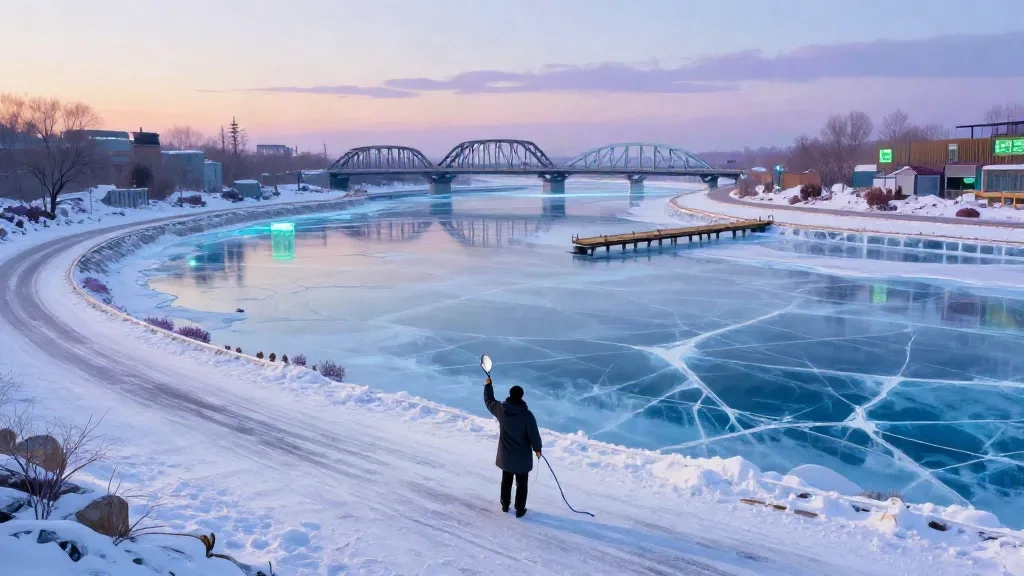
The first shadow crossed the frozen lake before the first ski lift opened. It moved without a body, keeping to the wet asphalt where plows had cut black seams through the lavender snow.
Mara Venn watched from the survey cabin as it climbed the frozen waterfall, stepped over a railing, and became the shadow of a guest she had not yet met.
Her work was called emotional hydrography. On paper it sounded grand. In practice, Mara tied a silver spoon to a length of blue thread and floated it across whatever moving surface she could find: creek, gutter, rain puddle, the shallow overflow beneath a frozen lake. The spoon leaned toward a nearby person’s voice. When a memory was strong but unspoken, the thread tightened in her fingers. If someone feared the coming spring, the spoon trembled.
Every morning for eleven years, she had surveyed private waters for the people who lived beside them. She recorded the small storms of Meridian Falls: grief loosening its grip, an old friendship cracking then knitting, a girl becoming brave in increments. Her maps belonged to no government. She kept them folded beneath a salt jar in her cabin, where the air stayed dry and the windows whitened with winter.
That morning, she found silver in the river.
It glimmered half a meter below the surface, a pale blade sliding over stones. Mara knelt at the bank and saw that it was a spoon, perfectly preserved, dragging a thread downstream.
The River Ledger
Where the resort’s stream passed beneath the ice, it kept moving. Mara broke the crust and lowered a brass sounding line. At ten meters, the line stopped ringing.
It had struck something solid.
She widened the opening and shone a lamp through green water. Beams, walls, iron pins, and pale stone appeared below: not ruins, exactly, but a compressed procession of bridges. Roman arches rested beneath timber footbridges; suspension cables curled around stone piers. Some were ancient and green with age. Others shone like tools from last winter.
The river carried the records of every bridge ever built.
Somewhere beneath them, voices rose. A child counting boards. Two lovers arguing across a river. A crowd cheering when the first steel span opened. Water poured through all of it, carrying whispers downstream.
Mara marked the discovery on her chart, then covered the hole with boards. The resort manager promised to arrive with divers. Instead, the shadows came.
They slipped beneath cabin doors and pooled around breakfast tables. Guests followed them through the lobby, laughing at first, then quieter. Each person seemed to cast not one shadow but two: one belonging to the body, another stretching backward toward an absent face.
By dusk, the guest list had doubled. People from abandoned towns appeared, stamped forms from unbuilt railways, children no older than the first bridge. They all wanted the same thing.
To cross.
Salt and Silver
Mara recognized the ritual now. The river preserved connection, but it kept connections in order. Every bridge held only the moment its builders had intended: the ceremony, the panic, the public claim. Beneath that surface lay the private crossing. The fear hidden inside trust. The reason behind a promise.
She opened the salt jar.
Crystals spilled over the map she had spent years making. When they touched its river lines, they did not melt. They stood upright, each grain reflecting a different version of the same journey.
For eleven years Mara had kept the maps hidden because she feared judgment: that she had turned love into measurement, grief into property. But a private map protected only the people who had carried it. The new arrivals carried too many crossings to count.
At dusk on the second day, Mara climbed onto the resort’s frozen skating lake. Beneath her boots, hundreds of bridges pressed against the ice.
She untied her silver spoon. For the first time, she did not ask it to point toward a feeling. She hung it above the largest silver patch, the heart of her own unfinished journey.
The spoon trembled. The thread tightened.
She had spent years listening for other people’s courage because she had mistaken restraint for strength. She had believed that to go first was to burden those who followed. Now she understood the opposite. A crossing became possible because one person entered it.
So she opened the salt jar in both hands.
The First Step
“This map does not show where the river has been,” Mara told the crowd. “It shows where we have carried one another.”
She poured salt across the ice. It fell in a wide silver road, too rough to ski, too bright to ignore.
The first arrival stepped onto it. Then another. A woman from a village no longer on any road map took Mara’s offered arm. Across them walked builders, children, skiers, and strangers. The spoon swung above them, pointing forward.
Under the lake, every bridge answered.
Stone rang. Cables sang. Footbridges knocked like knuckles. The river lifted their names in shining bubbles, but no longer held them in place.
By morning, the lake had become a public square. The resort lights glowed pharmacy green against lavender snow. Guests followed the salt road between banks of wet asphalt, speaking to those they had carried through harder crossings.
Mara’s oldest map lay drying on the cabin table, its private rivers joined by a new blue line.
The spoon pointed beyond the resort.
For the first time, Mara packed the map instead of hiding it. Then she went to meet the guests at the water’s edge, carrying their silver road between them.





