 Netwrck
Speculative Fiction.
The Note Under the Ice
Every bridge in Bellwether was a promise, and every river was a witness. The footbridge over Mire Creek carried a widow's vow to return. The stone arch at Lantern Street held a merchant's promise to pay honest wages. Even the narrow plank bridge beyond the cemetery was called Mercy, though no one remembered what mercy had cost.
On the morning Mara heard the first new note, the river had frozen halfway across its stones.
She was tuning her violin in the cooperage when Old Pell said, “I never signed the papers abandoning the north mill.” A silver spoon trembled against his teeth. The note rose from nowhere and inside Mara at once: a clear, high sound, like a bell struck beneath black water.
She knew it for the truth. Since childhood she had heard notes in other people's certainties—small truths, large ones, the bright chime of a promise kept and the dull thump of a promise abandoned. The village had mistaken her for a sensitive musician. Mara had mistaken it for a curse.
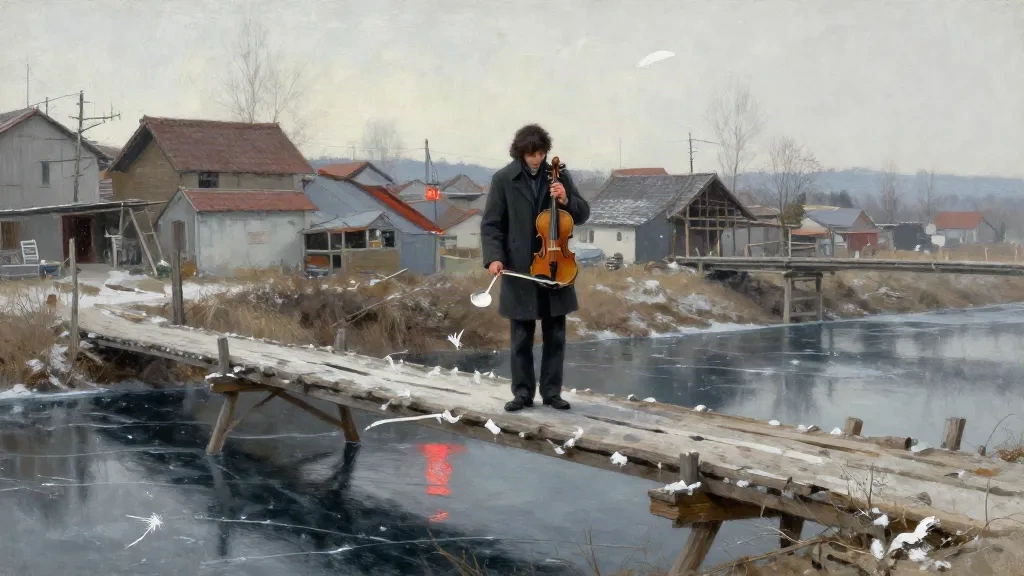
By noon, the note had followed her to the frozen river. A white feather rested on the ice, impossibly clean in the rust-red mud along the bank.
A Structure Against Winter
That winter began refusing to end.
First came the unusual cold. Then the thaw that never arrived. The river's ice thickened until bells could be heard cracking beneath it. Snow packed the lanes until doors opened onto walls. Every morning the mayor announced another week of winter, and every evening the sky lowered another pale layer of light.
Mara had one concrete desire: to build something that could survive the storyteller.
She meant the mayor, whose nightly announcements had become the only calendar left. She meant the old women who gathered in the warm room of the inn, trading tales of the last generation. If their stories changed, the weather changed. If they forgot a name, a road disappeared beneath the snow.
So Mara designed a bridge across the frozen channel. Not a promise to last forever. A place where several promises could meet without any one of them being asked to carry the rest.
She gathered iron rods, oak beams, and copper wire. She called the bridge the Unison. At its center she placed a shallow bowl made from a silver spoon.
“A bridge needs two banks,” said Pell, watching her work. “You have made three.”
“Then it will have three ways through,” Mara said.
He tested the wood. The spoon rang once.
What the Winter Refused
By the middle of winter, the bridge was almost finished.
But each new truth altered it. When the mill owner confessed that he had hoarded grain during the famine, one span twisted. When a child admitted she had never seen the river thaw, the ice beneath them emitted a deep, patient crack.
The town began bringing its confessions. Some were harmless. Some were not. A woman said she had never forgiven her brother. A man said the western bridge had been built to hide a body. Each truth added a note to Mara's violin, until she could no longer play one string without hearing the others.
The Unison stood half a mile from the river's center. It needed one more span.
No timber would hold. No iron stayed straight in the cold. The mayor offered a story about the bridge that had been built before the town existed, but Mara heard the lie scrape through it. Even the white feather on the ice was gone, replaced by a single white streak in the sky.
Then Pell brought Mara the old bridge records.
“The first bridge was never meant to be permanent,” he said. “It was meant to be repaired by the people who crossed it.”
Mara looked at him. The note appeared, impossible and plain.
Below the bridge, the river shifted in its frozen bed. Somewhere beneath the ice, water was moving.
The Ending That Held
They cut the Unison's central beam loose.
Not to abandon the bridge. To make it movable. Mara shortened the span, set the spoon in a socket at its center, and let the beam rest on three iron braces. The structure stopped claiming permanence and began accepting change.
When the next pale morning came, villagers carried stones to the river. The mill owner brought timber. The child with the frozen river memory carried a lamp. One by one they added pieces, repairing what the cold had bent.
On the first day the ice thinned, the river spoke through its breaking crust. It did not say the town had kept its promises. It said only that the promises had not been wasted.
By spring, Bellwether had rebuilt every bridge, but none looked as before. The Unison stood crooked, patched, and strong. Mara's violin had lost its highest string, yet she could still play.
Years later, children asked why the bridge leaned.
Mara gave them the white feather.
“It remembers the wind,” she said. “It does not pretend to be stone.”
Then she lifted the silver spoon from her coat and set it on the rail. The sun struck it, sending a small winter light across the river. The note was not the truth this time.
It was the sound of a promise becoming something stronger than a promise.





