 Netwrck
Fairy-Tale Fiction.
The Moving Map
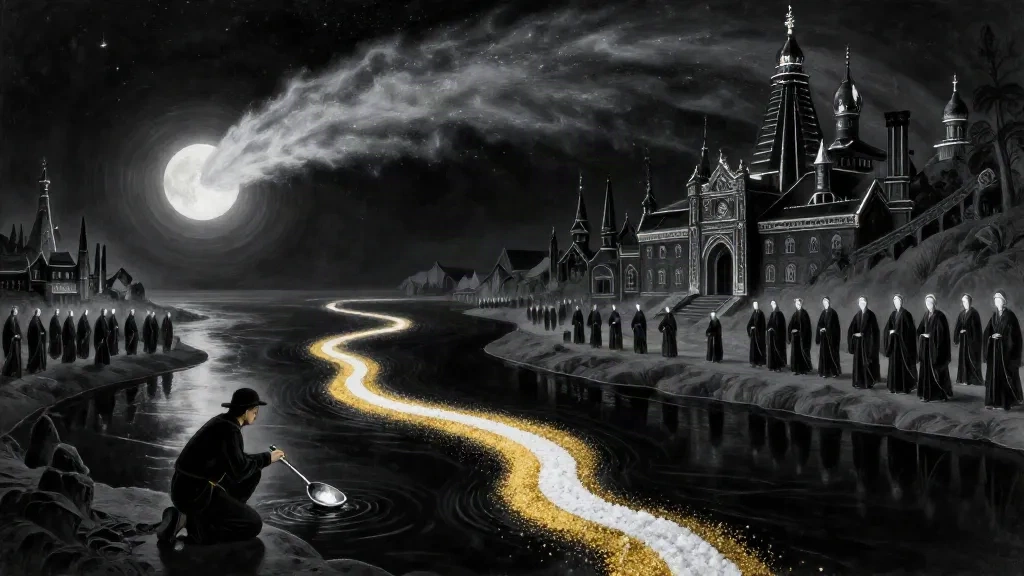
At the end of the monastery’s black-lacquer stair, Sister Anja followed the river that had no banks. It ran through the comet’s hollow spine, a black ribbon under a ceiling of cold moonlight, and moved whenever the stars shifted overhead.
Anja was a river surveyor. Her instruments were a silver spoon, a salt jar, and a narrow bronze compass that trembled whenever someone nearby concealed a feeling. She mapped emotions on the moving surface: grief made dark eddies, hope traveled in bright gold threads, fear sank beneath the water as smooth stones.
Every morning she knelt beside the river and measured one private emotion.
She began with homesickness. She stirred one spoonful of salt into the black current and watched the river carry the ache toward the village below. The ritual belonged to her alone. She had performed it for seven years, never telling the monks, never naming the village either.
On the night the comet’s shadow crossed the moon, the river turned silver.
Every Bridge Remembered
The change began beneath the monastery’s oldest bell. A bridge-shaped ridge rose from the water, then another behind it, then dozens more. Each appeared for a heartbeat before sinking into the current. Anja lifted the spoon from the surface.
With it came voices.
Not voices from the banks, but voices from the river itself. A child on a stone bridge over the western marsh. A merchant crossing a wooden span after the rain. A king beneath a bridge of black iron. A girl standing on the last bridge before the river swallowed her village.
The water carried every bridge ever built: its planks, ropes, prayers, tolls, and the footsteps that had crossed it.
One voice repeated a promise.
“I will remember you after the road is gone.”
Anja knew the voice. It was her own, spoken seventeen years ago when she left the monastery and crossed the bridge to the village. She had told the river she would return. She had not.
The bells rang without wind. Along the river, the bridges reappeared, joining into a single pale road.
The Salt Jar
The abbot found Anja beside the water, holding the salt jar in both hands.
“What have you summoned?” he asked.
“Not summoned,” she said. “Remembered.”
He looked old in the moonlight. The comet trembled around them, carrying the monastery one handspan farther from the world.
“If the river releases the records, the monastery loses its boundary,” he said. “Every hidden vow, every broken oath, every road we sealed beneath the stone. The living will hear what the dead confessed.”
Anja looked into the salt jar. Its grains shone like gold dust trapped in black glass.
She thought of the village she had never visited. The promise she had made to herself. Every morning she had hidden a small piece of her longing inside the river.
“I did not come here to keep a secret,” she said. “I came because I wanted one thing to be witnessed.”
The abbot glanced toward the stair. Behind him, the monks had gathered. None of them spoke.
Anja opened the salt jar and poured it into the river.
The Public Crossing
The salt did not dissolve. It lay upon the black surface in a white line, stretching from the monastery to the far bank of the world. Gold dust rose from it and settled on the monks’ black robes.
Then the river began speaking aloud.
It named every bridge. It named the hands that built them, the hands that repaired them, the hands that finally let them fall. It named the emotions carried over each crossing: gratitude, terror, devotion, shame, farewell.
People climbed from the village below. They came through the night with lamps and muddy feet. They stood along the banks and listened as the river gave their hidden memories back to them.
Someone wept. Someone laughed. Someone stepped onto the pale bridge of remembered roads.
Anja placed her silver spoon on the water. The current lifted it, turned it once, and carried it toward the village.
Then she took her place at the edge of the bridge.
“I returned,” she said, and every bridge held her weight.
By morning, the monastery’s private bell had become a road. The river still moved, but it no longer kept its records beneath the surface. They traveled where anyone could see them, silver under the cold moonlight, until the oldest bridge rang like a star striking stone.





