 Netwrck
Mystery.
The Water Between Shelves
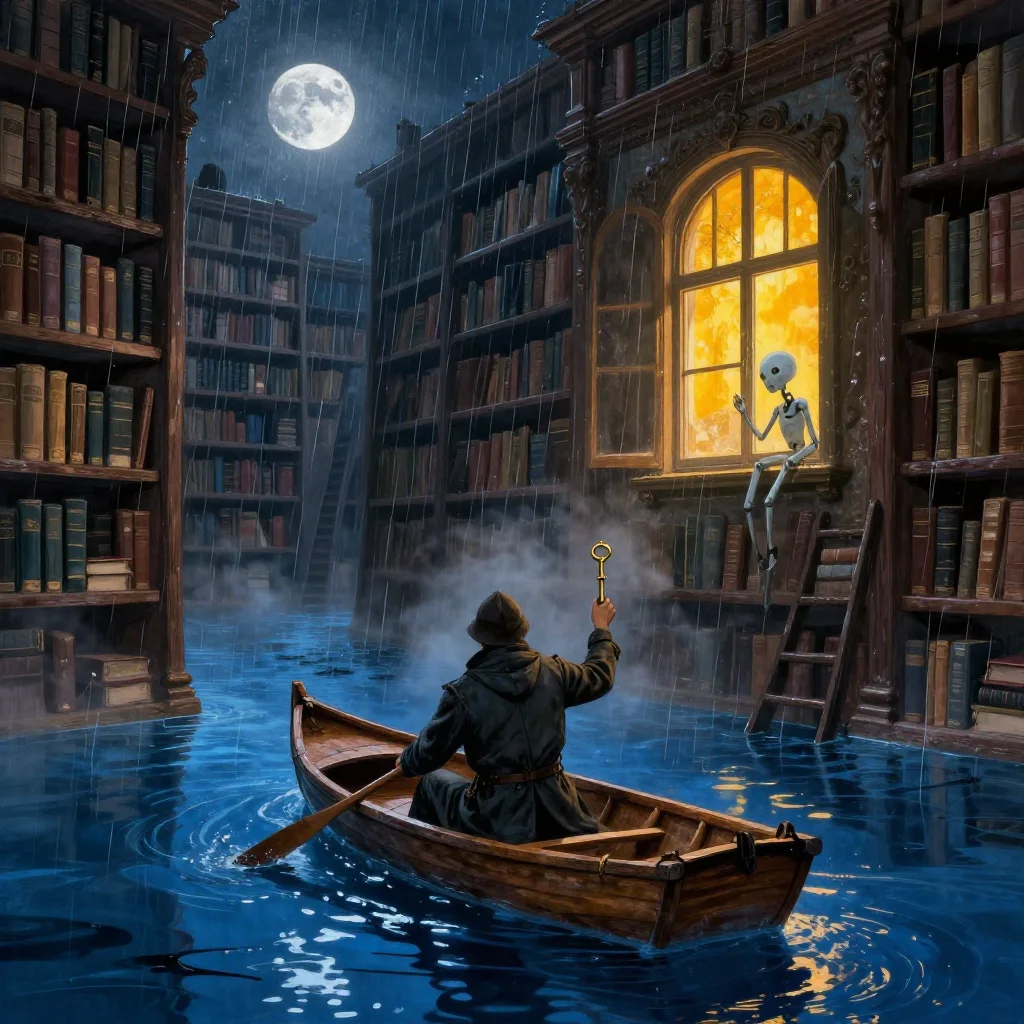
At dusk, the archive filled the flooded valley shelf by shelf, each oak row rising from black water like the roofline of a drowned village. Librarians rowed between them, calling catalog numbers across the rain. Their boats left no wakes, only narrow silver seams that healed behind them.
Mara Venn arrived with a ranger’s coat, a dry notebook, and the brass key of the missing woman she had come to find. The key had been tucked beneath Mara’s cabin door with no letter, only a wet footprint ending at the archive stairs.
She rowed past the maps, past histories of storms, past the botanical shelves where drowned roots pressed against glass cases. The forest had been evacuated from time three winters earlier. Its residents lived now in scattered years, carrying memories of the valley like seeds they had not been permitted to plant. Mara’s duty was to protect the boundary between the evacuated forest and the place where time still moved normally.
Her duty had changed when the ranger before her disappeared mid-survey.
Curfew at the Amber Window
The first curfew bell sounded beneath the floorboards. It was not a warning clapper. A long silver note traveled through the water, and every boat stopped.
Along the northern wall, one window glowed amber. A pale creature stood before it, no taller than a child, with joints that clicked like compass needles. It raised both hands and pointed toward the last light.
“No passage beyond the window,” it said. Its voice arrived from everywhere at once. “Curfew begins when the first moon appears in the west.”
Mara looked at the sky. A small moon, pale and coinlike, had begun to rise behind the stacks.
She had been told the creature was not hostile. That warning had seemed meaningless until the creature crossed the flooded aisle, carefully lifting each boat it passed. It did not block the books. It blocked time.
Mara showed the brass key. The creature tilted its head. “That key opens a door your missing ranger approached but did not cross.”
“Then let me finish the journey.”
“Your journey is not hers.”
The amber window brightened. Inside it, a woman stood with her back turned, rowing a boat through a forest of black trees. Mara recognized the woman’s torn sleeve, the same one seen in the last ranger report.
When the small moon touched the western shelf, the creature lowered its hands.
“Curfew lifted for three crossings,” it said. “Not four.”
Three Crossings
Mara rowed after the image. The archive rearranged itself as she moved. Catalogs became doors; a shelf of atlases opened onto a forest path under a sky of stacked seasons. She entered the first crossing.
Here, the missing ranger had left a thread tied around a black alder branch. Mara cut it free and found a second brass impression pressed into the bark. The trees were not memories, she realized. They were places where time had been removed and stored.
In the second crossing, a storm leaned sideways across the forest. Rain struck Mara’s face, though the water around her boat remained flat. She followed the amber reflection from window to window, passing seasons in which the valley had been built, abandoned, and rebuilt.
The third crossing ended at a submerged door bearing the same teeth as her key. Beyond it waited the unfinished journey: a path through the evacuated forest to the first shelter, where the displaced villagers had promised to return the stolen years.
Mara fitted the key.
The door opened a finger’s width. A voice inside whispered, “You are late.”
Mara recognized the missing ranger.
Behind Mara, the small moon vanished below the waterline. The precise creature began counting down from three.
The Door That Waited
Mara could not cross and return. The key belonged to the missing ranger, not to her. The journey had begun with that woman’s trust, continued through her choices, and required someone willing to carry it farther than the archive permitted.
So Mara turned the key backward.
The brass teeth withdrew. Water poured through the narrow opening, carrying the amber window’s reflection with it. The missing ranger’s face appeared, not inside the door but across the flooded aisle, where the archive kept what it could not return.
The creature’s counting stopped.
“You have crossed three times,” it said. “You may leave one thing.”
Mara raised the key. “Leave the way open.”
The creature considered her. It was not hostile, only precise, and precision recognized a promise that did not ask for more than the journey could bear.
At dawn, the flood settled. The missing ranger stepped out of the shelves, carrying a lantern with a small moon reflected in its glass. She had not been trapped. She had been waiting for someone to remember that every journey required an ending chosen by the person who inherited it.
Behind them, the forest returned one tree at a time. Mara kept the brass key, but no longer wore it. The small moon rose above the amber window, precise as a seal, and the archive opened its next door.





