 Netwrck
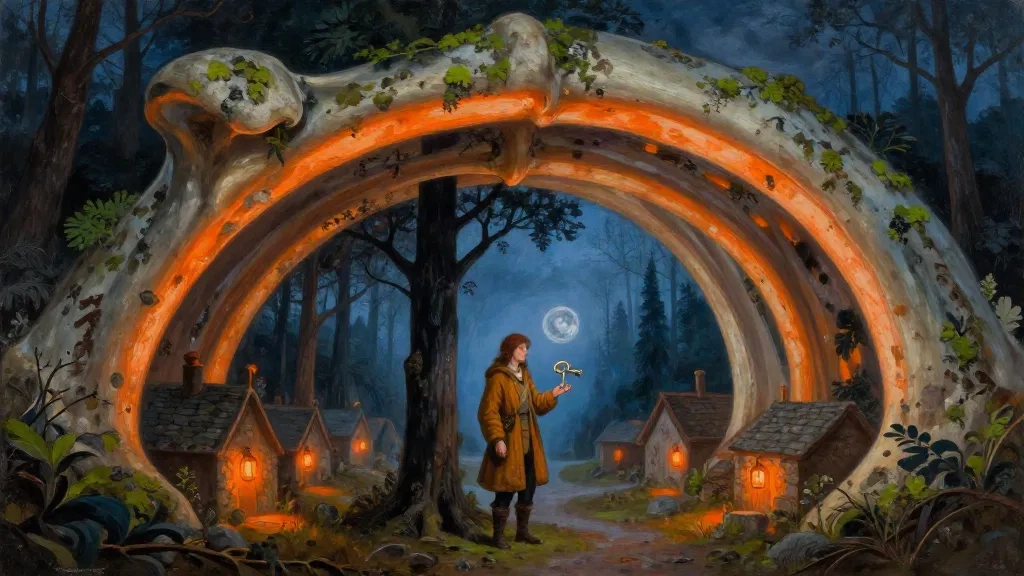
Surrealism.
The village in the ribs
Mara had been told that the village had no streets, only breathing rooms. This was nearly true. The houses clung between the curved white bones of a giant buried under the mountain, and the passages between them narrowed whenever he inhaled. At dawn, lanterns leaned toward the ceiling. At night, the villagers pulled their shutters shut before the blue storm-light touched the floor.
Beyond the western rib, where the giant’s shoulder disappeared into lichen and black stone, stood the forest. It was the last forest outside time. Not merely old, though its trees were old enough to remember being saplings. The forest had been evacuated from time, removed hour by hour until even birdsong there belonged to a morning that no longer existed. Mara was its ranger now.
Her mother had been the ranger before her. Eleven years earlier, she had entered the forest carrying a brass key, a small moon in a leather pouch, and a map with no destination. She sent back one letter: When I finish the journey, leave the light burning.
Mara had spent every year since trying to finish it for her.
The precise creature
The curfew began when the blue storm-light came through the mountain.
It was announced by a soft bell from inside the giant’s third rib. The villagers emerged carrying measuring rods, silver bowls, and little glass cases for insects. The creature arrived on four narrow legs, its body resembling a folded coat, its head a polished brass dome. It had no eyes. It moved without haste and never harmed anyone.
“The forest is closed,” it said.
Its voice sounded in Mara’s teeth. “Until the permitted moon is returned.”
The creature would permit only what had been counted. One bucket of water. Two breaths beneath the giant’s collarbone. Seven steps into the old forest. It ignored panic, urgency, and grief. Mara had tried every explanation. The creature tapped its brass dome and said, “Grief is not a measure.”
On the first night, Mara watched from the forest edge as storm-light turned the moss blue. The trees stood without moving, though their shadows pointed toward the moon. A path appeared between them, narrow as a needle and bright as wet iron.
She stepped across the boundary.
Seven steps, twice counted
The creature found her before the path closed.
It did not attack. It simply placed one paw over the seventh footprint and repeated, “Seven steps. Six permitted.”
Mara opened the pouch. The small moon was cold, round, and no larger than a plum. It had been in her family for generations, though its light came from neither sun nor star. When she raised it, the creature withdrew its paw.
“The moon is permitted,” it said.
“The key?” Mara asked.
“The key is owed.”
She turned the brass key between her fingers. Its teeth were uneven, as if it had been filed for a lock that no longer existed. Her mother’s letter was sewn inside the lining of her coat. Mara had carried it for years without seeing the faint blue stain beneath the thread.
That stain was a map.
Not lines, but absences: places where the forest had been taken from time. The key fitted them one by one. At the third hollow, Mara saw a door in a tree. At the fifth, she heard her mother laugh behind the bark. At the sixth, the path split.
One branch returned to the village. The other descended beneath the giant’s ribs.
The journey unfinished
Mara chose the descent.
Below the village, the forest grew upside down from the ceiling of a buried chamber. Its roots hung like black rivers. Blue storm-light gathered in their knots, and the small moon began to shine more brightly with every step.
At the chamber’s center stood the giant’s heart, sealed behind a lock shaped like a sleeping mouth. Mara’s mother waited there, neither alive nor vanished. Her hand rested over the keyhole.
“I did not abandon the journey,” she said. “I became its last turning.”
Mara understood then. The forest had been evacuated from time to save it from the giant’s waking. Someone had to remain inside the missing hours and hold the creature’s precise world shut. Her mother had chosen to become the threshold.
“Finish it,” Mara whispered.
The brass key entered the lock.
The small moon rose above the chamber, whole and silver-blue, and the curfew bell rang for the last time. Mara turned the key. Somewhere above them, the village inhaled.
When the giant exhaled, dawn entered through the ribs. The forest returned, but changed. Its trees now grew in rings, and every leaf held a moment of waiting.
Mara climbed out carrying no map. Her mother walked beside her, neither wholly returned nor entirely gone.
At the western boundary, the precise creature bowed its brass dome.
“The journey is complete,” it said.
Mara looked toward the sleeping forest. The small moon was fixed in the sky, smaller than before.
“No,” she said. “It has only begun.”





