 Netwrck
Magical Realism.
The Forest Outside the Hour
Mara Venn had been told that the forest had been evacuated from time, but the map did not explain what that meant. It showed a green boundary enclosing a blank white space, with tiny ink symbols around the edge: a dropped stitch, a closed eye, a bird facing west. At the forest gate, a brass plaque said TIMBER DEFERRED, and beneath it someone had carved a warning that the trees were not missing but elsewhere.
She arrived before dawn with a lantern, a bow, and the key of a journey she had not begun. The key had been left on her cot with a note in her brother’s handwriting: Finish the road. Do not trust the bell. His name was Elian Venn. He had been a cartographer, and eleven months ago he had walked into the evacuated forest carrying a brass compass and a small moon-shaped lens. He had not returned. His boots, one map, and the key remained.
Mara’s assignment was simple: protect the forest from trespassers, poachers, and anyone seeking to recover what time had confiscated. She disliked the wording. Time had not confiscated the trees. Something larger had folded the forest away and left only the roots, the birds, and the warm smell of resin in the air.
The Market of Unowned Things
On the first evening, the market came down the mountain.
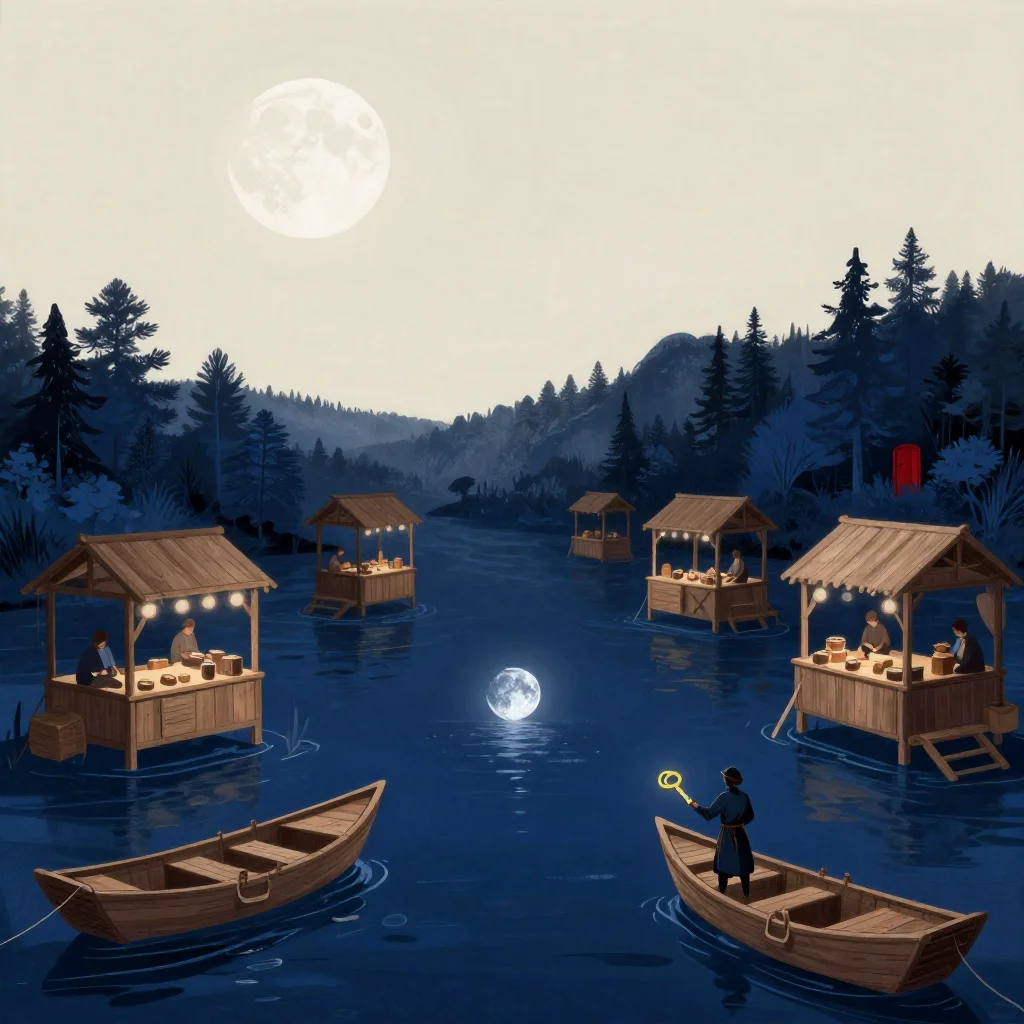
It arrived as a fleet of small boats suspended beneath a pearl-colored sky, each hull lined with stalls. Some held umbrellas remembered by children who had grown tall. Others held birthday cakes, green apples, winter gloves, and letters whose writers could no longer remember whom they loved. The vendors wore masks made from polished wood and sold memories in stoppered bottles.
Among them was a woman selling the smell of rain on hot stone. A boy offered a memory of a dog with three names, all of them true. Above the stalls floated the small moon Mara carried in her pack. It was not the moon in the sky, which was broad and blue, but a miniature version, cool enough to sting her palm.
“Ranger,” said the vendor of lost keys. He was a thin man with a face like a closed door. “Your brother bought passage here.”
“When?”
“Before the forest left.” He placed a brass key on the counter. The one Mara carried grew warm. “He said he was following a red door.”
At the far end of the market stood the door. It was the only red thing in the valley, set between two walls of blue evening. Above it hung a number carved in bone.
The Curfew of the White Stag
The market’s curfew arrived without footsteps. A white stag walked through the water beneath the boats, and every stall fell silent. It was not hostile. Its antlers held the patience of a careful clerk, and its eyes tracked each object with exact attention.
“No crossings after the second bell,” the vendor of lost keys said. “The stag forbids them.”
Mara stepped toward the red door. The small moon in her pack brightened. The brass key turned by itself, though the lock was thirty paces away.
The white stag lowered its head. A silver thread ran from its antler to the lock, and when Mara moved, the thread pulled tight. The door did not open. Instead, the market rearranged itself. Boats swung into new positions. Bottles of memories clicked against one another. A memory of a train emerged from a bottle and vanished into the sky.
“The creature is not hostile,” Mara said, remembering the instruction. “Only precise.”
She understood then. The stag was not forbidding passage. It was preventing two times from occupying the same threshold. If she opened the door while the market was still closed, the red door would divide her from the world she carried, or tear both apart.
At the second bell, the stag raised one hoof. The boats went still.
“The door opens when the moon touches the water,” Mara said.
That was why Elian had taken the small moon. Not to light the path, but to change the hour.
A Map Made of Missing Things
Before the bell’s echo faded, Mara climbed into the market’s highest boat. The vendor of lost keys followed, though he moved with the stiff care of someone crossing a dream. Below them, the white stag watched the blue water.
“The key opens doors,” he said. “The moon opens hours.”
“And the forest?”
“The forest is the road.”
Mara looked through the boat’s copper-bottomed hull. In the water lay a map made of reflections: a fork, a bridge, a narrow stair, the red door again, and beyond it a white forest beneath a moonless sky. Elian’s mark appeared at the edge of the map, a small blue circle.
The white stag lifted its head. Its antler-thread tightened around the key in Mara’s hand. The creature had allowed her aboard, but it would not allow her to arrive unprepared.
Mara set the small moon on the water. Its reflection sank, then rose, and the map rearranged itself. The fork moved. The bridge vanished. The blue circle became a red one.
“He changed the route,” she said.
“He changed the destination,” the vendor replied.
Mara took the moon back. The market began to close around them. Stallholders folded their awnings; bottles vanished into sleeves and pockets. The red door waited beyond the last boat, its paint darkening as night deepened.
When the third bell sounded, the white stag placed one hoof on the shore.
Mara jumped. The key struck the lock. The small moon rose behind her, casting a thin silver line across the door. The red paint split like dawn.
The Door That Remembered Her
Beyond it was the forest.
Not the forest she had guarded, but its missing hour. Trees stood beneath a midnight-blue sky, each leaf holding a drop of pearl light. No wind moved them. No birds called. The ranger’s path ran between the trunks, marked by small red doors set into the roots.
Elian waited at the first one.
He looked older, and his coat was white with forest dust. He held a brass compass whose needle pointed at Mara.
“You took your time,” he said.
“I thought you were dead.”
“I was, briefly. The forest has a second grammar.”
He touched the key in her palm. The red door behind her closed without sound. The white stag’s silver thread stretched through the trees, marking the way back.
“The road,” Elian said, “does not lead home. It leads to the place where lost things choose an owner.”
Mara looked at the little moon, still bright in her hand. The forest beyond the roots waited without wind, patient as a held breath.
“Then we finish it together,” she said.
Elian smiled. Somewhere ahead, through the pearl leaves, a red door opened.





