 Netwrck
Hopeful Science Fiction.
The Paths People Avoid
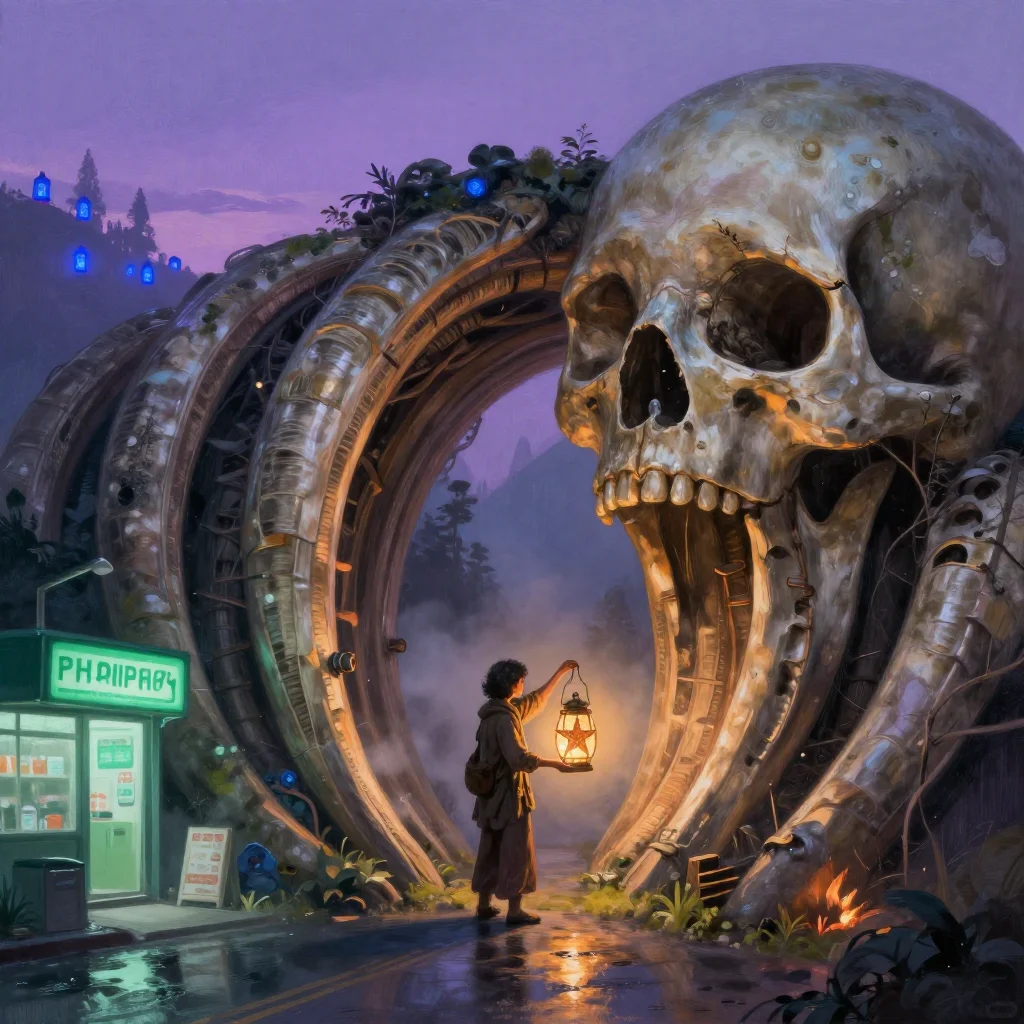
Mara made lanterns for the roads nobody wanted. Her workshop stood in the hollow between two ribs of the sleeping giant, where rainwater tapped softly against bone and the village paths crossed beneath a ceiling of stretched sinew. She polished copper, bent wire, and filled glass globes with pale fire.
Her finest lantern carried a copper star at its heart. Mara had found the star in the drainage channel during her first winter, sharp and bright as a splinter of sky. Beside it, on the same workbench, rested a glass bird with wings folded tight. Every child in the village wanted to hold the bird. Mara let them look, but never let them take it.
“Light the roads we avoid,” her teacher had told her. Mara had thought it was foolish advice. Roads were made for going somewhere.
Until the winter the border closed.
The Bell Beneath the Floor
The border was not a wall, only a line of blue lanterns laid across the eastern rib. Beyond it lay the low fields where the giant’s breath warmed the soil. On the other side lived the salt farmers, the glassblowers, and people whose names had disappeared from the village records.
Mara crossed the line every morning with her lantern and came back before dusk. She carried no passport, only the light meant for the abandoned paths. One evening, as she returned, the bell rang.
It was not the shrine bell in the upper hollow. This sound came from beneath the village floor, deep and bronze, passing through the giant’s ribs. The copper star in Mara’s lantern trembled. The glass bird sang a single clear note.
Everyone stopped.
“A decision has been made,” said Councilor Fen, though no one had spoken.
Mara looked down. Blue light filled the cracks between the floorboards. Each person in the village stood upon a small circle of darkness.
The bell rang again.
“You are all hiding something,” Mara said.
No one answered. The silence was the loudest thing she had ever heard.
What the Bell Asked
That night the bell rang beneath every closed door. It sounded in the schoolroom, the mill, the bathhouse, and the homes where the border had divided families. People pressed their hands over their ears, but the note continued through stone.
Mara followed it to the oldest rib. There she found a narrow door sealed with green paint, the color of pharmacy signs after rain. When she touched it, the copper star flared and the glass bird flew from her pocket, striking the lock.
The door opened onto a room filled with dust and small footprints.
On the wall, written in charcoal, were the names of everyone who had crossed the border and returned. Beside them was one empty line.
Mara understood then. The bell did not ring for decisions no one admitted making. It rang for decisions no one was willing to survive.
Her mother had crossed years ago. She had carried Mara inside her coat, across the blue lanterns, before the border closed. The village had called it rescue. The village never asked what Mara had carried away.
Now the empty line waited for her.
The Light She Carried
Mara placed the copper star in the empty space. The glass bird landed beside it. The bell gave a low, questioning note.
She could surrender the star, and the border might let her pass. She could surrender the bird, and the village might remember her mother. Or she could surrender the lantern itself and walk east with nothing but the road under her feet.
Instead, Mara lifted the lantern.
Its light poured through the doorway, across the dust, over the names, and through the sleeping giant’s vast ribcage. In every house, people saw the road they had refused. In every field, the abandoned paths glowed lavender against wet asphalt and the green glow of distant pharmacy signs.
The border’s blue lanterns went out one by one.
When Mara crossed, she carried all three things: the copper star, the glass bird, and the fire she had made for those with nowhere else to go. The village watched her go. No one called it betrayal.
On the other side, the salt farmers lit their windows. Then the children followed.
By morning, the road behind Mara was crowded. People carried their own small lights, their own unspoken choices, their own names. The bell finally stopped ringing.
Years later, travelers said the sleeping giant dreamed of footsteps beneath its ribs. They said the roads avoided by fear had become the safest roads home. And whenever the copper star and the glass bird appeared together on a lantern, a new path opened in the dark.





