 Netwrck
Fantasy.
The Paths People Avoided
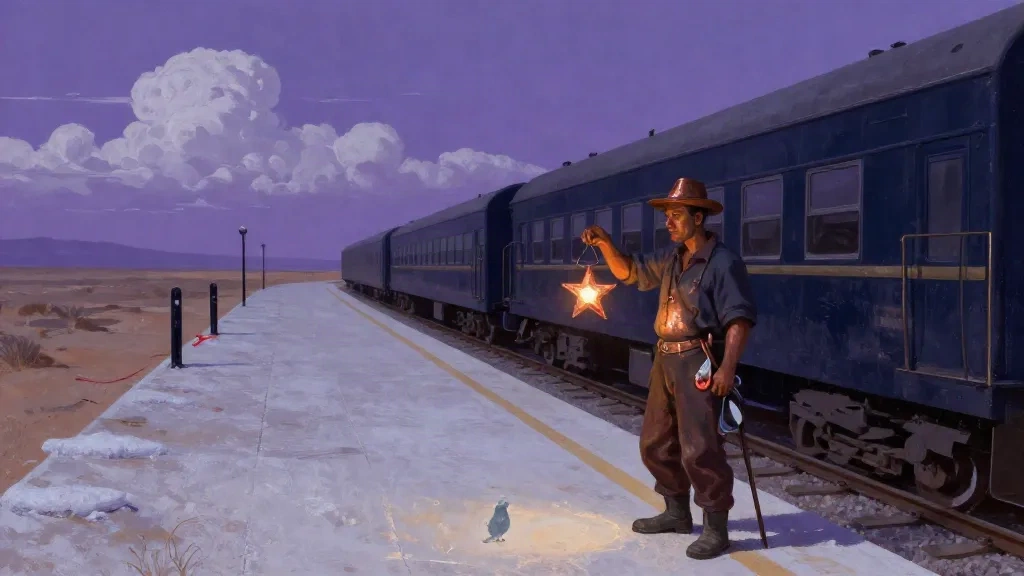
Mara made lanterns for the roads no one wanted to walk. She bent old brass into narrow stars, clouded the glass with charcoal smoke, and carried them to desert crossings, cemetery gates, culverts, and wells whose buckets had gone silent. People said the light guided their feet. Mara knew better. It guided their courage.
At the end of the violet hour, she reached Sereh Station, a thin shelter of salt-white boards and rusted rails. The station sign had lost every letter but the first. Beyond it, the desert sloped toward a border marked only by two black posts and a red thread.
Mara had crossed that border once, years before, carrying a copper star in one hand and a glass bird in the other. The officials had taken both. They had called them dangerous relics, then sent her home with a stamped paper and no explanation. She had rebuilt them from memory, imperfect things now, but hers.
This time she intended to keep them.
The Train With No Timetable
The bell above the platform rang without being touched.
It made one clear note, then waited.
Mara stood beneath the violet dusk while the rails trembled. A train arrived without wind or engine smoke. Its carriages were painted the blue of old ink, and its windows held rooms lit by gas lamps that had burned out years ago. The conductor wore a coat buttoned to the throat.
“Destination?” he asked.
“Across the border.”
“What do you carry?”
Mara touched the copper star beneath her coat. “Things that cannot be surrendered.”
The conductor glanced at the satchel where the glass bird waited. “The border collects declarations. It is very old and very literal.”
“Then I have none.”
The bell rang again. This time the sound came from inside Mara’s bag.
She drew the glass bird. Its painted wing trembled, though no wind touched it. The conductor stepped back.
“That is not luggage,” he said.
“It is mine.”
“Ownership changes at the frontier.”
“Not this time.”
He looked toward the black posts. “Then the train cannot stop there.”
What the Bell Named
They boarded. Inside, the train smelled of hot dust and rain trapped in a jar. Passengers sat facing one another with covered faces. Some carried maps with blank centers. Some watched a red thread tied around their wrists.
Every few minutes, the bell sounded. Each time, someone confessed.
“I chose the wrong road,” said a woman in a green coat.
“I sold the name of my brother,” said a man with a silver needle.
“I left the door open for the winter,” said a child whose shadow had no feet.
At last the conductor stood before Mara. “What decision do you deny?”
Mara looked through the window. The black posts were close now. Beyond them, a city burned with violet fire. Her own house stood among its shadows, empty, the lantern she had made for her mother still hanging in the doorway.
She had decided to cross. She had decided to hide. She had decided that survival required leaving pieces of herself wherever authorities could find them.
“I decided to come back,” she said.
The bell gave a low, bruised note.
The train stopped at the border. The conductor extended his hand. “The station requires payment.”
Mara placed the copper star in his palm. He closed his fingers.
Then she placed the glass bird beside it.
“One is enough,” he said.
“No,” Mara answered. “One is what they took before. This is what I chose to carry.”
The Road Made Bright
The glass bird shattered.
No sound followed. A white seam opened in the air, and Mara felt the border pass through her coat, through her hands, through the years she had spent pretending she had not left anything behind.
The copper star remained solid. Its point shone beneath the violet sky.
On the far side, the desert had changed. Grass grew in narrow silver lines. The black posts were gone. In the distance, a lantern burned at the edge of a road no one had named.
Mara picked up the largest shard of glass. Its cut edge caught cloud-white light.
Behind her, the train departed without a bell.
She did not look back. She walked toward the lantern, carrying the star in one hand and the bird’s bright fragment in the other. At the road’s beginning, a fresh footprint appeared beside hers.
Then another. Then a third.
By morning, the avoided path had become a road, and Mara had kept enough light to show the way.





