 Netwrck
Fantasy.
The Last Copper Star
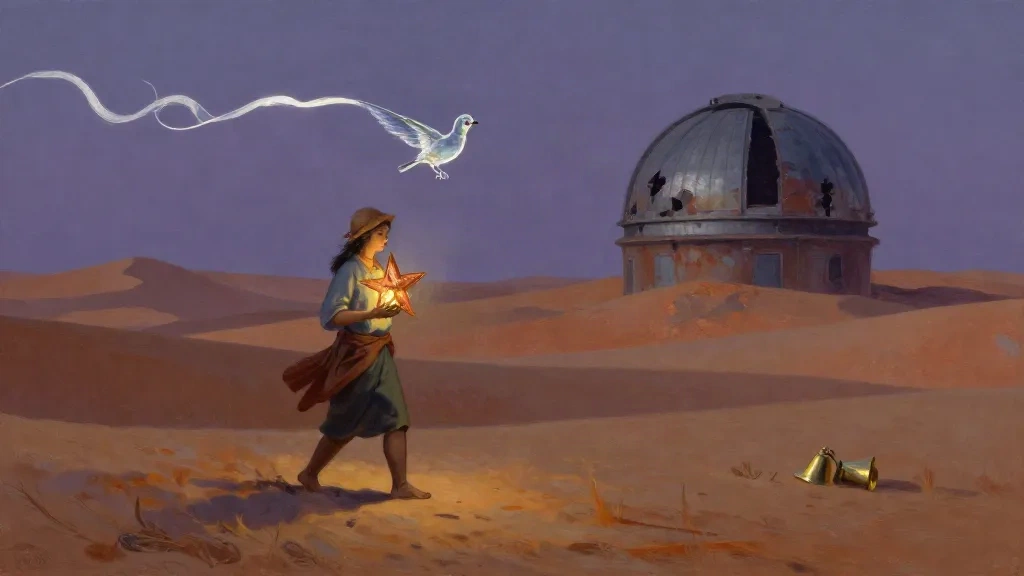
At violet dusk, the desert observatory appeared as a black jewel set into the dunes. Its dome tracked the stars with a slow mechanical sigh, and every night the astronomers waited for one of the messages to arrive. The messages came as patterns: a blue-white pulse, a scatter of copper sparks, a shape that resembled a door with no hinges.
Nima made lanterns in the market below the observatory. Her work was plain and useful. She polished the glass, cut the vents, filled the reservoirs with lamp oil. Her lanterns illuminated the paths people avoided: the narrow cuts between dunes, the dry riverbeds where travelers lost one another, the old roads marked with bones and broken oaths.
That evening, the astronomers gave her the last copper star.
It was no larger than a walnut, warm from the telescope chamber, and wrapped in black cloth. Nima had seen its kind before, a star-shaped bearing cut for the observatory's celestial engine. This one had fallen from its setting. In its place, the sky had sent a message made of glass.
The glass bird rested in a cedar box. Its wings were thin, its breast filled with a clear liquid that trembled when the wind rose. It had arrived that morning from beyond the eastern mountains, where no road crossed and no map admitted a destination.
Bring both to the border, the chief astronomer said, and do not open the box.
The Bell Beneath the Sand
The border was not marked by a wall. It was marked by silence.
Beyond the last inhabited well, the wind died whenever the dunes narrowed. Travelers who entered the quiet returned with their shadows missing, their names forgotten, their memories of the road erased. The empire sealed the crossing with a law: anyone carrying an unlicensed message must surrender it at the gate.
Nima did not intend to cross. She intended to deliver the copper star to the astronomer beyond the mountains, where the observatory had built a second eye for the southern sky. The glass bird had been sent to guide her. Its tiny wings pointed west, though the bird had no wind to feel.
On the first night, the bell rang beneath the sand.
It was not loud. It came through the soles of her boots, through the bell jar, through the copper star wrapped against her ribs. One clear note, then nothing.
At dawn, she found a line of footprints in the dust. They began at her tent and ended beside the glass bird.
She packed the lantern she had made for herself, the copper star, and the cedar box. The road waited beyond the last well. She took it.
The Decision No One Admits
At dusk on the second day, the border bell rang again.
Three times. A riderless horse stood in the hollow ahead, saddled and breathing. Beside it waited a woman in an observatory cloak.
“Give me the bird,” she said. “Give me the star. You may cross carrying your name.”
Nima looked at the horse, at the sealed gate hidden beneath the ridge, at the copper star burning faintly through its cloth.
The glass bird began to tremble.
Its clear breast showed two small figures standing on opposite sides of a border. One reached out. The other folded both hands behind their back.
“What decision did you make?” Nima asked.
The woman looked away. “I decided the southern observatory was worth more than the people trapped beneath it.”
The bell struck once, loud enough to shake the box.
Nima understood then. It rang for choices that had been made privately and blamed on necessity.
Her own decision had waited beneath every practical step: the star could cross without her. The bird could be surrendered and the message delivered by another hand. She had chosen to keep both because some things were not meant to be passed from one life to another.
“I decided to carry this myself,” she said.
The Road That Remained
The woman drew her sword, but Nima lifted the lantern.
Its flame did not point upward. It leaned toward the sealed gate, revealing a thread of violet light running through the sand. Along that thread lay the old road, visible only to a person who had chosen to own her choice.
“The law says you must surrender it,” the woman said.
“The law says the message is surrendered,” Nima replied. “It does not say I must abandon the person carrying it.”
She struck the copper star against the gate. It flared, and every buried bell in the border rang at once. The sound rolled across the desert, washing away the false footprints, the riderless horse, the silence that had swallowed so many roads.
The gate opened.
Nima crossed with the copper star beneath her arm and the glass bird held close. Behind her, the border did not close. It remained open, a narrow violet wound in the earth.
At the southern observatory, the astronomers received the star and opened the cedar box. The bird's wings caught the cloud-white light, and a new message appeared across the sky.
It was not a warning. It was a location.
Nima set her lantern down beside the telescope. Its flame turned toward the open border, illuminating the road she had crossed and the road she had chosen to keep open.
Some lights are not sent toward home. They are carried so others can find the way.





