 Netwrck
Science Fiction.
The Season Ticket
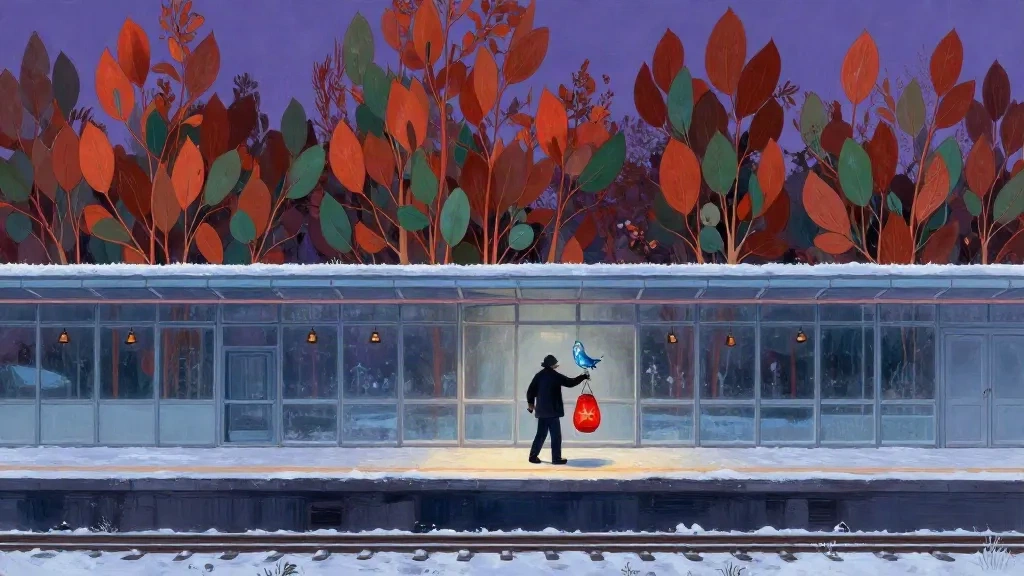
Mara kept her lantern in a red case lined with wool, though glass did not fear cold. It had learned the cold from her hands. In the winter station, where frost flowered across the iron rafters and the departure board displayed seasons instead of cities, she made lanterns for people who needed to walk where others would not.
Her copper star hung from the handle. She had shaped its six points around a flaw in the metal, an imperfection that caught the light and threw it sideways. Her brother’s glass bird had been her mother’s before that: a blue wing, a sealed hollow body, a beak turned toward a destination that did not exist on any map.
Mara’s mother had left both objects on the kitchen table and said, Keep what you can carry. The rest will keep you.
That night, Mara boarded for the border. She carried the lantern, the copper star, and the glass bird beneath her coat. The border lay between the station’s winter platform and the meadow district, where passengers could cross into another season. Some went to thaw a summer orchard. Some returned with snow still lodged in their shoes. Few admitted where they had really been.
The conductor checked her ticket. It was blank except for a pale blue line.
“Destination?”
Mara touched the glass bird. “Across.”
The conductor frowned at the empty field. “That isn’t a season.”
“It is where the seasons meet.”
The Bell Under the Platform
As the train gathered speed, a bell rang beneath the floorboards.
One clear note, then silence.
At the next station, a woman carrying a basket of oranges stepped aside. A boy holding a summer hat boarded without looking back. The train filled with people who had packed mismatched weather: sunburned cheeks, beach sandals, coats lined with autumn leaves.
Mara knew the bell’s rule from the stationmaster’s mother, who had once sold her a lantern shaped like a closed door. It rang only for a decision no one admitted making.
“You’re leaving something behind,” said a quiet passenger.
“Everyone is.”
“No. I mean something you promised to keep.”
Mara looked at the bird’s hollow body. Inside it, a tiny silver thread had appeared.
Her brother had given her the bird when they were children. He had wanted her to take it across the border and return it to their mother. Mara had promised. Then their mother died, the border closed for seven years, and the promise became a stone in Mara’s pocket.
She had crossed other borders since: the border between winter and rain, between rain and heat, between a city’s noise and its sleeping gardens. Each time, the station took something small. A scent. A name spoken too softly. The memory of a hand on her shoulder.
This time, the border required payment in choices.
Names in the Snow
When the train stopped beneath a sky like bruised fruit, the conductor found three names written in frost on the window.
Mara saw hers.
Beside it were two others: ELI. NORA. LEAVE HER.
“That is not my name,” Mara said.
“It is the name the border gave your decision.”
She stepped onto the platform. The meadow district lay beyond a low stone wall, but the wall had become a forest of glass and frost. Beyond it, warm orange light moved between eucalyptus trees.
The bell rang again.
“I came to deliver the bird,” Mara said.
“To whom?” asked the conductor.
“My brother.”
The answer rose inside her before she could stop it.
Her brother had died before the first border opened. She carried his bird because returning it meant admitting she had not saved him, that leaving had been a decision, that his silence had chosen to remain.
“Then you are not carrying a gift,” said the conductor. “You are carrying a witness.”
Mara opened the case. The lantern flared. Terracotta light washed over the wall, and the eucalyptus trees revealed hundreds of hidden doors.
Each door was a season. Each had a bell beside it.
One rang for the road taken. Another for the road refused. The smallest rang whenever someone said they had acted for another’s sake.
Mara lifted the lantern. “I don’t want to surrender the bird,” she said. “And I won’t surrender the promise.”
The Crossed Season
“Then cross without declaring what you carry,” said the conductor.
He had vanished from the train, but his voice came from every bell.
Mara stepped through the nearest door.
Winter followed her. Snow slid from the eucalyptus leaves. The sky pressed low, purple and green, bruised against the mountains. Her lantern burned steadily, and the copper star threw a small star beside the path.
At the border’s far side waited a bench beneath a station clock. On it sat her brother’s coat, folded neatly. Inside the pocket was a note in his handwriting.
You were never supposed to bring it back.
For a moment, Mara could not breathe.
Then the glass bird began to sing.
It was a thin, bright sound, impossible from sealed glass. The note caught in her throat. Beside her, the border opened—not as a door, but as a strip of blue morning laid across the snow.
Mara understood. Her promise had been to carry the bird across. It had never promised to bring it home. The surrender was not the object. It was the lie she had built around it.
She set the bird on the blue morning. Its beak turned east. The glass became clear, then small, then a bright point among the eucalyptus.
Behind her, the bell rang one last time.
Mara did not look back. She carried the lantern, the copper star, and the truth of her brother’s silence into the season she had chosen.





