 Netwrck
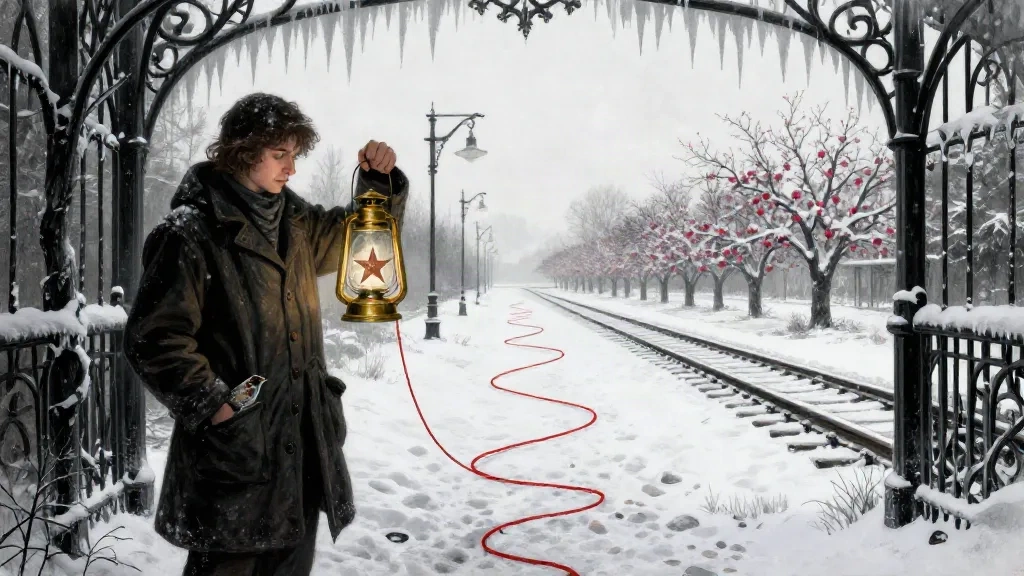
Gothic Fantasy.
The Unfinished Platform
At the end of the winter line stood a station with no name. Its roof sagged under a snowfall that had not touched the valley, and its clock had stopped at 4:17, the hour when people began pretending they had made no choice at all. Lantern maker Sera Venn arrived with a brass lantern in one hand and a red thread tied around its handle. Inside the lantern slept a copper star. In her coat pocket lay a glass bird, its wing chipped by an older winter.
Sera had come to cross the border without surrendering what she carried. The station’s season gates opened onto spring orchards, summer rivers, autumn fields, and a white coral country where the dead kept their promises. Officials permitted travelers to pass with one possession surrendered to the season they entered. The price was called a fair exchange, though no one could say who had set the scale.
The Bell Beneath the Snow
At the ticket window, a porter unfolded a map stitched from old receipts. “You may take the lantern,” he said, “or the things inside it.”
Sera looked through the glass. The copper star cast one warm point against the snow. The glass bird caught the lantern flame and held it, trembling, above her palm. Both objects had traveled with her since the night her mother had left the unnamed station. One remembered the way home. The other remembered a road that no longer existed.
A bell rang beneath the platform.
It was a small iron sound, swallowed by the falling snow. The porter touched the counter once, then withdrew his hand.
“That does not mean anything,” he said.
Sera felt the red thread tighten around her fingers. It ran from the lantern handle across the porter’s sleeve, over the map, and vanished beneath the station wall. The bell answered again.
At once, every lamp on the platform bent its flame toward the eastern gate. Somewhere beyond the white roof, a train announced itself with three mournful whistles.
The Season That Refused Her
“You have already chosen,” the porter said. “You came here carrying two things, and you meant to keep both.”
His eyes were fixed on the map, but his hand had stopped moving.
Sera understood then that the bell did not ring for accidents. It rang for promises made in the mouth, accepted in the body, and denied afterward. Her mother had denied leaving. The station had denied opening. The season beyond the gate had denied wanting her.
She drew the red thread free. It cut through the paper map and opened a narrow seam in the snowbank. Behind it, the border stood as a fence of icicles, each point carved with a year.
Sera placed the copper star against the nearest point. The iron bell rang once beneath her boots.
“I choose to cross,” she said.
“That is admitted,” the porter replied. “Not enough.”
The glass bird began to sing in her pocket. It was a thin, glassy note, almost beyond hearing. The snow on the platform melted into a dark ring around Sera’s boots.
A Border Made of Carrying
She refused the exchange. Not because the border was unjust, though it was. Because the lantern had been made for the paths people avoided, and its light had no meaning if emptied of the burdens it carried.
Sera lifted the lantern. The copper star shone through its panes, and the red thread ran from that small flame to the glass bird, then to every lamp, fence, and buried rail on the platform. The station became visible as a whole: a body made from all the things travelers had tried not to name.
The bell rang a third time.
No one moved to silence it.
Sera stepped through. The gate did not close behind her. Beyond it, spring had not yet learned how to grow. Red thread crossed the white coral snow, stretched toward a horizon hidden by falling ash, and continued.
In her hand, the lantern burned. In her pocket, the bird answered with one clear note. She had crossed the border carrying her past, and for the first time, the past was not asking to be set down.





