 Netwrck
Science Fiction.
The Last Warm Platform
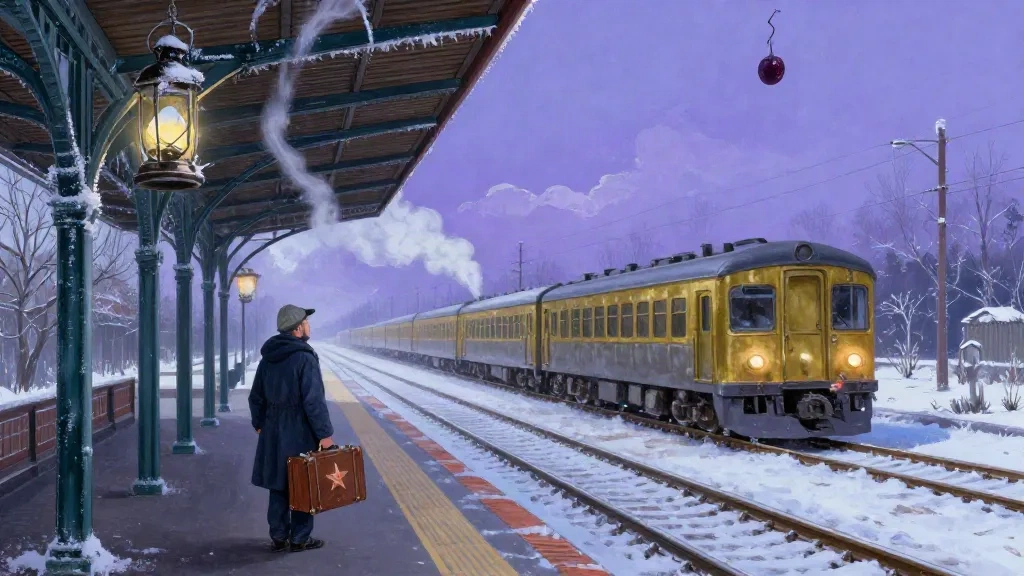
Winter had settled over Meridian Station with the patience of something that expected to win. Frost silvered the iron ribs of the roof. Beyond the windows, fields lay sealed beneath snow, while a strip of thaw ran along the tracks, green as eucalyptus and impossible as a memory.
Mara stood beside the departure board with a brass lantern in one hand and a small suitcase in the other. Inside the suitcase she carried a copper star, a glass bird, three coils of wick, and the name of the person who had taught her to make light.
The station offered four seasons to its passengers. Spring waited beyond Platform Three, warm and bright. Summer boarded from a tunnel smelling of hot dust. Autumn departed beneath a violet clock. Winter simply received you back, as if the journey had been an error.
She needed the spring border. The papers in her suitcase would let her cross, but only if she surrendered the objects that had no place on the manifest: the star her mother had forged, the bird her brother had blown, the lantern whose light illuminated the paths people avoided.
At Platform Three, an attendant checked her ticket and frowned at the case. “No unlisted cargo.”
“They are not cargo.”
“Then they are what?”
Mara lifted the lantern. Its flame leaned toward the glass bird. “My way home.”
The Bell Beneath the Tracks
The attendant stamped her ticket. Before Mara crossed the line, a bell rang beneath the platform.
It was a deep, muffled note, felt through the soles of her boots. No one else seemed to hear it. Passengers continued toward the spring train, their faces softened by eucalyptus steam. The attendant watched Mara instead.
“That bell does not ring for weather,” he said.
“Then what does it ring for?”
“Decisions people refuse to admit they have made.”
Mara looked back. The station clock had stopped at the instant the sound faded. Across the tracks, a second Mara stood beneath a summer sun, holding the lantern but not the case. In her shadow, the copper star glowed like a fallen sun.
The border had shown her a version of the choice: keep the objects and remain on the winter side, or keep her passage and leave the memories that pointed back.
She had chosen neither consciously. That was the problem. The bell heard decisions hiding inside habits: the lantern carried because setting it down would make her mother’s death final; the glass bird wrapped because breaking it would be an admission; the copper star polished each morning because hope could be maintained by labor.
The glass bird chirped inside the case. Its painted wing had turned toward the alternate platform.
“If I cross without surrendering them,” Mara said, “what does the border count as mine?”
The attendant touched the stopped clock. “Whatever you can still name.”
The Country Beyond Naming
Mara boarded the spring train without removing anything from her hands.
The border inspected her luggage. It unfolded the suitcase into light, finding the wick, the star, and the bird. Each object became larger than the case could contain. The copper star turned slowly, scattering sparks across the ceiling. The glass bird flew upward, striking the train’s invisible roof.
A voice asked for what she had not declared.
“The road you took instead,” it said.
Mara saw the winter streets behind her eyes: a flooded culvert, a railway bridge, a path through briars where she had left the lantern burning so a lost child could find his way home. She had never followed that light herself.
“I chose to keep watching,” she whispered.
The glass bird landed on her shoulder. Its wing was cracked from the crossing, but its song remained clear. The copper star dropped into her palm, hot enough to redden her skin.
“Then name the loss,” the border said.
She had feared that naming it would diminish it. Instead, the loss became precise: not her mother, not her brother, not the road. She had lost the belief that illumination belonged only to those who stayed behind to see it.
“I chose the lantern over going home,” she said. “I chose to remain useful.”
The suitcase snapped shut.
What She Carried Through
Spring arrived all at once. Green branches pressed against the windows, and the sky above Meridian bruised purple, its clouds dark as overripe plums. The train slid into a station where summer heat shimmered over the tracks and autumn leaves skidded beneath the wheels.
No one came to meet Mara. She opened the case. The wick had vanished, consumed by the border, but the lantern still burned. The copper star had lost its shine. The glass bird remained whole.
At the platform edge stood a child holding an unlit lantern. He had wandered from the road, and the station had sent him back to winter.
Mara lifted her own lantern. The flame bent toward him, revealing a path through the grass. She did not ask him to follow her, nor did she pretend that guiding him repaired the choice she had named. She simply walked beside him until the path met the road.
Behind them, the station bell rang once.
This time Mara knew it was not announcing a decision. It was recording one made honestly: she had crossed, and the crossing had cost her an old lie. The light she carried was smaller than before, but it belonged entirely to her.





