 Netwrck
Fantasy.
The Last Bell of Saint Vey
At violet dusk, Sister Orra found a stranger kneeling in the bell chamber of the clockmaker monastery, with her face buried in the floor.
The novice carried a copper star polished to the brightness of a wound and a glass bird clouded by the smoke of twenty years. Between them she held a narrow iron case, no larger than a prayer book.
“I have come for passage,” she said.
“Every stranger says that,” said Sister Orra. “Few say what they carry.”
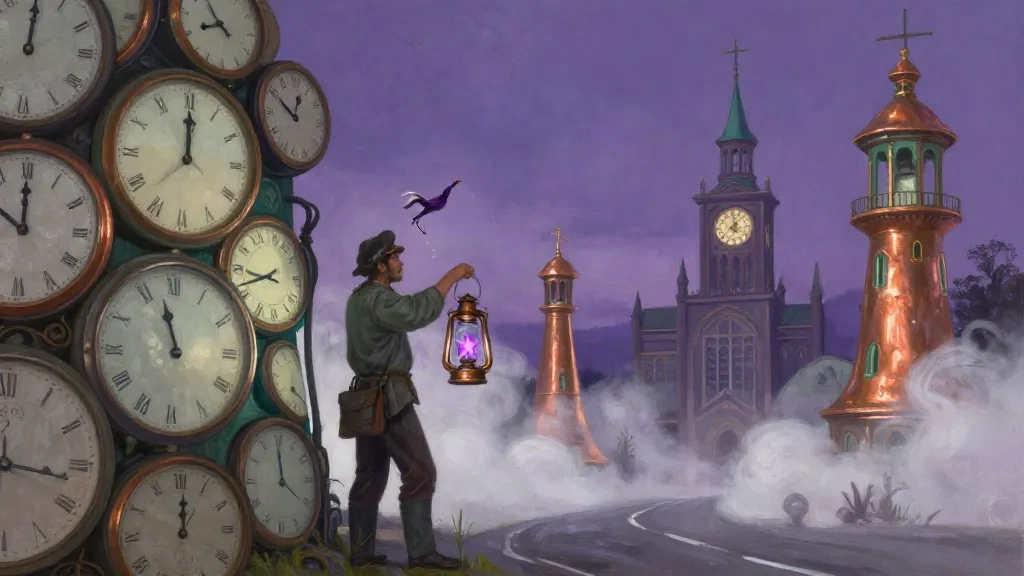
Outside, the monastery’s thousands of clocks disagreed without urgency. Some hurried. Some stopped. One tolled thirteen times, though the year had only twelve months. Sister Orra’s lanterns illuminated the paths people avoided: thorn tunnels, flooded culverts, the narrow stair between two dead towns. Her light did not make a place safe. It made a place undeniable.
The prioress laid the iron case on a table of black walnut. Inside lay a strip of vellum bearing the border warden’s seal.
“The Ward of Hours requires every crossing traveler to surrender what binds them to an earlier country,” the prioress said. “Memory, name, allegiance. Otherwise the border cannot recognize where you belong.”
The lantern maker touched the glass bird. “If I surrender it, will that be enough?”
“If what you carry is inside it.”
A Bell Without a Tongue
That night, while the monastery slept beneath cloud-white moonlight, a bell rang in the empty tower.
It had no clapper. The sound arrived without vibration, first inside the lantern maker’s teeth, then through the beds, the stone walls, and the dark valley beyond the cloister.
Orra climbed the tower carrying her lantern. The flame leaned toward the invisible sound.
The stranger stood beneath the bell. Her eyes were dry. “It has been ringing since I crossed the courtyard,” she said. “I have done nothing.”
“That bell does not recognize deeds,” said Orra. “It recognizes decisions.”
“Then it knows nothing.”
“It knows you chose to come.”
At dawn, the prioress summoned the monastery’s finest clockmaker, a dry old man who measured time by the length of candle shadows. He examined the iron case, the glass bird, and the copper star without touching them.
“She is carrying a birth record,” he said. “A child born on the wrong side of a war border. The registry names the mother as a citizen and the father as a fugitive. The child escaped before either name could be placed on her.”
The lantern maker looked at her case. “I did not know that.”
“Then you decided to carry it anyway.”
The bell answered from the tower: one clear note, though its mouth remained still.
The Road Beneath the Closed Gate
They offered three roads. The northern road passed through the clockmaker villages, where authorities compared footprints. The southern road crossed the Salt Verge, where time moved backward whenever a traveler lied. The third descended through abandoned paths lit only by Orra’s lantern.
At the last hour before violet dusk, the lantern maker chose the third.
The bell rang thirteen times. Every clock in the monastery stopped.
“You admitted nothing,” said the prioress.
“I admitted this,” the stranger said. She lifted the glass bird. Inside its clouded body, a tiny flame revealed itself—not memory, not a name, but a living spark no registry could classify.
Orra understood. The object was a seed of remembered time: the first summer its mother had lived freely, preserved inside a child’s keepsake. To surrender it would be to surrender the life from which the woman had chosen to flee.
At the border, the Ward of Hours rose as a wall of pale clock faces, each showing a different hour. The warden demanded the case. The soldier behind him demanded the star. Behind the glass bird, the small flame trembled.
Orra stepped forward. “Then let the border measure me,” she said, and held up her lantern.
The Hour That Refused Her
Her light struck the wall. Across the warden’s face appeared the hour of the monastery’s forbidden bell, the instant a traveler chose a road without consulting the clockmakers. For that hour, the border had no authority. A decision made freely belonged to no country.
The warden seized the glass bird.
The lantern maker opened the iron case.
She did not surrender the birth record. She tore it once, separating the mother’s name from the father’s, and placed both halves beneath the warden’s clock.
The mechanism crushed them into dust.
Then she dropped the copper star into the glass bird. Its metal touched the tiny flame. Light burst through the cloudy body, not white and holy, but violet, green, and the deep red of heated copper. The star became a new sun inside the bird.
The border wall opened.
Behind the warden, the forbidden bell began ringing. Far away, every monastery clock answered with a different hour, until the whole country seemed to wake from one long, unnoticed decision.
On the other side, the lantern maker carried the glass bird in one hand and her lantern in the other. She had crossed without surrendering what she carried.
Only now, at last, she admitted that she had no intention of returning home.
The bell struck once. The road ahead appeared in cloud-white light.





