 Netwrck
Fairy-Tale Fiction.
The Paths in the Sleeper
Mara made lanterns for people who feared the dark. Not palace lamps or festival globes, but small, stubborn lights for ditch-crossers, lost children, and travelers sent along roads everyone else had abandoned.
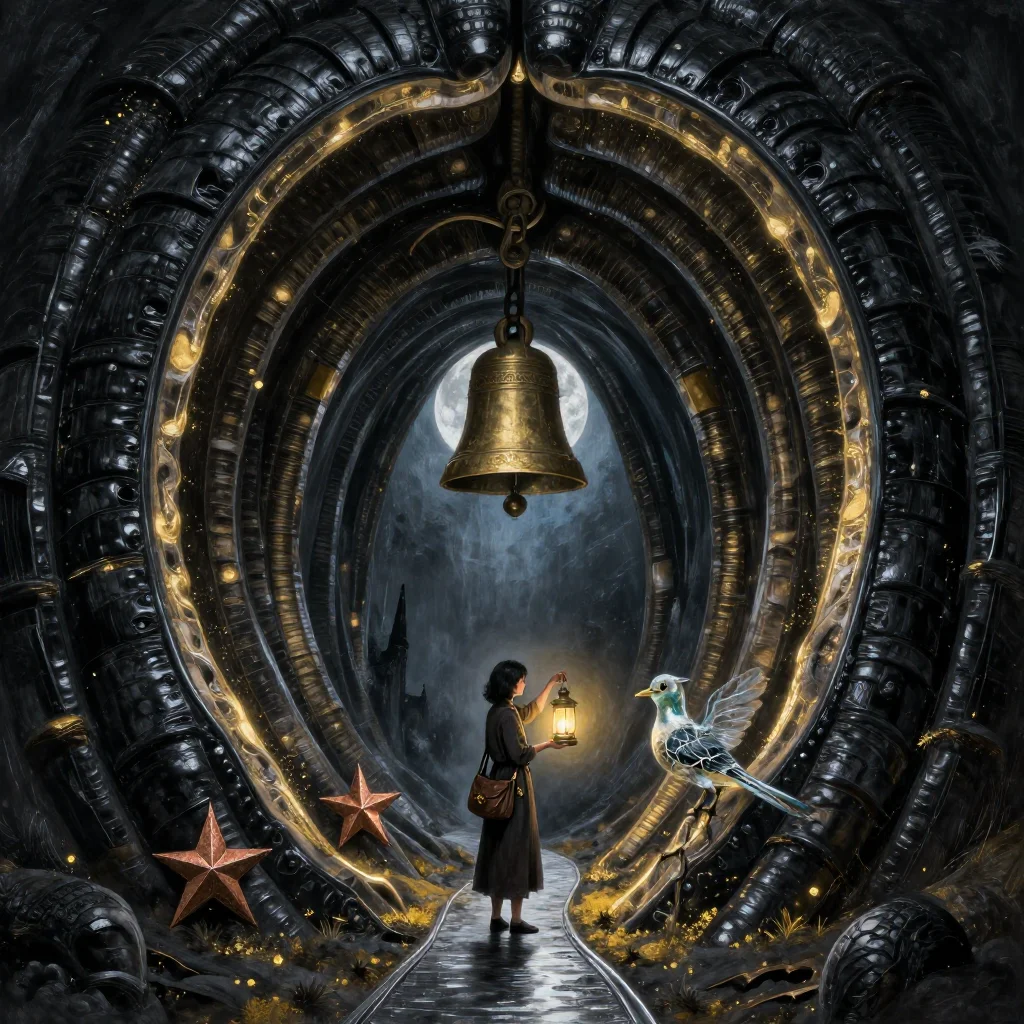
Her village occupied the hollow spaces between the ribs of a sleeping giant. Black lacquer curved overhead like the underside of a boat. Gold dust sifted from cracks in the bone, and at night, when the giant breathed, moonlight leaked through the gaps between his ribs in thin, cold blades.
Mara’s workshop stood where the widest rib met the earth. Copper tools hung from hooks, oil waited in black jars, and finished lanterns shone along the wall, each one no brighter than a coal.
She did not ask what roads frightened her customers. Fear was an expensive enough confession.
Inside the satchel beneath her workbench lay a copper star wrapped in a square of oilcloth and a glass bird with a cracked wing. The bird had been her mother’s. The star had belonged to her father. Both were too small to be valuable, yet Mara had carried them across every lighted path in the giant’s body.
That morning, a message came sealed with blue wax.
Bring the star to the eastern seam. The border is closing. Come before the second bell.
There was no name on the message. Mara read it twice before folding it into her pocket.
Her destination lay beyond the village’s last lantern, where the sleeper’s seventh rib bent downward and met a veil of darkness. Beyond that veil, the old road crossed into another country. People traded, married, and disappeared there, but the border guards did not permit free passage. They required a person to surrender one precious thing.
Not money. Not a weapon.
Something remembered.
The Bell Under the Floor
Mara packed the copper star, the glass bird, a needle, three wicks, and enough lamp oil to make a light that would not go out. She did not know which object the border wanted. The message named only the star, but messages from the seam were famous for telling half the road.
At dusk, she followed a path of black stones through the village. In the first chamber, an old woman refused to enter because her son had promised to return and never had. Beyond her, a boy stood beside a black pool, holding a lantern toward the reflection of a door that was not there.
“The light stays,” Mara told the boy.
“The path does not.”
She lit the next lantern. Its gold glow spilled across the lacquer wall, revealing scratches shaped like wings.
Farther on, the floorboards thumped once.
Mara stopped. The village bell hung above the market, silent for years. No one rang it. Its rope had snapped and its bronze body was green with age.
Then it rang.
The sound did not travel through the air. It rose through the floor and into Mara’s teeth.
One.
The glass bird cracked another piece along its wing.
Two.
The copper star turned in the oilcloth, cold as a nail.
She understood then. The bell rang for decisions no one admitted making. It had sounded once when she decided to leave the workshop. Again when she chose the difficult path instead of the safe one.
At the seam, the border guard waited beneath a canopy of bone. His uniform was black lacquer threaded with gold dust. His face resembled hers.
“You have decided to go,” he said.
“Yes.”
“You have decided not to surrender the star.”
“Also yes.”
The bell sounded a third time.
The guard smiled without pleasure. “Then why are you standing there?”
The Price of the Narrow Door
The seam opened onto a country without stars. A silver road crossed the darkness, but it narrowed toward a single lamp.
“The border takes what a person cannot admit they need,” the guard said. “Give me the star, and you may carry the bird.”
Mara looked at the cracked glass wing. She remembered her mother’s hands shaping it beside a furnace, the blue flame turning the metal soft. She remembered her father polishing the star until it reflected her face.
“The bird is the memory of home,” she said.
“The star is the promise of leaving.”
“The border does not deal in meanings.”
He held out his hand.
Behind them, the bell began to ring continuously. The sleeping giant shifted. Dust fell from the roof in a gray curtain, and the silver road buckled like a loose thread.
Then Mara saw the truth.
The border had not been built to keep people out. It had been built to keep decisions from travelling. Every surrendered treasure was a decision that had been sealed away before it could change the road.
She opened the satchel.
The copper star flashed.
The glass bird trembled.
“I will cross,” Mara said, “but I surrender neither.”
For the first time, the guard’s face lost its copied calm. “Then you must choose what to leave unnamed.”
Mara stepped onto the silver road.
The bell went silent.
The Light That Carries Its Own Weight
Each step demanded an answer. Why had she left? Why had she obeyed the message? Why had she hidden the bird beneath the star?
She answered without disguising the cost.
Because her mother was gone, and no road could return her.
Because someone had to carry what the village forgot.
Because the bird was not fragile. It was only loved.
With every admission, the road brightened beneath her boots. Not with gold dust, but with moonlight.
The border narrowed. The guard reached for her satchel, but Mara held the lantern high. Its flame burned without fuel, revealing cracks in the black lacquer world and the old marks of countless hidden choices.
At the far side stood another village. Its windows shone on a road no lantern had ever touched.
Mara crossed the threshold with the copper star and glass bird still inside her satchel.
Behind her, the sleeping giant exhaled. His ribs lifted, and the border folded shut with a quiet finality.
She never learned who had sent the blue-waxed message. She learned something else.
Years later, when a child in the new village complained that the road ahead was too dark, Mara lit a lantern and pointed toward the houses where the unclaimed decisions waited.
“Which way do you choose?” the child asked.
Mara looked back at the closed seam. Beyond it, she could see no stars, only the pale gleam of the road she had crossed.
“That,” she said, “is the part you must admit.”
The child carried the lantern into the night. Its light moved over the road, small and gold, revealing one impossible step after another.





