 Netwrck
Historical Fantasy.
Letters Beneath the Iron Snow
On the morning the future stopped writing, Mara Venn found three letters beneath the monastery’s kitchen door.
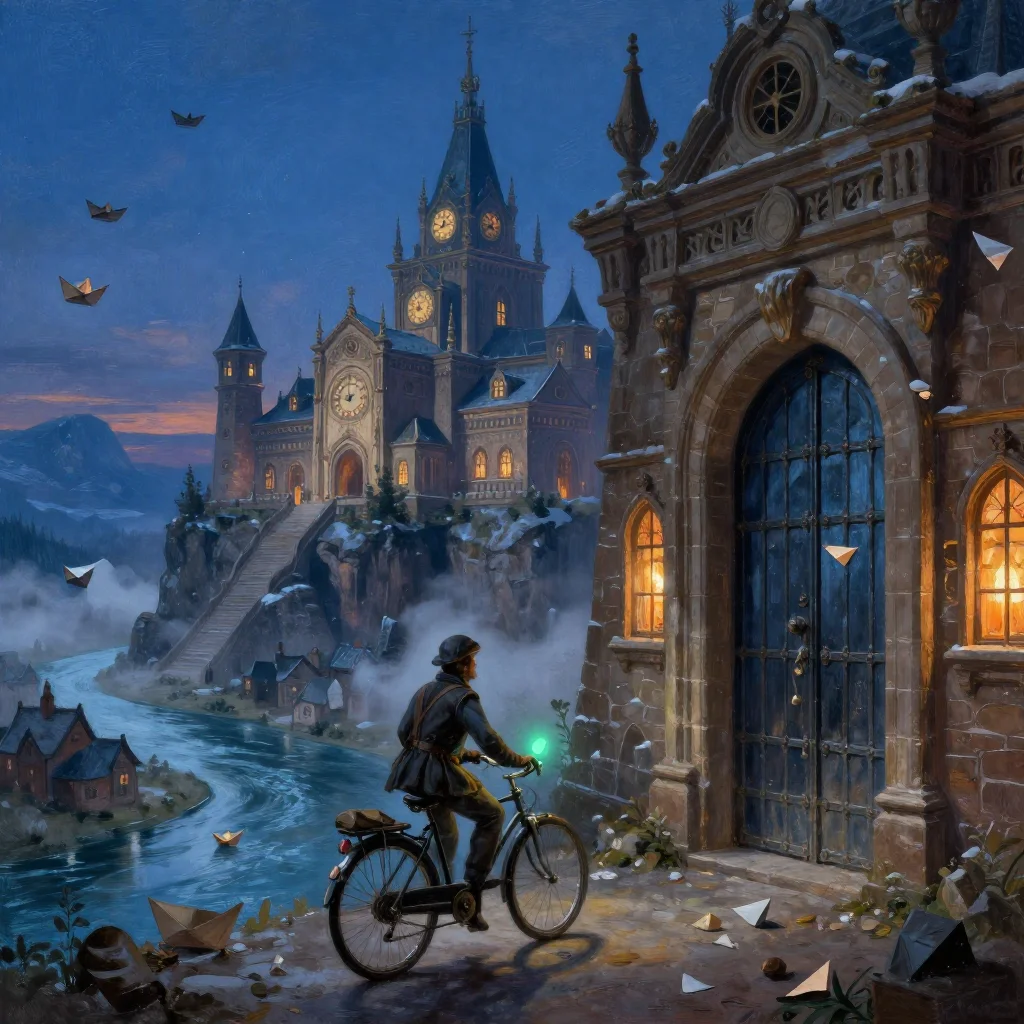
They had arrived by bicycle. Not through the post road, but through a narrow passage in the old city wall that had been bricked shut for eighty years. The bicycle stood beside it, mud frozen to its spokes, its front wheel still turning when Mara came outside with the ash scoop.
The letters were addressed to people who had not yet been born. One promised a blue railway ticket. Another described a son named Emil, born in winter, with a silver tooth and a habit of singing badly. The third contained only a date, eleven years ahead, and a line in the monastery’s oldest hand: Do not let them ring the fourth bell.
Mara did not care about the date. She cared about the name at the bottom of the second letter: her own.
She tucked the letters into her coat and began walking.
The Monastery of Closed Doors
The monastery of St. Orra stood above the river in a country whose clocks disagreed with one another. In the villages, noon arrived early. In the capital, dusk lasted until supper grew cold. The government had once tried to fix the disorder, but every clockmaker brought a different argument, so the king declared time a local matter and made no more laws about it.
Within the monastery, however, the clocks were exact.
Steel-blue dawn entered through high windows. Tobacco-brown cases of oiled wood lined the walls. Candlelight lay on the floor in broken pieces, trembling whenever a mechanism turned somewhere below.
The monks worked without speaking. They wound gears, repaired escapements, and listened to tiny brass hearts. Their silence was not devotion. It was obedience.
Mara found the treaty in the archive beneath the old infirmary. Its vellum had been repaired so often that the words shone like seams in a scar. Article Seven granted the monastery legal permission to listen whenever the land’s future became uncertain.
Article Eight permitted it to keep the future from arriving.
Mara read the clause three times. Then she heard a sound behind the wall: a paper boat scraping against stone.
The Room That Held Tomorrow
She entered through a door that had no handle. The bicycle rolled after her.
Beyond the door was a narrow chamber filled with unopened letters. They floated in the air, suspended by strings of red sealing wax, and every few minutes one would fold itself into a boat. The boats slid into vents beneath the floor and vanished toward the lower vaults.
On the central table sat a green stone, smooth and cold beneath her palm. When Mara touched it, she heard a thousand clocks striking different hours. Underneath the noise, a child counted backward from ten.
Abbot Sel came into the room carrying the fourth bell in both hands.
“The future is not gone,” he said. “It is frightened.”
Mara looked at the paper boat at his feet. It carried a small drawing of a bicycle, its wheel shaped like a key.
“You have been receiving letters from people who have already lived,” she said. “And sending none back.”
Sel placed the bell on the table. “The treaty allows us to listen.”
“Listening does not require silence.”
“You misunderstand the danger.” He glanced toward the vents. “If tomorrow knows it can be heard, it will come here. If it comes, every abandoned road, every unkept promise, every death that was only postponed will arrive with it.”
Mara unfolded the third letter. The date had changed while she held it.
The Fourth Bell
Now it was her birthday.
She placed the green stone inside the paper boat. The little craft crossed the table, lifted by reflected candlelight, and entered the black seam beneath the floor.
Then Mara rang the bell.
The sound was small. It moved through the monastery as if passing through water. Clocks stopped. The hanging letters began to turn their blank sides outward. Far below, a lock opened with the groan of a gate.
From the lower vault came an answering bell, then another, then thousands.
Mara’s bicycle rang its own iron bell as it rolled through the open chamber door. The sound was unlike the monks’ bells: rough, impatient, alive. Paper boats burst from the vents. They struck the walls, climbed the windows, and lifted toward the roof.
Abbot Sel fell to his knees. “You have made the future arrive.”
“No,” Mara said. “I have made it answer.”
At dawn, the monastery stood empty except for the clocks. They had all stopped at the same minute. Outside, snow lay over the country in unbroken fields, and beyond the wall the hidden road was open.
Mara pushed her bicycle through it. In the basket rested one new letter, addressed to a child named Emil who had not yet been born.
She did not open it. Some futures were better carried than read.





