 Netwrck
Adventure.
The Bell That Chose Her
Mara Vale was seventeen when the bell beneath her shop rang without being touched.
It was a small iron bell, one of three she had cast that spring, each no larger than a plum. The others hung silently above the workbench. This one sounded once from inside the floor.
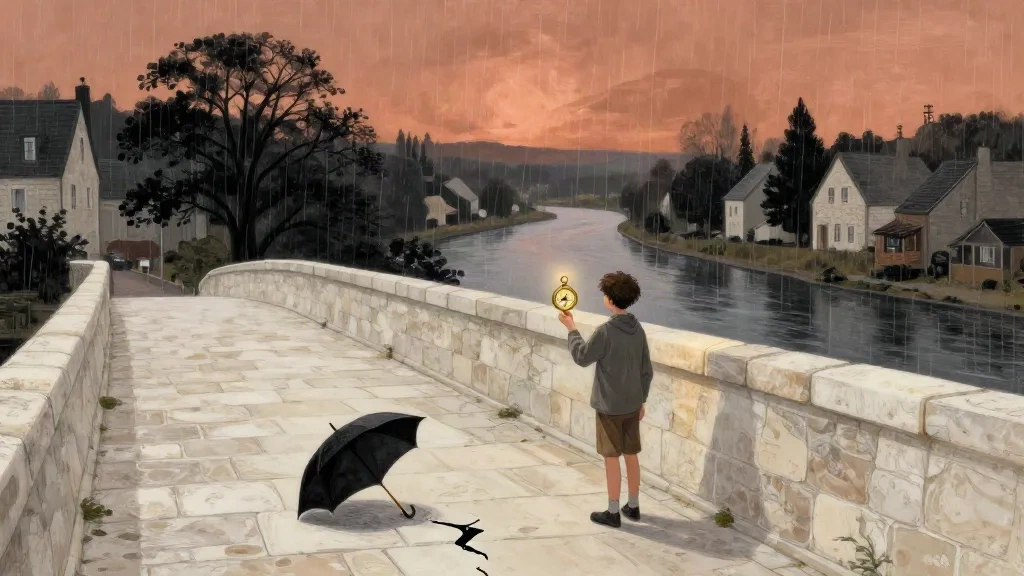
Mara set down her hammer. Beyond the narrow windows, Lantern Street shone with afternoon rain. At the end of the street, the border river flowed north beneath a pale stone bridge, carrying red leaves toward the neighboring kingdom. At midnight it would turn and carry them back.
She lifted a paving slab with a chisel. Beneath it lay not soil but a stairway, its steps descending into a blue-black darkness. Air rose from below, carrying the smell of wet iron and oranges.
Someone had left a black umbrella on the top step. Its handle was carved in the shape of a closed door.
Mara had been making bells since childhood. Her father had taught her that every memory wanted a sound. Joy was bright and quick. Sorrow had a long downward note. Fear was made with a cracked mold, because fear loved to catch in the throat. The bell she made for memories not yet owned had no pattern at all.
That was the mystery she intended to solve. She wanted to know the true shape of the world beneath the familiar street.
The Holiday Without a Name
At sunset, town criers pasted notices to every lamppost.
Tomorrow: the Day of the Unspoken Grief.
No one knew who had lost what. The holiday had begun three generations earlier, when a courier crossed the river carrying a sealed letter and returned without his shadow. The town had grieved him, his message, and the future it might have contained, but no one could remember the name of the loss.
Every year, people carried black umbrellas to the riverbank. They watched the water turn at midnight, then walked home in silence. The custom was called remembrance, though nobody remembered anything.
Mara’s brass compass had belonged to the courier.
She found it inside the bell’s clapper after the first ringing. Its needle pointed downward, not north. When she held it over the stairway, it swung toward the black umbrella.
That night, the town prepared candles and folded mourning cloth. Mara descended.
A Country Turning in the Dark
The stairs ended in a room no larger than a customs booth.
Maps covered its walls, but they rippled like cloth stirred by invisible wind. Streets doubled back beneath houses. Rooms opened into fields. Rivers ran through ceilings and poured from the sky in copper-colored threads. A brass compass lay on every map, its needle trembling.
In the center stood a woman made of black cherry wood.
“You are late,” she said.
“Late for what?”
“The changing of the river.”
Mara looked down. The floor had become a map of Lantern Street. Her shop, the bridge, the courthouse, and the bell tower were all there. Beneath each lay another version, until the town appeared to have been built on a buried country.
“This is beneath the street,” Mara said.
“This is what the street refused to become.”
The woman raised one hand. A black umbrella opened between them.
“The town’s grief was a door,” she said. “When the courier vanished, the people closed it so firmly they forgot there had been a door. They buried a whole country to preserve one night of safety.”
Outside, bells began ringing.
Not the town’s funeral bells. Mara’s bells. They sounded from every wall, from the maps, from the black umbrella’s curved ribs.
The brass compass spun in her hand.
The Name at the Bottom of the World
“Your father is here,” the woman said.
Mara looked toward a door marked with a bell.
She crossed the room. Behind the door, her father stood beside a furnace, younger than she remembered, holding a mold filled with glowing metal.
“I heard one of your bells,” he said.
“You taught me to make them.”
“No.” He smiled. “I learned from you.”
Then midnight struck.
The buried country turned. Rivers reversed, streets folded into one another, and the horizon opened beyond the room: copper, bright as a struck match.
Mara remembered a memory she had not owned. She was a child beneath the bridge, holding her father’s hand. The river changed, and he told her that every direction was a promise someone had broken.
She understood then. The bells had not been waiting for the future. They had been ringing for the past the town had buried.
She struck the small iron bell.
The sound passed through the walls, the bridge, the courthouse, every black umbrella in Lantern Street. The nameless grief opened. Not into forgetting, but into a name.
Possibility.
At dawn, the river ran north again. Beneath Mara’s shop, the stairs had vanished, leaving only a pale stone floor and a scattering of black cherry pits.
The courier’s compass rested on her workbench. Its needle pointed toward the door.
Mara followed it outside.





