 Netwrck
Historical Fantasy.
The Unreliable Country
At the Monastery of Saint Orra, the clocks were made of brass, horn, pearwood, and other arguments. They disagreed openly. The western tower marked the hour before the western sun, while the infirmary clock insisted that dawn had arrived in winter. Once every seven years, the Crown sent inspectors from the capital with a silver chronometer and a request that the monks stop making time locally.
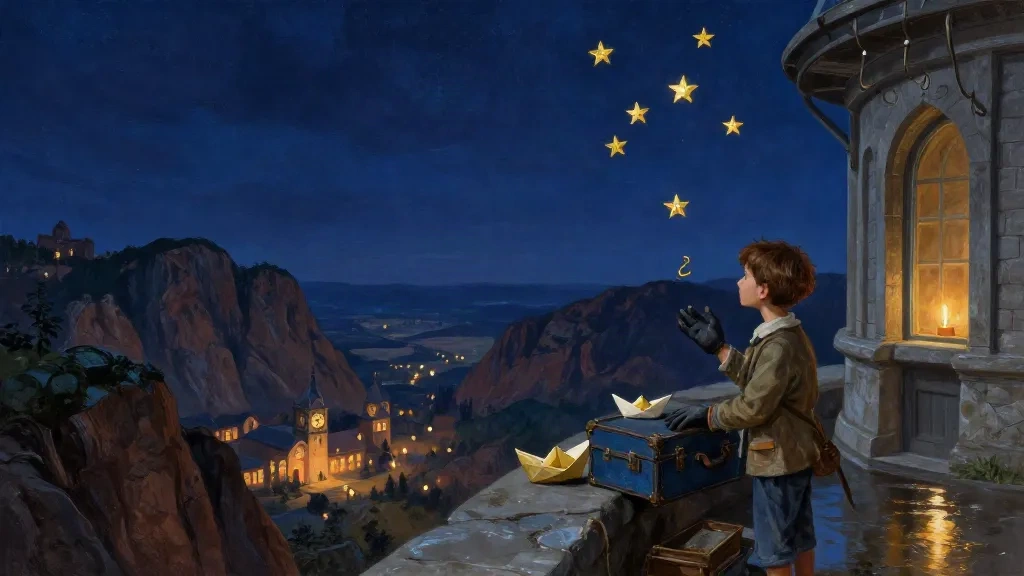
Eleven-year-old Nera kept the archives beneath the eastern bell tower. Her mother had been an archivist before her, and her mother’s mother had carried records in a blue suitcase. The current suitcase was scuffed at the corners and smelled faintly of rain. Nera liked its weight. Books, she had learned, became dangerous when they were allowed to remain merely books.
On the night of the first false frost, a map unfolded in the archive press. It showed twelve stars arranged beneath a torn sky, with a red line leading to a blank square. Across the square, in ink the color of old blood, someone had written: Deliver me before the hour of my death.
Below the words sat a small silver key.
The Suitcase’s Other Weather
Nera found the constellation behind the archives, where the damp came up through the floor and candle flames leaned toward the walls. Twelve tin stars hung from a copper wire inside a cedar box. Each star carried a country name: Aster, Mallow, Vey, Brann, the Salt Marches, the Widow’s Reach. They were the last twelve pieces of a constellation the old kingdom had cut from the night during a war nobody living could properly name.
She knew because the box hummed when thunder approached. She knew because every star showed a different season. She knew because the wool glove on the shelf beside her had grown warm.
The glove belonged to Sister Pell, the monastery’s bell founder. One glove only, charcoal gray, its thumb repaired with blue thread. Pell had worn the other during an expedition to the northern observatory and returned without it. She had also returned without the two years the journey should have taken.
“They said I died at the end of the third winter,” Pell told Nera. “I stood there and watched them bury a woman with my face. Then the snow melted, and I was hungry.”
On the archive table, a paper boat trembled in a saucer of water. It had been there for months, unmoving despite drafts and spilled ink. When Nera placed the twelve stars aboard it, the boat turned toward the north wall.
That night the monastery clocks rang at different minutes. The sound traveled through stone and arrived in Nera’s teeth.
The Deadline Still Breathing
Pell admitted she had stolen the stars. She had found them beneath the ruined observatory, where the royal astronomers had stored the sky in wooden cases and labeled each missing group with a destination. “The country is losing its nights,” she said. “Not darkness. Direction. People wake beneath the wrong moon. Rivers arrive before their sources.”
She had intended to return the constellation after repairing the great clock beneath the cloister. Instead, she had spent thirty years replacing its escapements. Her body had aged in ordinary fashion, though the clocks inside it had not.
“The deadline is not a date,” Pell said. “It is a debt. The sky is still attached to me. Before I die, it must either return to its place or take me with it.”
At dawn, the northern road was already buried under a storm that had not reached the valley. Nera packed the paper boat, the glove, the cedar box, and the silver key into her blue suitcase. The other archivists refused to come. One said the stars were dangerous. Another said Pell had already died once and ought not to be disturbed.
Nera left them a record of the departure, then took the old mountain path alone. By noon, the storm had stopped. Every tree stood beneath a different sky, and the shadows pointed north.
The Place Where Night Began
The observatory lay beyond the river, where the cliff held a seam of reflected candlelight long after sunset. Its dome was open to a sky crowded with unfamiliar constellations. Nera climbed with the glove tucked inside her coat. The paper boat had grown heavier with each step.
At the summit, she found twelve empty hooks and a brass dial set into the stone. The missing stars belonged exactly there.
Pell followed, climbing badly. The borrowed years had begun to collect. Frost whitened her eyelashes. She pressed the wool glove into Nera’s hand.
“The key does not open a door,” she said. “It opens a decision.”
Nera turned it. The dial stopped. For one breath, the stolen sky and the present sky belonged to different countries.
She lifted the constellation from the paper boat and placed it in the stone. Each tin star warmed beneath her fingers. The reflected candlelight ran along the brass and became a road.
Pell died as the first star returned. Not because the sky took her, Nera knew, but because the borrowed hours had no reason to remain once the debt was paid.
At dawn, the monastery clocks rang together. Nera carried the empty cedar box home in her blue suitcase, with the glove folded over the silver key.
Years later, when a child asked where constellations came from, Nera pointed to the eastern bell tower. Then she opened the case and showed them the pale crescent cut into the cedar lid, where one final star had burned through.





