 Netwrck
Adventure.
The Bell at the Museum Door
Mara Venn made bells for memories people had not yet owned. They came up the two flights to her workshop on Copper Street with coins in a jar and a story they were not yet sure they wanted. She cast the bronze, engraved no name, hung the bell in the museum of doors — that long pale-stone gallery where every arch opened onto a different kind of courage — and then walked home to her mother’s flat and pretended the work was ordinary.
It was not ordinary. A bell for a memory not yet owned is a bet. Mrs. Idris had come in autumn with a jar of savings and a daughter due at the spring equinox, and asked for a bell small enough for a child’s wrist, quiet enough not to wake her. Mara had taken the money and, being honest, told her the wait. Black cherry bronze came from one caster’s final melt, and the last of it sat in a locked tin on Mara’s highest shelf, a seam of dark metal gone soft and strange at the edge, as if it had cooled around something it was sorry to lose.
The mould for Mrs. Idris’s bell was half-cast and would have to be finished in April. Mara had told herself she was saving the metal. She was also, she knew, saving the excuse.
“Unfinished,” said the conservator, Pell, when she brought the plum-sized bell down to the museum for cataloguing. He turned it under the cold window light. “No clapper.”
“The missing sound is the point.”
Pell, who catalogued everything in the gallery including the dust, wrote unresolved in his flat green hand and did not argue. Then he looked up, because the bell had rung.
Not chimed. Rung — one dull, subterranean note that arrived through the soles of her boots and up her teeth, from underneath the floor of a building that had no basement.
The Holiday Without a Name
She followed the vibration the length of the gallery, past the Door of First Speech, which opened onto a babbling room, and past the Door of Going Anyway, which opened onto a staircase going down in a stairwell that had been demolished, and on to a narrow arch labelled only STREET, KNOWN.
Beyond it lay her street. Crooked shopfronts. A blue public notice with half its corners gone. The smell of rain on warm stone, which is the smell of a city being kind on purpose. Mara knew the third-floor window with the dead geranium. She knew the dog that disliked her.
But the cobbles under her feet were transparent.
Far below, copper light ran through a landscape of canals and buried gardens, streets folded into one another like cloth in a drawer, and rooms with no doors. She wanted to know its true shape. She had wanted to know it for eleven years, and the wanting had a taste: iron and rain, and underneath that, something sweeter and worse.
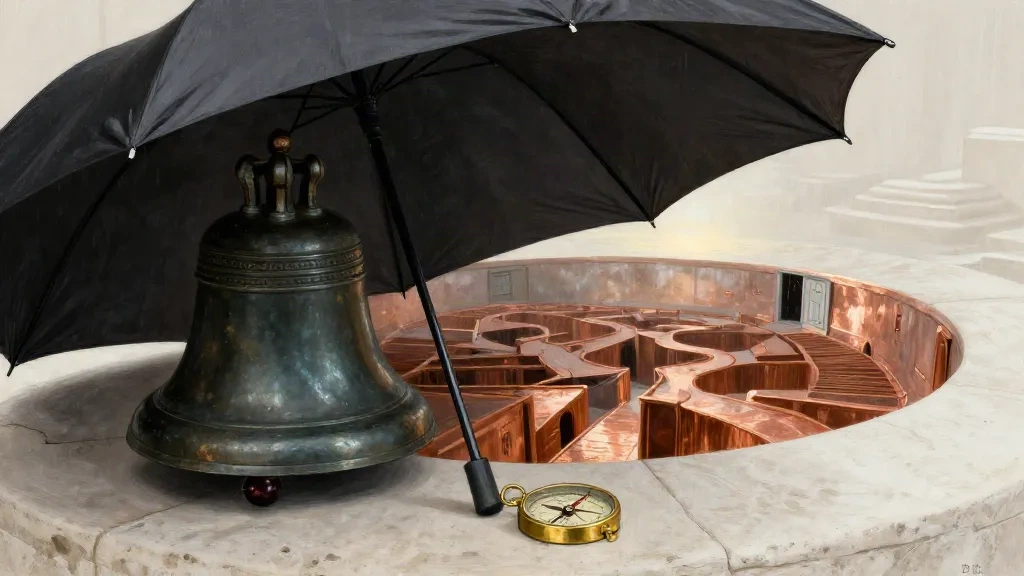
At the far end of the gallery stood a black umbrella, abandoned under a sign: GRIEF UNNAMED. The museum’s public holiday was kept there each autumn, though the city calendar had never recorded a date, and the museum had never explained who paid for the harps.
Under the umbrella waited a brass compass with a needle shaped like a tiny open hand. The needle turned and pointed at Mara, and kept pointing, which she found more frightening than if it had swung wildly.
“You are late,” said the attendant.
Mara had never seen him before. He was made of folded coats, one dark woollen sleeve over another, and his face was gone entirely under a broad hat. He moved the way a person moves when they have been standing very still for a long time.
“The grief is about to be missed.”
“Missed?”
“That is what it has been practicing.”
When the bell rang again, every door in the museum swung inward at once and a procession entered from nowhere. Mourners carrying bowls of water. Children in black scarves, not one of them crying, the way children do not cry at funerals they were born into. Old women carrying the names of streets that no longer existed, read out loud to nobody. None of the mourners spoke to each other. None looked at the side of their head.
At the centre walked a man in Mara’s father’s coat, who is to say a coat of the same make, cut the same year, buttoned the same careful way, and no face.
He set the brass compass on the floor. The needle spun, hunted, and fixed on Mara.
The Assessor and the Equinox
“You are not the one who rings it,” said a voice like a ledger being closed.
She was a small woman in grey, spectacles with brass rims, a satchel of documents. On her coat, where a name would go, someone had typed only ASSESSOR.
“Nobody rings it,” said the attendant. “That is the whole difficulty.”
The Assessor opened the satchel. “Grief that is not named does not go away. It settles. It becomes silt. Last autumn it came up through the pavements of Klimt Alley and the residents could not agree on the name of their own market. The spring before that it took Dun Row. There is a district of this city, madam, where people know they are hungry and cannot remember what they ate.”
“And if it is named?”
“Then the dead are permitted to leave, and the living are permitted to stop performing.” She said performing the way an auditor says variance. “At the first bell of the equinox, the silt either is given a name or it finishes its work. There is no third outcome. I only inventory.”
“You only inventory people.”
“I inventory what people will not.”
Behind her, the procession shifted. Mara saw, and wished she had not: a young woman in a rain-dark coat at the very back, three or four years older than herself, holding a sealed letter. The coat was bad. The letter was in her own mother’s handwriting on the envelope.
The black umbrella trembled on its hook.
What the Earth Remembered
“The ground below the street is not a country,” said the attendant. He held out the umbrella. “It is a promise made before the first house was built. Every grief this city refused to name was buried in it, and the city built on top, as you do.”
Mara took the umbrella. It was heavier than a street door and lighter than a thought.
She opened it and rain began inside it, falling upward toward the copper horizon, each drop carrying a sound on its point: a first footstep, a locked door, a name called across open water and not answered. The drops went up through the canopy and hung there, and the whole vault above the galleries filled with slow silver weather.
She stepped onto the transparent street with the compass in her fist. The needle had stopped pointing at her and begun, faintly, to tremble toward the procession, which was the answer to a question she had not asked out loud.
The world beneath her tilted. She passed under the foundations of her own neighbourhood and found them packed like a ship’s hold. Rooms sealed with laughter: a kitchen, a stairwell, a bus in the rain, all of them shut and still, laughter going on with nobody in it. Old roads braided into the roots of a black cherry tree. Lamps burning in cellars for people who had never been born. A dog, stone and patient, waiting at an alley mouth for an owner three centuries short.
At the third canal she stopped, because the water was carrying a voice.
The Courier of the Unfinished Sentence
It was not her father’s voice. She made herself hear it properly before she let herself want it, which is a trick she had learned at fourteen and had never once managed to use.
The young woman in the rain-dark coat came out of the procession as Mara came down the canal bank, and bowed, and held up the letter, and said, “I am to ask you to leave this unnamed.”
“Ottoline,” Mara said, and did not know where the name came from except that it was correct. “Ottoline Brack, nineteen, hired out of the workhouse, three days’ wage. You are in the third chapter and you die at the end of the fifth.”
“I am in a list,” Ottoline said, “and you are in a house on Copper Street, and we are both still working.”
The letter said what such letters say. Your father has been asked to go north. He did not wish to tell you at the table. There is money enclosed. Do not sit up. Eleven years old, and the sentence in the letter had a period at the end, and the sentence in her own mouth had had nothing at the end, and she had been carrying that unfinished sentence around the city like a stone in a shoe for eleven years.
“Why does he need asking?” Mara said.
“He doesn’t.” Ottoline’s face was composed and nineteen and sorry in a professional way. “But if he is asked, then he is a man who was sent for, and not a man who chose a different city, another name, another life. If he is asked, then what you are grieving is a duty, and duties may be resented, and resentment closes a door.”
“And if I name it, he is a man who chose.”
“Then he is a man who chose,” said Ottoline, “and there is no polite sentence left for anyone in the family.”
The copper light shifted. Below them the canal took the rain upward.
Mara understood then that the procession was not made only of the abandoned. It was made of everyone the city needed in order to keep the story comfortable: the one who carried the letter, the one who signed the papers, the one who said nothing and let it stand because saying nothing was also a decision and cheaper.
Somewhere above her, four storeys up and thirty feet of folded street away, her mother was asleep in the flat with the good chair, saying he was called away in her sleep the way she said it in her waking.
The Door of the Unfinished Sentence
At the bottom of the world stood the black cherry tree, its branches full of doors, hanging like fruit.
The man in her father’s coat pointed to one without being asked. Through it Mara saw the kitchen on Copper Street in November, eleven years ago, her father at the table with his hat already on, younger than she could hold in her mind at once. He was not a ghost. He was a man with a jaw.
Then the door showed her the rest of it, because doors in that country do not lie about how they open.
He had come back three times. Twice in the first year, once in the fourth. The second time he had stood in the alley and not come up, and the third time he had knocked, and Ilsa had looked through the glass and not opened it, and each time he had gone away down the street and been a little less a person on the way out — because that is the arrangement, that is the price, that is the one thing Mara had never once suspected.
You cannot leave a city without saying goodbye. A city keeps what it is told. And grief that is not named becomes silt, and silt rises, and a man who leaves without being missed has nowhere in the world to be remembered in, so he comes back a stranger, and is a stranger again, and eventually cannot be recalled at all — not by the ones who loved him, not by himself. He was not gone. He was unfiled. Somewhere north there was a man who could not produce his own name on demand, and who had a daughter’s face in a pocket, and who had stopped coming up the hill.
“If I give it a name,” Mara said, and her voice was not steady and she let it be unsteady, “will it let the dead go?”
“No,” said the attendant.
The answer struck her harder than a bell. She had gone down three canals and under a folded city for no.
“And if I name it?”
“Then your father can be found again, by anyone, anywhere. He will not thank you. He will not be able to.” The attendant turned the brim of his hat a quarter-turn, which was as much as his face ever did. “And the silt goes with the name. Three streets, and the district, and every household that has been eating a meal it cannot remember. It is a flood, madam. It does not choose what it repairs.”
Mara looked at the procession and counted what would come up through the pavement with it: the courier, the man who signed, the landlady who raised the rent on a flat that now had one wage in it, the doctor who said nerves and wrote it down. And her mother, walking in the middle of it in her good coat, with no tidy sentence left to hold in front of her face, because the tidy sentence had been the silt.
She had wanted, for eleven years, to be told that her father was a man who chose. She had not once, in all that wanting, considered that the wish was a wall built of the specific kind of stone that keeps a city dry.
“He is down there asking me not to,” she said, because her father’s hand had gone to the door frame and she had not seen it do that.
“Yes,” said the Assessor. “He has been asking for three years. He has never once been able to knock.”
The Door Beneath the Bell
Mara took out the plum-sized bell. It had no clapper. It had never had a clapper. It had come out of the last of the black cherry bronze with a stain like a pit across its throat, and it had sat on her highest shelf for years labelled unfinished by a man with a green pen, and she had told everyone including herself that the missing sound was the point.
It was not the point. The point was that her father had taught her to cast, on a wet Tuesday, when she was nine, with his hands over hers on the lever, and that the bell had been his to the last hour of the metal, and that he had left it in her one unfinished thing.
“That is not the mould for the Idris child,” said the Assessor. “You will have nothing left to cast the child’s bell in.”
“No.”
“Ordinary bronze. It will not carry.”
“I know what ordinary bronze does.”
“And the bell you are about to ring has to hold no memory of anyone who ever owned it, or it cannot open a door from the inside. It is the last of his metal. Ringing it spends him.”
The rain went up through the branches of the cherry tree and hung there, and every drop of it said a sound, and somewhere among the sounds was a man in a kitchen with his hat on.
Mara thought about what she would keep afterwards. She thought about it carefully, the way you check a bag before a long journey. She would keep the fact of him. She would keep the letter and the date and the name and the unfinished sentence and the shape of the coat. She would lose the voice. Not the words of it — she had those — the voice itself: the particular way he had laughed through his nose at the third pour, the sound of him at the top of the stairs at midnight saying her name as a question. Gone into the making of one opening.
She rang her unfinished bell.
It made no sound at all. She felt it in her wrist, in her teeth, in the flat cold place behind her sternum where she had been keeping it for eleven years.
The door shaped like a bell opened from the inside.
Beyond it was not her father. It was a narrow stair going up into the ordinary world, toward her street, her workshop, her mother’s window, the life that remained hers. The procession streamed through it shoulder to shoulder, released from the holiday without vanishing, and the copper light above them brightened by a degree you could feel in the teeth.
“It is done,” said the Assessor, and did not congratulate her. “Klimt Alley will know its market by morning.”
Mara went up the stairs with the empty bell in her hand and no umbrella, and the attendant said nothing at her back, which she understood later to have been the only kindness he had.
After the Holiday
She came back into the museum at morning, wet to the knee, in a museum that had rearranged itself slightly overnight: two arches now opened onto streets, and one of them opened onto a market she recognised.
The black umbrella was gone. So was the compass. Her plum-sized bell lay on her workbench, clean, dry, and looking like an ordinary small bell that had never been finished and never would be. She shook it against her palm and it gave her nothing, which was correct, because it had nothing left to give.
Her mother was awake at the bottom of the stairs, sitting in the good chair with her coat on, at an hour Ilsa Venn was never awake.
“Was it the equinox,” said Ilsa. Not a question.
Mara stood in the doorway with wet shoes and could not find any of the eleven years of sentences she had sharpened for exactly this. She could remember that her father had a jaw. She could not remember whether he had laughed through his nose or through his teeth, and she had one more chance to get it right, and the bell had already spent it.
“I can’t answer you,” she said. “Not the part you want answered. I can answer the rest.”
“That is not an answer, Mara.”
“It’s the only one I have left.” And then, because her mother had spent eleven years on a sentence she had not chosen either, and because the flood did not choose what it repaired: “He was not called away. He came back. He came back twice and you did not open the door, and I do not know yet whether that was cruelty or a woman who was alone, and I am not going to decide it for you, because that is the thing the flood is for.”
Ilsa put her hand flat on the table, the way you steady a boat.
And that was all. Nobody was forgiven; nothing was fetched back out of the ground and made to sit at the table. A courier in a workhouse got a letter of thanks, which she framed, which was worse. The landlady learned what her rent had cost and put up the price, and put it up for a while. Klimt Alley argued about the name of its market until Thursday, and then agreed, and something in the street stood up straighter.
In April, Mrs. Idris came up the two flights with her daughter on her hip, and Mara set the little bell on the workbench and showed them the seam of ordinary bronze where the black cherry stain would have been.
“It’s duller,” she said. “It will carry inside a room. It won’t carry across a street. I thought you should hear that from me and not discover it in a year.”
The child was named Wren, and Wren took the bell in a fist and shook it hard, and it gave one clean ordinary note that filled the whole of the workshop and did not carry one inch further.
Mara smiled and answered the sound, the way you do, and then she stood a moment in the copper light with her hand in her pocket, feeling for a laugh through a nose, and finding, with the specific relief of a person who has paid and knows exactly what for, that it was gone, and that she was not a child, and that the door on the other side of it was still open.





