 Netwrck
Adventure.
The Last Screening
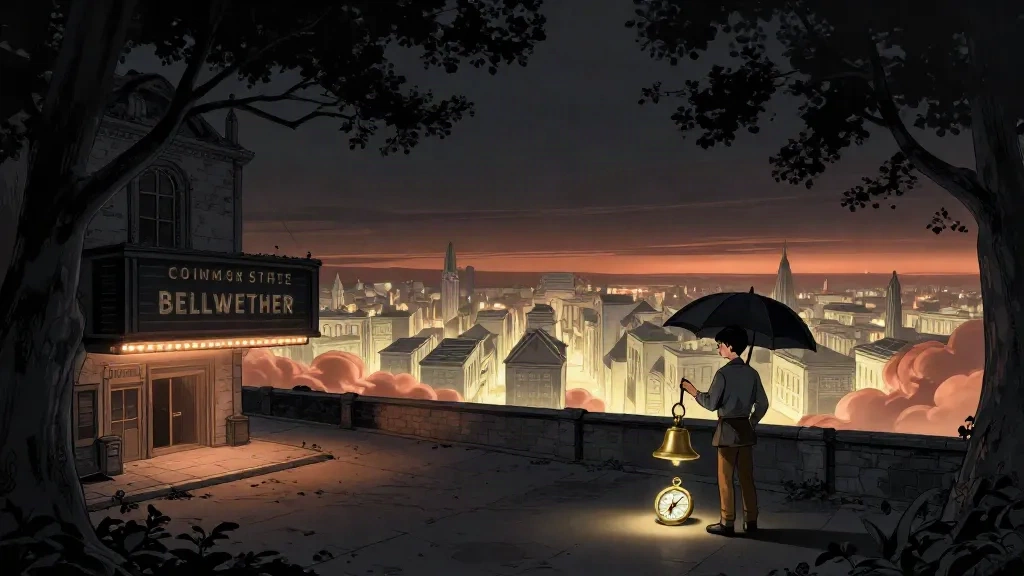
Bellwether Street had a cinema with no name. Its marquee had gone dark so long that pigeons treated the empty letters as ledges, and the black cherry trees along the pavement had rooted into the cracks beneath its doors. Mara Bellmaker knew the building by its sound: a faint projector flutter behind the walls after midnight, as if the place were still showing a film to an audience of dust.
She carried her newest bell in a cloth bag. It was too small for a wrist, too bright for an ordinary signal, and it had no clapper. The bell rang by itself when someone was approaching a memory they did not yet own.
That night it had led her here.
On the cinema wall, a paper holiday notice curled under a brass tack. The ink had faded to pale stone:
PUBLIC GRIEF DAY
Bring what you cannot name.
Do not bring what you wish to keep.
Mara read it twice. No one in Bellwether had ever observed a day for grief without a name. The city had holidays for rainless summers, invented ancestors, and the day the river changed direction. Unnamed grief belonged to no saint, no department, no calendar.
Except the notice was real. Beside it rested a black umbrella, its handle carved in the shape of a closed door. On the cinema roof, a brass compass turned without a needle.
A Street With No Bottom
The cinema doors opened before Mara touched them. Inside, the seats descended farther than the building should allow. Rows of empty chairs faced a screen where copper-colored clouds hung over a black cherry horizon.
On the screen, Bellwether Street floated above a second city.
Mara recognized the clock tower, the bakery, the cracked step outside her mother’s house. Beneath them ran pale stone corridors, filled with rooms that were not rooms: kitchens in clouds, gardens under winter, stairways leading into the same dawn. A silver caption appeared:
NEARLY HAPPENED, 12 OCTOBER.
She stepped into the aisle. The floor gave beneath her shoe and became a map of streets. Not names. Not directions. Under her palm, the stone felt warm, and she heard thousands of bells ringing in different basements.
“You came for the shape of the world,” said a voice from the projection booth.
Mara looked up. An old usher stood beside a reel of film that glowed like a winter window. He had no shadow.
“Your street is a lid,” he said. “Lift it, and the city will spill out.”
She thought of the blue cellar at home where the pipes complained every winter. The thought arrived with a memory that had not yet happened: her mother laughing in a kitchen below the bakery, flour on her wrists, while a small brass compass pointed toward the floor.
The Holiday of Unfinished Things
Across the hidden city, a gong sounded. On the screen, people carried objects into the square: a wedding veil without a bride, a child’s shoe with no child, a telephone ringing in an empty room. The black umbrella rose from the crowd. Under it stood a figure dressed in mourning clothes, though no one could say who had died.
Mara knew the figure. Not the clothes. The posture: shoulders held carefully so grief would not spill.
She descended the stairs. The hidden corridors changed with every step. A bakery wall opened into a forest of stone chimneys. A gutter carried seawater, though Bellwether lay inland. The brass compass in her pocket pulled toward every left turn.
At the square, the umbrella-bearer lifted its edge. Beneath it was a hole where a person should have been.
“This is the holiday,” the figure said. “A day for every grief the city refused to name.”
“What do you want?”
“A witness.”
Then every bell rang at once.
Mara’s small bell split the air without sounding. On the screen, the nearly-happened city trembled. A future flickered into view: Bellwether buried beneath copper weather, its people alive but unable to remember the surface. The next flicker showed the city remaining intact, while someone below it was forgotten forever.
The Bell That Chooses
She understood then. The cinema did not predict futures. It displayed the cost of choosing one.
The figure held out a hand. In it rested a small, unformed memory, dark as black cherry.
“Name it,” the figure said, “and the street can open.”
Mara could lie. She could invent a dead king, a vanished sister, a heroic accident. The city would restore its surface and leave the forgotten world beneath it.
Or she could sound the bell.
She struck it with the brass compass.
The note rose through the square, through the corridors, through the cinema above. It did not carry an answer. It carried the sensation of a room she had entered before she was born: warm hands, a window rattling, someone promising to return before the weather changed.
Her mother’s voice came from below.
Mara’s bell answered with its own unfinished memory: her mother beneath Bellwether Street, younger than Mara remembered, placing a black umbrella over a box marked with a pale stone and a copper horizon. The label read: THE GRIEF WE WILL NOT NAME.
Mara took the compass. The hidden city folded around the light. The umbrella-bearer vanished into the weather, and the square filled with the soft, impossible bells of people remembering what they had lost.
She climbed back to the auditorium as dawn entered through the broken roof. The screen had gone dark. The black umbrella leaned beside her door, and the compass pointed upward.
Mara stepped onto Bellwether Street. Beneath her feet, far below the known curbs and cellars, something vast turned in its sleep.
Then one bell rang.
What the Street Remembered
She did not know who owned the memory. She did not yet know the true shape beneath her feet. But she knew the holiday had ended where every holiday should begin: in the street, among the living, with its grief still nameless.





