 Netwrck
Weird Fiction.
The Library of Arrivals
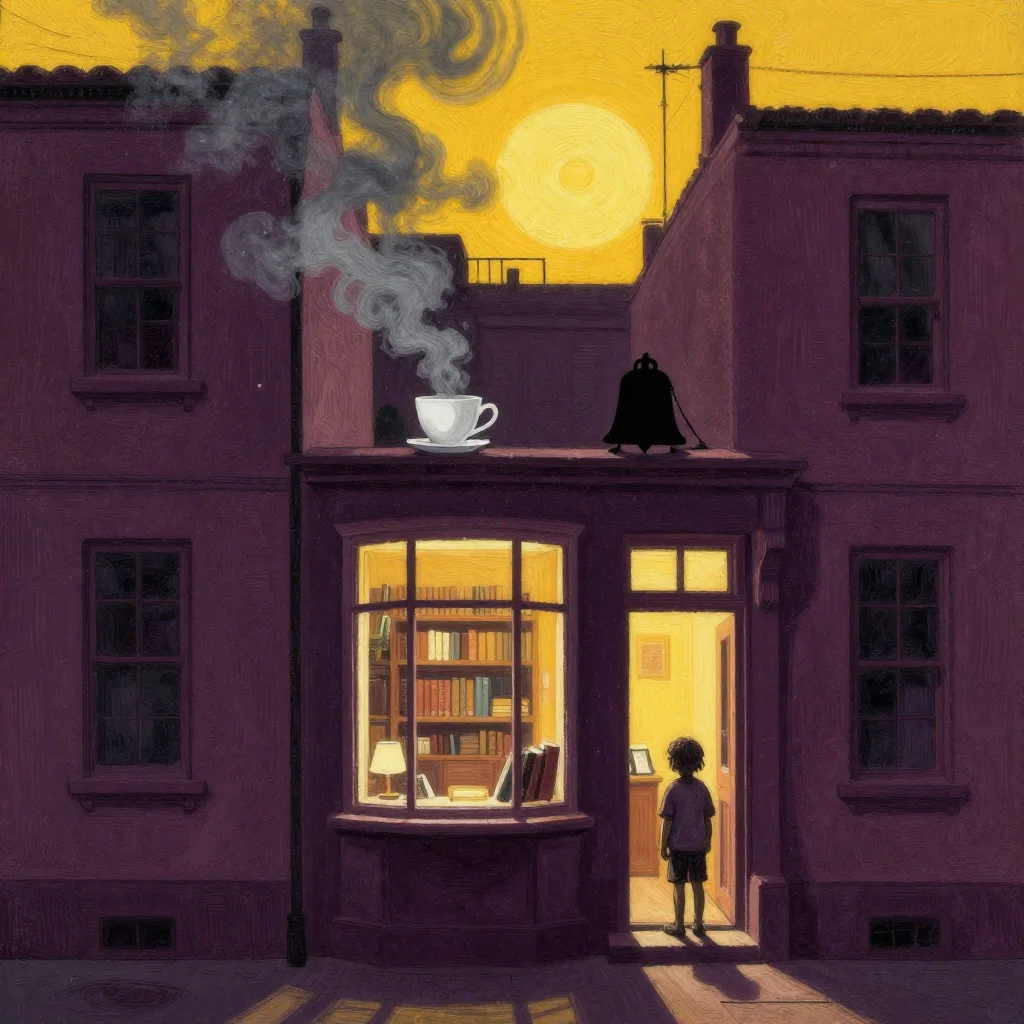
Mara rented room 6C because its window faced the wall of the next building and therefore promised no view. The apartment building for people who could only remember the future stood on a narrow street beneath a saffron sun, its windows clouded with smoke-grey air. Every resident arrived already grieving something that had not happened, or celebrating it before the cause had consented.
On the first floor, a woman pressed her palms to her chest and said she remembered a city underwater. An old man kept a suitcase packed for a train that departed in 1987. In the elevator, a boy announced that the elevator would become a chapel, then corrected himself: it had become a chapel, then fallen into the sea.
Mara worked in the library, a narrow room between the boiler and the mailboxes. Her job was to lend books to people who had forgotten how to live in sequence. On the desk sat an empty teacup, white as a small moon, and beneath it a cracked bell no larger than a plum seed. She kept them there for reasons the library did not record.
The Same Book
The impossible book had a blue cover without a title. Mara first gave it to a woman who believed she would die on Thursday. The woman returned it smiling, though Thursday had not yet learned her name. Mara gave it to a man who remembered the end of his marriage before the wedding. He returned it with a pressed flower between its pages. A mechanic borrowed it, then a child, then a woman who spoke only in future weather.
Each reader saw a different ending inside, and each became less afraid of the life awaiting them. The book was not a prophecy. It was permission.
Mara wanted a home that accepted impossible residents. She had applied to every building in the city, but the forms asked what a resident remembered. She wrote tomorrow, and they sent her back. She wrote several tomorrows, inconsistently, and they sent her a correction letter.
The Child Who Named It
On the seventh evening, a child named Ivo knocked at the library door. He was nine, or would be nine, depending on which day he was visiting.
“The building is breathing,” he said.
Mara gave him the book. He opened it and frowned.
“This is blank.”
“You are holding it upside down.”
He turned it over. The pages filled with sentences. Mara leaned closer. They described a fire in the basement, a wedding in the stairwell, a bell ringing beneath the floor, and a woman standing in smoke-grey air with an empty cup in each hand.
Ivo looked toward the desk. “You keep the bell there.”
“It is cracked.”
“No. It is hiding.”
Every resident had agreed not to notice what lived below the boiler room. They called it dampness when the pipes knocked. They called it footsteps when the floorboards rose at night. They called the sweet smell of iron tea.
Mara had heard it too. At midnight, beneath the library, something rang the cracked bell. She had told herself the sound came from the old building settling. She had told herself many things, carefully, in the order that made them easiest to bear.
What the Building Forgot
Ivo opened the book to the final page. A sentence appeared in handwriting like frost:
Every home becomes possible when someone stops asking what the impossible resident will change into.
Mara read it twice. She looked at the cup, the bell, the boy who had seen what the adults had agreed to overlook.
“The thing downstairs is the last resident,” she said.
Ivo nodded. “It remembers the building before it was built.”
Together they opened the basement door. Smoke-grey air spilled up the stairs, carrying the saffron scent of old tea. At the bottom stood a small figure wrapped in wet shadows. It had no face, only a keyhole where a face should be.
The figure held out the cracked bell. Mara understood then that she had been keeping it safe from the residents, not from itself. The bell was not calling them to account. It was asking whether they would make room.
She placed the empty teacup beneath it. A single drop appeared in the cup, though no tea had been poured. The bell rang once. The walls remembered every future they had feared, and for one bright instant allowed all of them to remain.
At dawn, Mara did not leave. She moved her chair into the hall and placed the impossible book where anyone could reach it. The residents came carrying their contradictory days. Some brought news of endings. Some brought apologies. Some brought only themselves.
Ivo returned the book with a new inscription on its blue cover: Home is the room where the impossible may keep its shape.
Outside, the saffron sun rose over smoke-grey air. Inside, the empty teacup shone, and the cracked bell sounded whenever someone found a place to belong.





