 Netwrck
Mythic Fiction.
The Last Screening
Mara Venn made bells in the basement beneath her grandmother’s lockshop, where sea-glass green light leaked through the coal chute and sand collected in the corners of every shelf. Each morning she poured wax into the molds; each evening, after the lockshop closed, she listened for the sounds they made when no hand touched them.
Her bells rang for memories not yet owned. They could summon a first winter, an unmade promise, the name someone would choose decades later. Mara never pursued the rings. Memories were safer before they belonged to anyone.
That changed on the night of the Nameless Mourning, the public holiday held every autumn for griefs too tangled to name. Her brass compass, inherited from her grandmother, swung toward Bellweather Street instead of north.
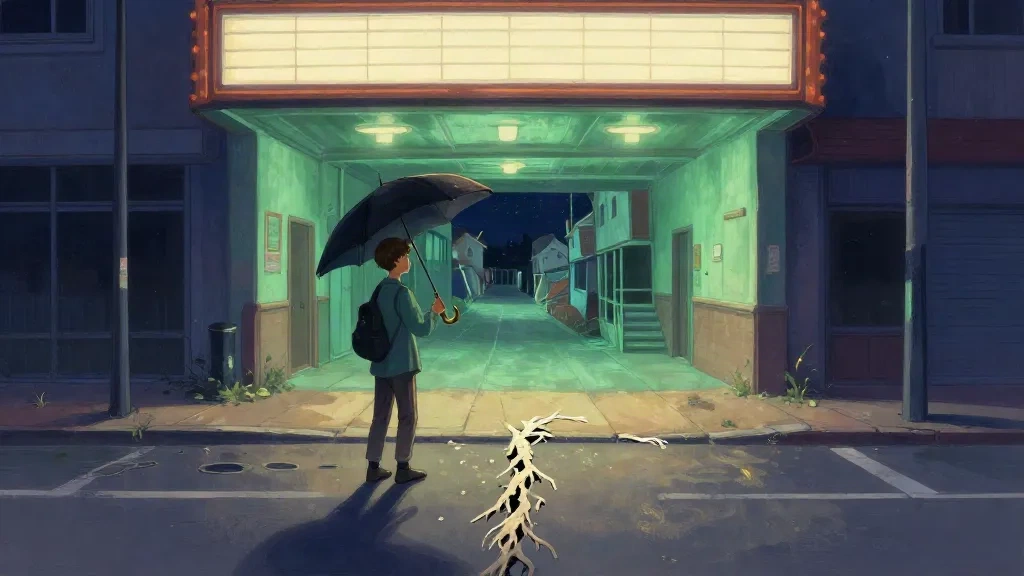
At midnight, the abandoned cinema across the street unlocked itself. On its marquee, burned letters read: THE STREETS WE ALMOST LIVED ON.
Admission: bring the life you failed to choose.
Inside, the projection room glowed cobalt. A film waited beneath the reel: Mara walking down a flooded subway, ringing a black umbrella in a language she had never learned. The audience consisted of empty seats, each bearing the brass nameplate of a shop from her street.
A City Under the Avenue
The film began. The camera descended through brick, foundations, pipes threaded with pale roots. At the bottom lay another Bellweather Street, folded small and folded again, its houses standing on the backs of vanished ones.
In the projectionist’s booth, Mara found a catalogue of futures that almost happened. One film showed her grandmother sealing a narrow blue door beneath the lockshop. Another showed the holiday arising from a public square where a city had burned the names of its dead to keep the plague from crossing the river.
“The grief was never nameless,” the projector whispered. “You only were.”
Mara lowered the reel. Her grandfather appeared, young and furious, carrying a woman toward a station that no longer existed. The same black umbrella sheltered them from ash. In his pocket was the compass she now carried.
She had spent years believing the street’s shape was fixed: lockshop, shuttered bakery, cinema, bus stop. Yet beneath its pavements lay rooms her family had traded away to keep the surface ordinary. Her grandmother’s house was balanced above the room where her grandfather had vanished.
What the Holiday Remembered
Outside, bells began ringing across Bellweather Street. Each family heard a different lost arrangement in them. Doors unlatched. Photographs warmed beneath forgotten frames. People stepped into the night carrying objects they suddenly remembered hiding.
At the cinema entrance, the black umbrella waited beside the booth. When Mara took it, its ribs tightened like fingers. A strip of film stitched itself along the canopy, showing the flooded subway beneath the avenue.
She entered the booth’s lower door and found the hidden stairway. The brass compass pointed not down, but inward, toward the true center of the street.
At the last landing stood a brass door marked with her family’s erased names. Beyond it, the city’s lost rooms trembled. A bell rang somewhere below, and Mara understood: the world beneath Bellweather had been built by suppressing every life that might have changed it. Its streets were not dead places. They were possible lives denied a voice.
The hidden city began to shake. If the door opened, the familiar street would lose its shape. If it stayed shut, someone else’s memory would remain buried.
The Shape of a Street
Mara rang the black umbrella against the door. The sound traveled through walls and rooms. The hidden streets answered with bells: her grandfather’s laughter, the bakery’s missing oven, names she had no right to speak.
She turned the compass. For once, it showed no direction, only a web of streets crossing beneath the avenue, each route leading to a different survivor.
So Mara opened the door.
Light rose in blue, silent waves. Across Bellweather, people stepped back from walls that had grown thin. In the basement, her grandmother found the station her son had left behind. On the rooftops, empty rooms lit their windows.
The Nameless Mourning became the Naming Day. No single grief was chosen. Each person called out something recovered, and the hidden city answered with a new bell.
By sunrise, the street remained familiar, but its corners no longer agreed. The bakery had appeared beside the bus stop. A narrow stair descended from Mara’s own bedroom. The brass compass pointed several ways at once.
Mara hung the black umbrella by her workshop door and set a new bell on the sill. It gave one clear note into the morning.
She did not know whose memory it announced. For the first time, she did not need to know. Beneath the street, the lost roads were being measured by those willing to listen.





