 Netwrck
Folk Horror.
The Empty Platform
At Bellwether, the railway ran on faith, rust, and whatever the wind carried across the salt. The station stood alone beneath a white sky, its timetable listing trains that had stopped running before the town had a name. Only one line remained inked into the timetable: THE ARRIVAL — 4:17 — WINTER OR OTHERWISE.
Mara Vale was municipal gardener, though the town preferred to call her the woman paid to disturb the weeds. Her work was neglected courtyards: dry gardens behind shuttered houses, thorned lots between apartment blocks, the narrow spaces where families had once hung washing. She planted stories instead of seeds. In a courtyard where a woman had hidden bread during the famine, she grew black beans. Where a boy had promised to return, she planted yellow flowers shaped like small doors. Her tools were a trowel, a brass key worn smooth by her grandmother, and a cracked bell from the ruined house beyond the dunes.
She had a concrete desire: to turn the family story her grandmother had told her into a shelter for strangers. The story began with seven travelers sheltering in a burning house and ended with the eighth traveler opening the door from the inside.
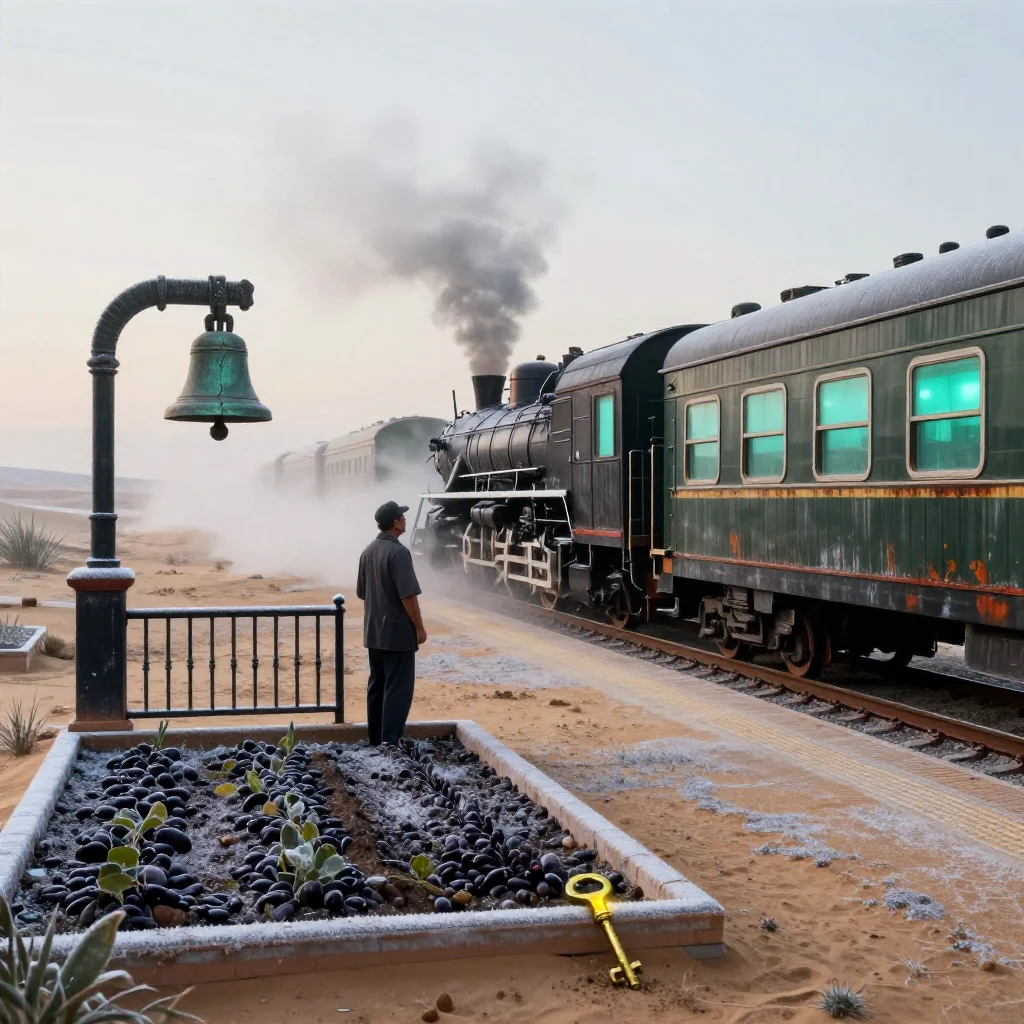
Mara planted a row of black beans beside the station, then shaped the courtyard wall into seven windows. She placed the cracked bell over the entrance. The brass key went into the lock.
What Arrives
On the first cold morning, the train came.
It did not approach from the horizon. It emerged from the blue darkness behind the platform, one carriage appearing after another beneath a sky that had not been there an hour before. Frost silvered the rails. The windows glowed with the soft cyan of an impossible dawn, and frost formed inside them in shapes like open mouths.
Passengers stepped down carrying objects no one in Bellwether owned: clocks, silver thread, a jar of black soil, a child’s shoe filled with sand. Mara saw her grandmother among them, younger than she had ever been, holding the same brass key.
The station door stood unlocked. Beyond it, the courtyard was shelter, walls thick enough against the desert wind. The story had become real. Mara felt the old house take shape around her, saw the seven places at the table and the eighth place waiting beyond the door.
Then the crack in the bell widened.
The Doubt Engine
The machine was beneath the platform, an iron device shaped like a lantern with no glass. A hand crank turned by itself, slow and reluctant. A brass plate read:
THE SHELTER IS SERVED ONLY BY THOSE WHO DO NOT BELIEVE IT WILL BE NEEDED.
Mara thought it a warning. The passengers thought it a joke. When one traveler touched the machine, it stopped.
So they laughed. They said the train had arrived by miracle, the house had grown by coincidence, the door was merely an old door. They touched the walls, stamped the frozen courtyard, called the shelter a stage set. Each denial loosened the machine. The courtyard bricks became transparent. The seven windows narrowed.
At 4:17, the impossible dawn faded from the carriage windows. The station began to empty.
Mara climbed down and seized the crank. The machine tore at her palms. She thought of strangers who would arrive needing somewhere to sleep, children asking whether the desert was safe, her grandmother saying that a door is only a promise someone has not yet decided to keep. She thought she believed in every word.
The crank would not turn.
The Eighth Traveler
Her grandmother descended from the train without a shadow.
“You have made a shelter from a story,” she said. “Stories are dangerous when their endings are fixed.”
She pointed to the brass key in the lock. Mara understood. The machine worked only when nobody believed in it. But a shelter could not be held together by doubt. Someone had to enter without certainty, carrying no promise of safety, asking for nothing.
She withdrew the key.
The door opened onto the burning night from the family tale. Heat struck her face. Beyond it stood seven people at a table, their faces hidden by smoke. An eighth hand reached through the darkness from the far side.
Mara stepped through.
Behind her, the machine began to turn. The courtyard rebuilt itself in frost and iron. Strangers arrived from the station, drawn by a door they could not see, and found beds, water, a warm room where no one asked their names.
By morning, the train had gone. The courtyard remained. The cracked bell hung silent above the gate, its fracture filled with a thin line of cyan light. Mara buried the brass key in black soil.
That night, something knocked from inside the wall.
She did not ask who was there. She only opened the door, doubtful, hungry, and ready to shelter whoever had come home.





