 Netwrck
Surrealism.
The Courtyard of Unfinished Sentences
At the bottom of the comet monastery, where the stone walls curved inward like the inside of a bell, Mara Venn planted stories in neglected courtyards. She worked with a silver trowel, a watering can filled with rainwater, and the municipal ledger that recorded which courtyards had forgotten their names.
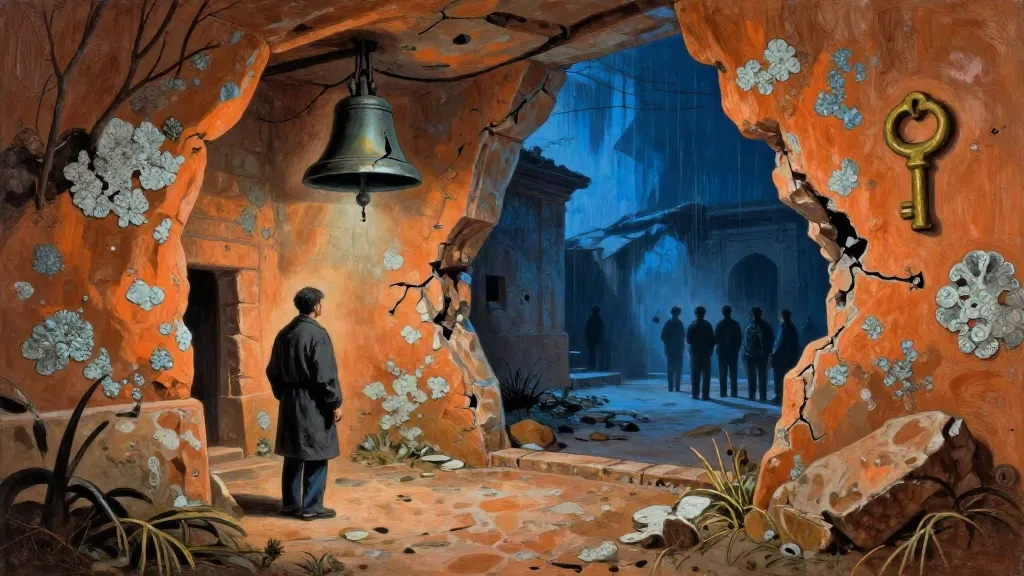
The chapel courtyard had forgotten three. Its walls were stained burnt orange, its weeds had grown through the mortar, and blue storm-light trembled across the paving whenever the comet turned toward the old dark. Mara planted her family's story there: a daughter who left home during a meteor shower and returned carrying a brass key in her palm.
That was all. The family had spent seven generations arguing about what the key opened. The grandmother said a door. The mother said a country. The father said it was only a key, and that people made doors out of hope because they disliked arriving with nothing.
Mara wanted the story to become a shelter. She had seen the strangers gathering beyond the monastery's northern wall: boot-wearers, ash collectors, children from the observatory, people whose homes had been swept into the comet's luminous tail. If the story took root, perhaps its walls would rise around them.
The Machine of Unbelief
Shelter came in a brass case marked PROBABLE DWELLING, ONE FAMILY VERSION. It had a copper dome, three glass eyes, and a foot pedal shaped like a crescent moon. The abbess had inherited it from a monastery on a dead asteroid.
The machine worked only when nobody believed in it.
This rule was written on its side in a hand small enough to belong to a beetle. Mara discovered it after trying to build the shelter herself. The first wall appeared, then dissolved. The second floor lasted until she admired it. The third became a flock of silver birds and struck her sleeves.
So she told no one the machine could work. She showed the strangers its brass case and described it as a municipal instrument for measuring wind. When one child asked whether it could make a home, Mara said, “Only the wind can answer that.”
At night, she wound the machine with the brass key from the family story. The key was warm as a loaf of bread. The copper dome whirred. No one came. Mara hid inside an empty cistern and listened through the drain.
Somewhere in the monastery, a cracked bell began to ring. It gave one bright, uncertain note, then stopped.
A Shelter Against Agreement
On the third night, the strangers came to the courtyard. They brought no tools. Some carried blankets. One held a dead lantern. Mara positioned them around the machine without explaining what it was.
“What is this?” asked the boot-wearer.
“A machine,” Mara said.
“Can it shelter us?”
“It can measure the distance between a question and an answer.”
They looked bored. That was good. Belief was dangerous here, as sharp as a nail.
Mara pressed the pedal. The three glass eyes rolled toward the family story she had planted. The silver trowel began to tremble in the soil. Beneath the paving stones came a sound: doors being tested in houses that had not yet been built.
The machine did not believe itself. The strangers did not believe the machine. The story, for once, believed neither of them.
A wall rose from the courtyard. It was warm, rough, and painted the color of old rust. Another wall followed. The cracked bell rang again, and a beam of blue storm-light cut through its fracture, illuminating rooms without doors, tables without legs, and beds filled with folded shadows.
Someone laughed. Mara struck the pedal before laughter could become conviction.
The shelter finished badly and beautifully. Its roof was low. Its windows opened onto the comet's burning interior. But the strangers entered without asking permission, and the walls remained.
The Key in the Wall
By morning, the abbess found Mara asleep beside the machine. The brass key had sunk halfway into the courtyard wall, as if the shelter had swallowed the last argument about it.
The family story had changed. No longer did it say that the daughter returned with a key. It said she returned with a wall, and behind the wall were beds for everyone who had no story left to tell.
Mara pulled the key free. The cracked bell gave its last note.
Then the machine started working on its own.





