 Netwrck
Surrealism.
The House That Kept Falling
At the far end of the comet, where the monastery narrowed to a point of blue-black stone, Sister Vey kept the library. Her books had no names on their spines. Some had wet pages. Some contained doors. One was blank until someone touched it, then it became a record of their entire life, except for the part they had spent the most time trying to forget.
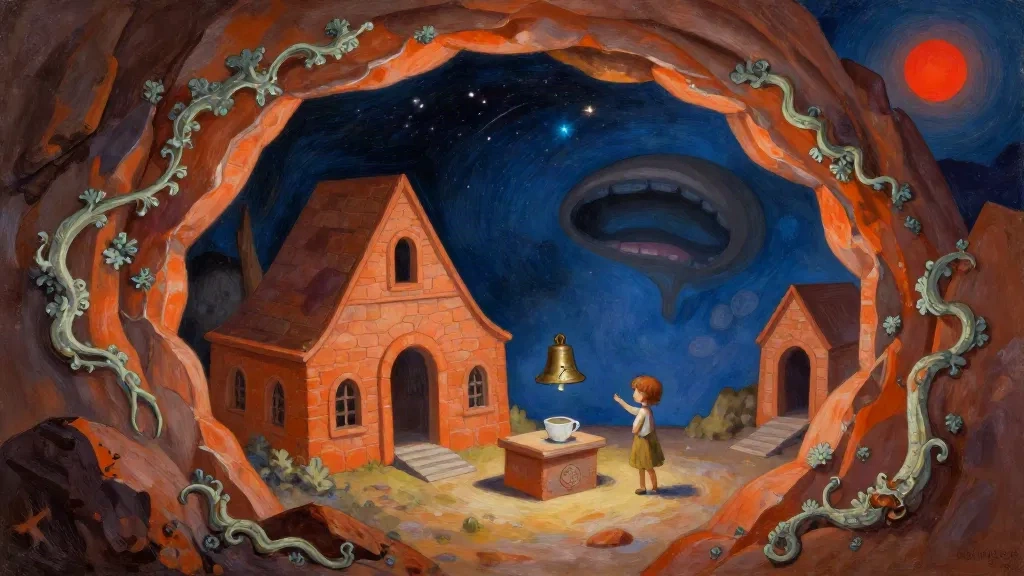
Vey’s room had a window cut through the comet’s shell. Through it she could see the stars sliding past, each one burning in a different color. The monastery itself was stained burnt orange, with pale lichen creeping along the walls in letters no one could read. Whenever the blue storm-light came, the room turned briefly into the inside of a drowned bell.
Her own room was small and had no window. She slept beneath a shelf of atlases that opened onto places which did not exist. Every morning she placed an empty teacup on her desk. Her favorite cup, she told visitors, had gone looking for a sea.
“Will I ever have a home?” she asked the cup.
The cup did not answer. It had never answered, but Vey had learned not to take this personally.
People came to the library because the comet was the last place where their strangeness could remain unfolded. A woman arrived with two shadows. A man brought a bird that spoke only backward. A bride came without a head, carrying a silver bell in her hands. Vey lent them all the same impossible book.
It was blue, hardbound, and warm. On its first page was a house with many rooms. In each room stood a person who had been rejected by the world. The second page showed the house accepting them. The third page showed the house becoming a home.
Nobody had ever reached the fourth page.
The Child Under the Floor
On the night the storm-light turned the monastery violet, a child came into the library. The child had no shadow and was carrying the cracked bell from the upper chapel.
“Everyone else says the library is on the ground,” the child said.
Vey looked down. The child was standing on the floor, but through the floor Vey could see the comet’s burning heart. A black shape moved inside the stone, vast and slow, keeping time with a pulse.
“What do you see?” Vey asked.
The child pointed upward. “A mouth. The mountain has a mouth. It has been saying a word, and everyone has agreed not to hear it.”
Vey had heard it, too. For years she had mistaken the sound for the wind moving through the monastery’s narrow corridors. The cracked bell trembled on the child’s palm. Its missing piece was the shape of a small house.
“The impossible residents need a home,” the child said. “But the home needs a mouth before it can let them in.”
Vey opened the blue book. For once, its pages were blank. Then a line appeared in burnt orange ink: THE FIRST ROOM IS THE LISTENER.
She understood then that the book had not been lending itself to different people. It had been lending them to one another. The woman with two shadows had stayed in the library because the man with the backward bird was afraid of her darkness. The headless bride had been waiting for a body willing to carry her ring. Vey had kept them apart because apart was easier to manage.
Outside, the comet groaned. Lichen peeled from the walls in long green strips. The blue storm-light began pouring through the window, bright enough to erase the room’s edges.
A Room for the Unfinished
Vey carried the book to the chapel. The child followed. Together they placed the cracked bell beneath the altar and set the empty teacup beside it. The cup filled with a thin, orange light.
The impossible people arrived. They filled the chapel without making it larger. Their shadows crossed. The backward bird sang. The bride’s silver ring struck the floor.
“Listen,” said the child.
The mountain opened its mouth.
The word that came out was not a word any language had survived. It sounded like a house opening its doors in winter. The people who had been told they were too strange to belong wept without shame. The two shadows merged. The backward bird forgot its last syllable. The bride found a shadow, though it had no head.
Vey felt the library leave her. It slid through the stone, through the comet, through the dark between stars, and became a small room inside the mouth of the mountain.
Her teacup remained on the altar, empty again. The cracked bell held the missing piece of itself in its bronze throat.
The Address
At dawn, a new wing opened in the monastery. Its walls were orange stone, its windows full of blue light, and its roof covered in lichen. The rooms were narrow, crooked, and warm. A sign hung outside, though no hand had carved it:
HOME FOR THOSE WHO HAVE NOT BEEN KEPT.
Vey stood in the doorway. The child was already asleep beneath a window, the bell resting beside them. Beyond the glass, the comet’s tail curved through the dark, carrying the monastery toward a red star.
She had wanted a home that accepted impossible residents. Now she understood that acceptance was not a gate. It was the willingness to leave a light on.
Vey placed the impossible book on the shelf. For the first time, it had a title:
The House That Learns Your Name.
When she looked up, the child had filled the empty teacup with rain.





