 Netwrck
Folk Horror.
The Last Warm Place
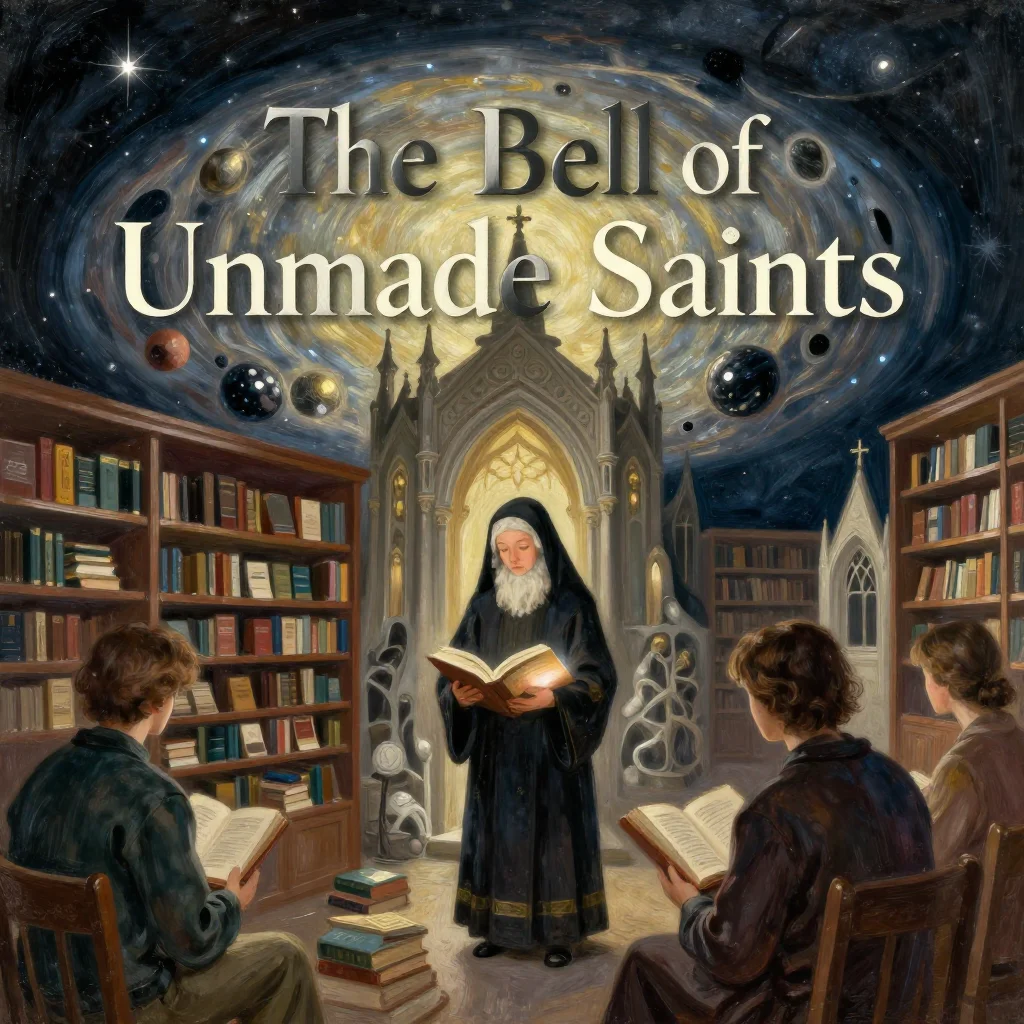
Mara had lived in the monastery for seventeen winters, and in all that time no one had ever asked where it was. The monastery was carved into the tail of a comet that had come to rest behind the northern mountains, its black stone threaded with veins of pale ice. Outside, the sky remained night all year. Inside, a soft cyan dawn leaked from the walls whenever the bells were silent.
Every morning, before the others rose, Mara swept the reading room. She polished the brass spines, repaired torn pages with rice-paper paste, and set a single empty teacup beside the desk. The cup belonged to Brother Ossian, who had disappeared before she arrived. No one would explain where he had gone. The monks only said the monastery had accepted another resident, and that acceptance did not require a body.
Mara had not come seeking peace. She had come seeking a place that would not ask her to explain the small impossible thing living behind her sternum. It was not a heartbeat. It was not a memory. It made a soft clicking sound when she was alone, as if some vast and patient machine were counting the rooms in a house.
At dusk, the monastery doors opened. Whoever entered received shelter, bread, and the promise of a place to sleep. Mara watched them disappear into the narrow cells below the chapel, listened to their breathing thin into the stone, and waited for the question she never asked aloud: What will you become here?
The Blue Book
The book lived in a locked case near the furnace. Its cover was blue without being painted, a deep impossible blue like the light that entered the comet before sunrise. It had no title. When Mara opened it, the pages changed according to the reader.
To the farmer who came seeking a cure for his wife's cough, it showed fields where every crop returned twice. To the runaway bride, it showed a house with a door that opened onto the year she had been born. To the old soldier, it showed an empty chair at a table set for his entire family.
Each borrower returned the book within seven days. Their impossible hope became ordinary, or else they became impossible themselves. That was acceptable. The monastery had room for both.
Then, on the seventh day of the iron frost, a boy came to the reading room. He was perhaps nine, wrapped in a coat made from grey sailcloth. He placed the blue book on the desk. On its cover, where no title had ever appeared, someone had written a name in black thread.
The name was Mara's.
“I brought it back,” the boy said.
“I can see that.” She looked at the thread. It was wet. “Did you write this?”
The boy shook his head. “It was already on the page when I opened it. Your name is the only thing in the book that is not a person.”
She asked his name. He said Elian, then paused as though listening to another voice inside the walls. “That is the name I use for the door,” he said. “The other one is underneath.”
Mara reached for the empty teacup. It had appeared at her elbow without her hearing it placed. Its rim was wet, though no one had poured tea.
What the Child Saw
The bell cracked at midnight.
It hung in the chapel tower, an iron bell cast before the comet had cooled. A fissure ran through its lower lip, so that whenever it sounded, the note arrived in two pieces. First a warning, then the answer it tried to take back.
When the bell struck, Elian went rigid. “They are pretending again,” he whispered.
Mara heard nothing. The monks came from their cells, barefoot and calm. Brother Tallo began sweeping the nave. Sister Venn arranged seven cups on a table, though only six monks lived there. They moved as if the floor beneath them had become uncertain.
“What is he seeing?” Mara asked.
Tallo looked at Elian with mild disappointment. “The other road.”
Elian pointed toward the altar. The cyan dawn had strengthened. In that light, a procession moved through the chapel: monks who were not monks, each carrying a book, each crossing a threshold that had no door. At the front walked a figure with Mara's face and a hole where her chest should be.
Mara saw only the altar.
The figure in the light stopped. It raised the blue book. On its cover, the black thread loosened and began stitching itself into a second name.
Elian pulled Mara down behind a pew. “Don't let it finish.”
She could hear the bells inside the walls now, thousands of them, all cracked at the same place. Beneath the chapel, the monastery groaned. The impossible residents were waking.
Mara understood then what they had accepted. Not the living. Not the dead. The unfinished things that could not survive anywhere else. The monastery had been built as a shelter for them, and the comet had been chosen because it was already falling toward forgetting.
She had wanted a home that accepted impossible residents. It had accepted her precisely because it had no intention of changing them.
A Home With Doors
Mara took the blue book and climbed the tower. Elian followed, carrying the empty teacup in both hands. The cracked bell swung above them, its iron mouth filling with cyan light.
She opened the book. Her page was blank.
“A home is not found by being made smaller,” Elian said.
“How do you know?”
“Because the thing pretending to be the monastery knows what you want to keep.” He pointed into the blank page. Beneath it, a thin line was forming. A door, drawn in pale blue. On the other side were rooms: a kitchen with a crooked table, a nursery containing a bed for a child made of weather, a cellar full of names that had not yet been chosen.
Mara understood. The book was not lending destinations. It was lending people. Everyone who returned had brought a piece of themselves back from the rooms they feared, and the monastery had absorbed those pieces until it could no longer tell which walls belonged to the living.
She took the black thread from the cover. It tore. The names on the page began to bleed into the paper, each one becoming a small blue door.
“Choose the one you will keep,” Elian said.
Mara looked at the cup in his hands. “I don't want to keep anyone.”
“Then leave room for someone to choose you.”
She wrote a name on the final page. Not her own. A name she had never heard, but which the empty teacup answered with a faint click.
The monastery split.
One half opened onto the comet's frozen exterior. The other became a warm room above a town that had never existed. In the distance, people began walking toward it: a farmer with doubled fields in his sleeves, a bride carrying a childhood door, a soldier whose chair held only sunlight.
Brother Tallo stood in the ruined chapel. “You are destroying the archive.”
“No,” Mara said. “I am giving it windows.”
She rang the cracked bell. Its note divided, but this time the two halves did not answer separately. They became a path.
At dawn, the monastery settled into the comet. It remained impossible, but no longer hidden. The impossible residents opened their doors each morning, and the living were permitted to knock.
Elian stayed. Mara stayed. They placed the empty teacup on the sill between them, waiting for whoever would come home hungry, unexplained, and carrying a book they had not yet finished writing.





