 Netwrck
Weird Fiction.
The Book That Would Not Stay Inside
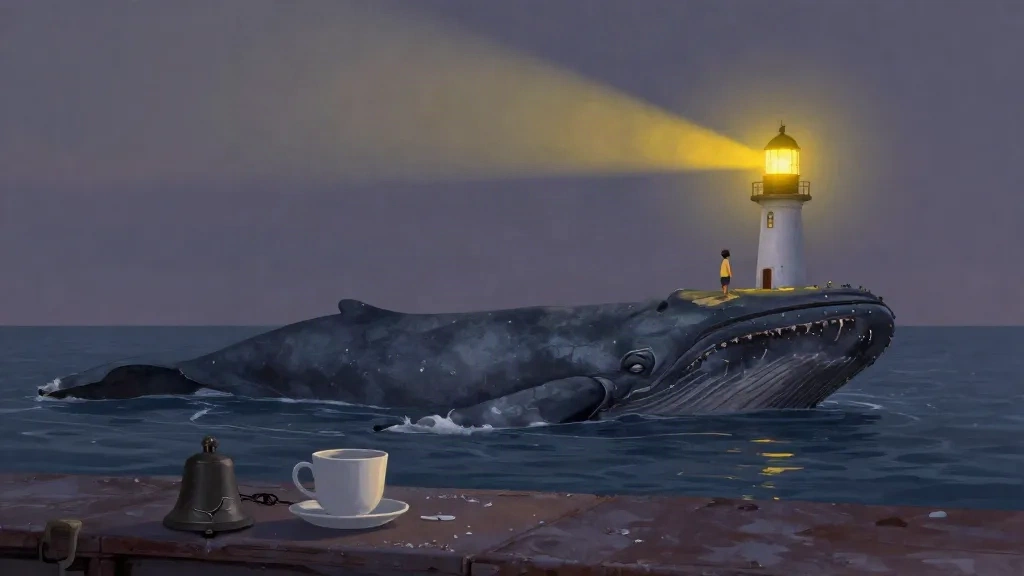
The lighthouse stood on the back of a mechanical whale, its lantern burning saffron yellow through smoke-grey air. The whale lay belly-down in the sea, enormous ribs rising beneath the copper roof like the hull of a ship sunk in slow motion. At night its metal eyelids opened, and the light searched the horizon for ships that no longer existed.
Amelia Vey was the librarian. She had inherited the post with the whale, the lighthouse, and one locked room. The room contained no furniture. On its floor sat an empty teacup, white inside and warm as if someone had just left it.
Every traveler who arrived by ferry asked for a book with a door inside it. Amelia gave them the same volume: The Residents of Unlisted Shores, bound in deep plum leather, with brass letters spelling a title no language could pronounce. Inside were descriptions of cities that floated above mountains, houses that remembered their former owners, and a small nation of transparent people who ate shadows.
“It is a guidebook,” Amelia explained.
“To where?”
“To a place that accepts your particular impossible resident.”
She said it because the desire had burned through her by then. She wanted a home where her own impossible resident could sit at the table without being mistaken for furniture.
The Child Under the Stairs
One morning the whale's ribs rang like a struck bell. A boy waited below the lighthouse stairs, wrapped in a raincoat stitched with scales. He pointed at the wall and said, “There is a man breathing through the bricks.”
Amelia looked. The bricks were damp, moss-green, unremarkable. The boy tapped twice. The wall inhaled.
“Everyone else sees nothing,” he said.
“Of course they do.”
“No. They agree not to see.”
He explained that the lighthouse had a cracked bell beneath its floor. It had been rung on the night the whale stopped moving, and everyone in the village had heard the same story: the bell cracked, the sea took a child, and nothing unusual remained.
Amelia had heard the story too. She had repeated it without thinking, as people repeat the names of dangerous things to make them smaller.
The boy opened his palm. A tiny glass fish turned between his fingers. “This is my sister,” he said. “She was born inside a storm. Father says storms cannot have daughters.”
Amelia took the book from behind her desk and lent it to him. The glass fish leapt from his hand into the plum-colored cover. On the page, a sentence appeared in wet black ink:
Bring the overlooked one to the whale's mouth.
The Agreement of the Water
They descended through the whale's spine. Brass pipes branched like ribs around them, carrying warm seawater and the smell of oiled machinery. At each junction, something invisible stepped aside. A woman with too many knees. A drowned dog wearing a human coat. A house folded into a bird.
All the village's agreed absences.
Amelia felt her own resident stir inside her chest. It had no face. It was a small gray weight, the thing that had followed her since childhood and made mirrors show a second outline. The whale's throat shone ahead, a vast iron mouth full of saffron darkness.
“If we show them,” the boy said, “will they stay?”
“No,” Amelia replied. “But we will.”
At the mouth she opened the book. The invisible things rushed toward its pages. The cracked bell began ringing beneath them, its broken note traveling through the whale. Above, the lighthouse lantern flared. Across the water, every window in the village lit at once.
The villagers came down with axes and nets, determined to repair what they had already repaired.
Amelia stepped into the whale's open mouth. The boy followed. The gray weight in her chest became warm.
A Residence in Plain Sight
By morning, the whale had sunk three feet lower into the sea. The lighthouse remained on its back, and the cracked bell had been replaced by a new one cast from pale iron.
Amelia opened a small home above the harbor. Its sign read: IMPOSSIBLE RESIDENTS WELCOME. The first tenant arrived before noon: a tide that insisted it had been born in a house.
The boy placed the glass fish on her empty teacup. It swam happily in air, impossible and plainly visible. Outside, the villagers argued about the bell. They disagreed on whether it had cracked, but no one denied its sound.
That, Amelia decided, was a good beginning.





