 Netwrck
Folk Horror.
The Book of Unregistered Nights
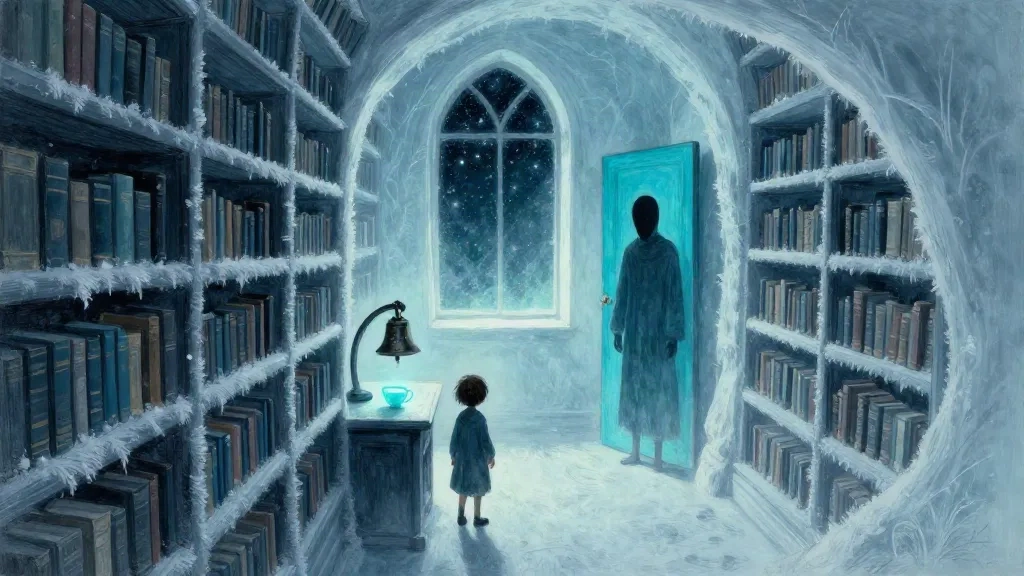
Mother Vale kept an empty teacup beside the catalog desk, though the monastery had no tea, no kitchen, and no garden. Frost silvered its rim each morning. She never washed it, and no one else dared move it.
The monastery had been carved into the comet when the saintly astronomers found a hollow in its tail. Its halls followed curves the builders could not explain. Doors opened onto rooms that were warm, gardens, or starfields. The iron bells along the cloister had cracked, yet every evening they sounded beneath the floor.
Vale was the librarian. She catalogued the starless books, the maps with no countries, and the parchments that changed when spoken aloud. Her shelves held fewer books than the monastery supposedly contained. That was permitted. What the monastery owned could not always bear being looked at.
Her desire was modest and exact: to find a home that would accept impossible residents.
She had been born aboard a freight ship between two ports that denied her name. Every settlement had a room for people who looked ordinary enough. Nobody had a room for her.
On the ninth frost, a woman came to the desk carrying a suitcase made of black stone. She wanted to borrow a place to sleep.
Vale brought out the same impossible book. It had no title. Its blue leather softened beneath her hands.
“This is the only room the monastery can give you,” she said. “On the page, you are already expected.”
The Child at the Door
The woman opened the book. Frost climbed out of its spine and silvered her eyelashes.
“Your room is north of the refectory,” Vale said.
The woman looked toward the passage beyond the desk. Her face had the stillness of someone hearing their own name spoken in a crowd.
“There is a room,” she whispered. “It has been there all along.”
That evening, a boy entered the library. He carried the cracked handbell from the cloister, though no one had rung it. He was perhaps eight years old, dressed in grey wool, and utterly unsurprised by the shelves that leaned away from him.
“You gave her the room,” he said.
“I lend books.”
“The bell is also a book.” He placed it on the desk. “It has that one.”
Vale understood at once. The monastery’s residents did not vanish. They were agreed away. Each impossible person was given a destination no one questioned.
The child rang the bell.
Sound travelled through the walls without returning. Frost gathered in the library. Books opened by themselves, spelling out names in a patient procession.
Vale caught the last one before the pages closed.
It was hers.
The Agreement of the Comet
They found the thing in the observatory, where a black corridor branched through the comet’s core. It had no stable shape. Sometimes it wore the dimensions of a person, sometimes a corridor, sometimes the empty cup on the catalog desk.
Everyone else saw only masonry.
“They agreed not to see me,” the child said.
“Who made the agreement?”
“Everyone who was afraid.”
The thing turned toward Vale. Its face, if it had one, was a room with the door shut.
“You have been lending me away,” it said.
Vale looked at the bell, the cup, and the blue book beneath her hands. The monastery had taught her to trust the person carrying the impossible thing. It had never taught her to trust the impossible thing itself.
“Then stop hiding in the room,” she said. “Come to the desk.”
The child held out the bell.
Vale took it and rang once.
The cracked note did not ask agreement. It travelled through the monastery, touching every hidden resident, every sealed chamber, every starless garden. The thing’s outline loosened. A door appeared in the observatory wall.
Beyond it lay a kitchen, small and warm, with a kettle beginning to boil.
Cataloguing the Dawn
Vale wrote a new entry before dawn. Her hand shook from the cold, but the ink remained clear.
ACCESSION: the place where no one is required to disappear.
LOCATION: not measured by walls.
CONDITION: occupied.
She placed the book beside the empty teacup. At once, steam rose from the cup. It smelled of bitter leaves and woodsmoke.
Outside, the comet turned through its ancient dark. Soft cyan light entered the cloister for the first time. It touched the cracked bell and turned the fracture gold.
The child drank from the cup and grimaced.
“Too weak,” he said.
“Everything here is stronger than it looks.”
At the far end of the library, the thing stood in a doorway. It had chosen a shape that did not resemble fear. A broad shoulder, two steady hands, and a face no longer hidden behind a shut door.
Vale opened the book again.
This time, she did not lend it away. She wrote a new page: HOME, ACCEPTED.
The room did not close.
And beyond the monastery walls, the comet kept its impossible dawn.





