 Netwrck
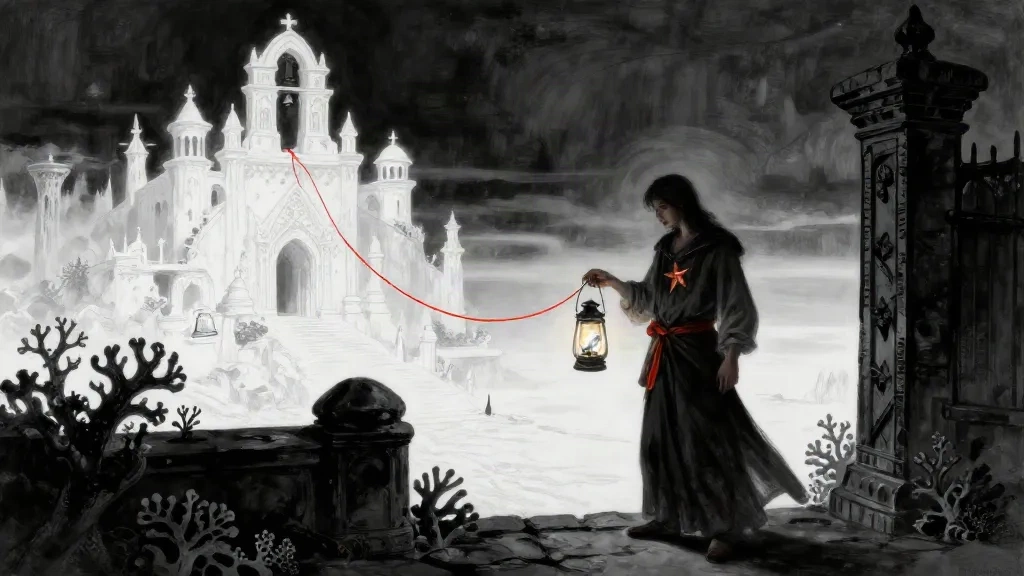
Gothic Fantasy.
The Monastery Without Morning
At the monastery of clockmakers, the bells were kept beneath the floor because the country had stopped trusting them.
Mara Venn arrived with a lantern in one hand and a copper star sewn inside her coat. The star had belonged to the last person who crossed the eastern border without surrendering what she carried. Its points were blunt from being clutched too tightly, and beneath the white coral stains on her fingers it shone with the dull patience of old weather.
The monastery stood on a cliff above a country of unnamed hours. Doors opened at dusk, roads changed direction after rain, and rivers sometimes froze only after a traveler had crossed them. Inside the monastery, clockmakers repaired mechanisms whose purpose had been forgotten. Some counted backward. Some counted breaths. One measured the distance between two people who had stopped speaking.
“You will need a lantern,” said the prioress, Sister Anja, “if you mean to take the lower road.”
Mara lifted the lantern. Its glass bird had not flown since she found it inside a dead woman’s coat, wings sealed with red thread.
“I mean to cross the border.”
“Everyone means that. The border asks what you are willing to leave behind.”
Mara did not answer. Beneath her coat, the copper star pressed against her ribs. She had carried it through salt marshes, black forests, and a village that burned its own maps every dawn. At the border checkpoint, she intended to place it on the inspection table, declare it a mere ornament, and walk away before anyone could see the name engraved on its reverse.
The Bell That Refused to Be Silent
That night, the bell rang.
It came from beneath the monastery, a single iron note that traveled through the floor and into Mara’s lantern. The glass bird trembled. Its red-thread wings loosened by one careful stitch.
“No one called it,” said Brother Cassian.
He had been sorting broken clocks in the western gallery, his sleeves powdered with white coral dust. He listened with his head tilted toward the stone.
“It rings for decisions,” Mara said.
“Not decisions made aloud.” The prioress stood in the doorway, her black habit stitched with white coral branches. “It rings for the ones we pretend were inevitable.”
They descended through three locked galleries to the lowest chamber. There, beneath a circular iron plate, hung a bell no larger than a child’s skull. Red thread had been wound around its clapper, loop after loop, so tightly that the metal looked wounded.
Mara touched the thread. The bell rang again.
Somewhere above them, a clock began striking thirteen.
“That is not possible,” Brother Cassian said.
“It is possible here.” Sister Anja pointed to a copper star cut into the chamber wall. “The border was drawn by someone who wanted the country divided by decisions no one would confess to making.”
Mara looked at the star. It was not the same as hers. This one had six points, each marked with a tiny gate.
Her lantern suddenly went dark. In the blackness, the glass bird spoke with the voice of the dead woman.
“They will ask for the star,” it said. “Give them the lie that keeps your name.”
What the Lantern Revealed
At dawn, the lower road was sealed.
Beyond the monastery gate, the cliff path had vanished beneath a white tide. Coral branches reached from the fog, each holding a small clock with no hands. At the horizon, a red thread stretched from one dark tower to another, marking the border that now floated above the sea.
The checkpoint officials arrived before noon. Their uniforms were black and white, their faces smooth as unlit windows. The chief inspector carried a glass case lined with red velvet.
“You carry a relic,” he said.
“A star.”
“Stars are not recognized at the border.”
Mara set her lantern on the table. The flame inside was not orange. It was white coral, burning without heat. When the light touched the copper star beneath her coat, the hidden name appeared: Elian Venn.
Her father’s name.
He had been the cartographer who drew the border. He had also erased the villages inside it, declaring them uninhabited so the army could pass without witnesses. The country had spent decades forgetting a crime it had agreed not to name.
The inspector opened the case. “The relic may cross if you surrender its history.”
Mara understood then what the bell had heard. The border did not want the star. It wanted her to decide whether to preserve the evidence of her father’s guilt, or escape with the only proof that her mother had existed.
The glass bird lifted from the lantern. Red thread trailed from its wings and drew itself across the inspection table, dividing the star from the flame.
“Choose,” said the inspector.
Mara picked up the star. The bell began ringing beneath the cliff, beneath the tide, beneath every road that had forgotten where it led.
A Border Drawn in Red
She did not surrender the star.
She opened its small reverse compartment and removed the folded map hidden inside. The map showed the border as it had been before her father drew it: a thin red thread passing through living villages.
Mara placed it in the glass case.
“This crosses,” she said. “The star stays with me.”
The inspector smiled. “Then the relic is contraband.”
“No,” said Sister Anja from the monastery gate. “It is testimony.”
The bell rang.
This time, every clock in the monastery rang with it. The officials reached for their weapons, but the fog lifted first. The coral branches cracked, releasing the handless clocks into the air. Their invisible hands began moving, not toward a fixed hour, but toward the hour when the border was drawn.
White coral covered the road. Red thread crossed every surface: across the dead sea, over the towers, through the windows of the checkpoint, and finally through the inspector’s gloved hand.
He released the case.
Mara stepped toward the border. The copper star remained warm against her chest. The glass bird settled on her shoulder, still unfinished, its thread trailing like a path that did not promise safety.
Behind her, the bell stopped.
Ahead, the road was impossible to read, but it was there. Mara lifted her lantern and walked across the line without becoming smaller.





