 Netwrck
Fantasy.
The Path Under the Third Stair
At violet dusk, Mara lit the staircase nobody used.
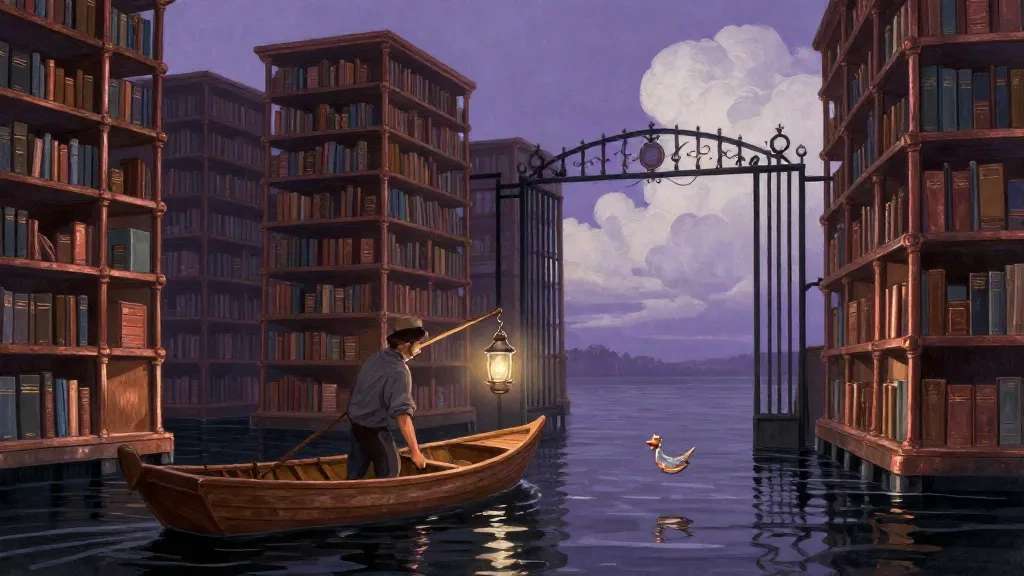
The flooded archive stretched shelf to shelf beneath a cloud-white ceiling, its drowned corridors deep enough to swallow a standing librarian. They crossed them in narrow boats, poling between ledgers swollen like bladderfruit. Above the water, labels survived on brass rails: LAWS BORROWED, NAMES IN ARREARS, PLACES THAT CLOSED THEIR DOORS. None described the stair Mara had found beneath the east stacks.
She was a lantern maker. Her lamps revealed difficult things: cracks that had swallowed travelers, flooded rooms whose doors faced inward, paths abandoned because every map had smoothed them away. People paid her to illuminate places they wished did not exist.
Her own father had crossed the third stair carrying a copper star in one hand and a glass bird in the other. The star had been hers. The bird had been her mother’s. He returned without either object and with no memory of Mara. The border had kept the stars, the bird, and, somehow, her father’s acknowledgment of her.
On the seventh evening, Mara carried both relics down the hidden steps in a waxed case beneath her lantern. She intended to cross the border and recover the name the archive had taken from him.
A Bell for Every Private Choice
The water at the landing was perfectly still.
A librarian waited there in a boat trimmed with tarnished wire. She was old enough to have been useful once and sharp enough to remain dangerous. “That lamp,” she said, pointing to Mara’s lantern. “Who chose it?”
“I did.”
The bell sounded beneath the water.
It was no larger than a fist and hung inside an iron cage between the landing and the far shore. Its note rose through the flooded stairs, making every brass label shiver. Mara knew its rule from forbidden trade manuals. The bell rang for decisions no one admitted making.
“I found the path,” the librarian said. “I decided not to report it. Then I moved the stones that covered it. The bell remembered the denial as the decision.”
“It rang before I spoke.”
“It rang when you decided to tell me the truth.”
Mara shut the case. “I only said I found the path.”
The librarian’s mouth thinned. “You chose to say only that.”
Across the channel, the border waited: seven iron posts rising from black water, each fitted with a hand-shaped latch. At dusk, they opened a narrow passage. The guards allowed departing scholars to carry documents, tools, and declarations. Everything else became archive property.
Mara had already surrendered her license. At the third post, the guard raised a hand.
“Open the case.”
The Weight of Open Hands
Inside the lantern, the wick burned blue. The glass bird caught its light, cloud white around a copper-colored heart. The star weighed almost nothing, but when Mara touched it, the bell rang again.
“Leave the relics,” the border guard said. “You may keep the lamp.”
That was the bargain offered to every fool who mistook admission for surrender. He would keep the small light and take the things that had carried its meaning across the water.
Mara closed her fingers around both objects. The old librarian leaned forward.
“The bell,” she said, “does not punish desire. It recognizes the instant your purpose changes. If you meant only to cross, the relics might pass. If you mean to use what you carry to restore what was taken, the border will call that theft.”
Mara understood then. The archive’s silence had not been protection. It had been a decision renewed every day: a name removed, a question unanswered, a daughter made to doubt her own place.
The guard reached for the wick.
“I will not give them up,” Mara said. The bell struck again, violent enough to send ripples against the iron posts. “But I won’t lie about why I carry them.”
She stepped from the boat and up the sloping stair. Guards shouted behind her. At the seventh post, the latches snapped inward, not to restrain her but to receive her hands. The iron burned cold.
A Name the Water Remembered
Beyond the border lay no road, only a reed marsh under violet dusk. The copper star reflected clouds. The glass bird turned once in Mara’s palm and opened its beak.
A single word came out, faint and bright.
“Mara.”
Not the name the archive had taken. Hers.
Then another voice traveled over the dark water, roughened by years but unmistakable. Her father’s.
He stood far down the channel in the old librarian’s boat, copper star balanced on his palm. He had chosen his silence too, and the archive had used that choice to erase him from himself.
He could not cross until he admitted what he had done.
So Mara lifted the glass bird. “Keep the star,” she called. “I’m carrying this.”
Her father held out his hand. The border struck once, ringing the marsh, shelves, and drowned city with a sound like every unfinished sentence finally finding its verb.
Then he took the bird.
Mara kept the lantern.
They had not surrendered what they carried. They had stopped letting the river carry it for them.





