 Netwrck
Science Fiction.
The Water Between Names
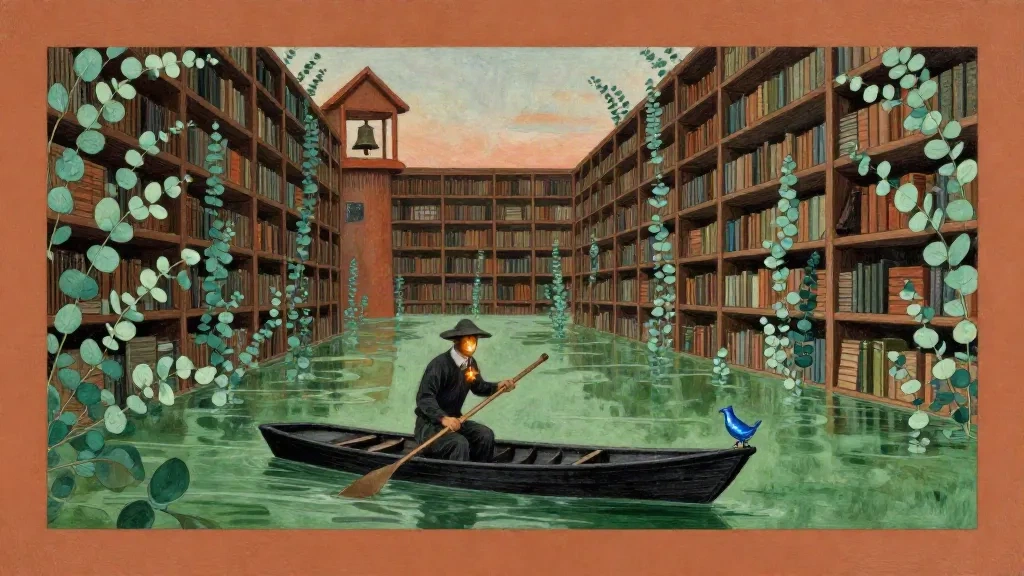
The archive had drowned slowly, one sentence at a time. Its lowest shelves stood in green water, their spines softened to paste, while librarians rowed between the stacks in narrow black skiffs. They carried wax tablets, reed pens, and brass lamps shaped like cupped hands. No one walked. The floor had become a rumor.
At the eastern stair, beneath a canopy of eucalyptus branches lashed to the ceiling, Mara repaired lanterns for passage. Her lanterns did not brighten the shelves. They illuminated the paths people avoided: the aisle where a drowned clerk had hidden his appointment book, the corridor where a historian refused to count the missing, the turning whose water remained warm after midnight. Travelers paid in memories they could spare. Some brought names. Others brought the childhood scent of bread.
Mara needed less than a memory. She needed the border permit sealed in the bell chamber beyond the archive's last aisle.
What the Bell Remembered
The permit required surrender. At the crossing, every object carried without a legal inscription would be placed in the Bell Chamber and returned only if the official recognized its story as true. Mara's copper star hung beneath her collar. Its point had been filed smooth by her mother's thumb. Her pocket held a glass bird, blue as a bruise, one wing cracked and sealed with clear resin. She had carried them through three provinces, two wars, and the night the water entered the archive.
At the eastern stair, an old librarian poled his skiff beside her.
You are going to ask for passage without surrender,
he said.
“I am.”
“The border hears only what it is given.”
“The border is made of water,” Mara said. “Water can carry something without swallowing it.”
He looked toward the shelves. Somewhere below them, a bell rang once.
No hand had touched it. The sound traveled through the water and came back as a question.
By dusk, the whole archive had begun to ring. Once for the clerk who had hidden the appointment book. Once for the historian who had renamed the missing. Once for every decision no one admitted making.
The Choice Under the Floor
Mara rowed toward the sound. The librarians turned their lamps away. They did not stop her. At the crossing, the Bell Chamber rose from the water: a terracotta tower with an open belfry and a black tide beneath it. A border official sat on the steps, wearing a coat the color of bruised fruit.
“Empty your hands,” he said.
Mara lifted the copper star. “This is a direction.”
“Directions are property.”
“It was given to me.”
“Gifts are claims.”
She placed the glass bird on the stone between them. “This is a mistake.”
The official's hand stopped above it. The bell struck again, close enough to shake water from the eaves.
“Everyone says that,” he said.
“Then the border is built from decisions disguised as facts.”
Inside the tower, the bell began ringing without pause. Mara understood then that it had never rung for her crossing. It rang whenever someone surrendered to an easier name: lost, stolen, foreign, unrecorded. It rang for the clerk who had called concealment prudence. It rang for the historian who had called omission mercy.
She drew the resin from the bird's cracked wing.
The bell stopped.
A Border That Could Float
Inside the bird was a small folded map. Mara had made it herself, years ago, from the flood marks on the archive walls. It showed a passage through the drowned stacks, then a narrow channel beyond the border tower. No official had ever seen it because every official had demanded that she explain it before allowing her to keep it.
“You carried an unrecorded map,” he said.
“I carried an unrecorded way.”
He looked at the copper star. Its brass caught the eucalyptus light and scattered tiny red sparks across the water. Then he looked at the glass bird, whole-winged now only in reflection.
“Crossing without surrender is not permitted,” he said.
“Neither is crossing without knowing what you carry.”
He placed the permit on the stone. The paper changed as the water touched it: a pass, a confession, a contract, a blank sheet. Mara took it. Behind her, the archive bells began ringing in separate towers, each one admitting a choice no one had named.
At dawn she rowed through the hidden channel, lantern in the bow, the copper star beneath her collar and the glass bird upright on the prow. The border officials watched from the terracotta steps. They did not ask what she had surrendered. They could no longer remember deciding to.
By the time Mara reached the far shore, the bell was silent. She set the glass bird among the reeds. Its repaired wing opened toward the bruised-fruit sky, and the copper star reflected once in its body: not a claim, not a verdict, but a direction belonging to whoever carried it next.





