 Netwrck
Mystery.
The Courtyard That Refused a Seed
Mara Venn carried a silver trowel and a notebook full of abandoned things. Her work was municipal and strangely tender: find the courtyards the city had stopped visiting, loosen their soil, and plant a story.
Stories needed roots, she had learned. A lost child’s red scarf, a baker’s unpaid debt, a woman who waited beside the tram tracks every winter. Give the seed water and a name, and strangers would begin remembering one another.
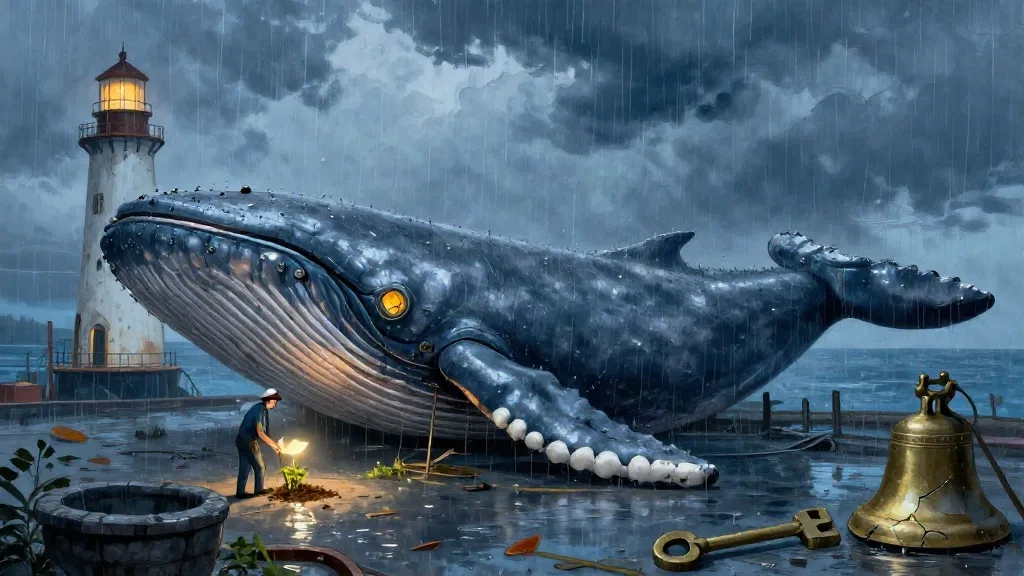
On the back of a sleeping mechanical whale, in a courtyard sealed by salt and municipal neglect, she found a stone basin filled with black rain. Beside it rested a cracked bell and a brass key polished by decades of useless hands.
Mara’s own family story lived in her coat pocket. Her mother had left a lighthouse at the age of nine, carrying a brass key and promising to return before the sea froze. She never did. The whale had carried the lighthouse on its broad metal back for three hundred years, waiting for a story large enough to open it.
The Machine That Doubted
At dusk Mara planted the story beneath the basin. She spoke the facts her mother had given her, then added the truths she had invented to survive their absence: the key opened a shelter, not a door; the bell warned the lost rather than calling them home.
The ground opened. A narrow stair descended into the whale’s body, where brass pipes trembled like ribs. At the bottom stood a machine with a glass dome and a single lever. A label read: THE HOUSE OF STRANGERS REQUIRES NO BELIEF.
Under the label, smaller letters had been scratched away. Mara held the brass key to the light. The machine spoke without a mouth.
“One witness prevents operation,” it said.
So she tried believing. She believed the shelter would work. The glass dome clouded.
She tried doubting. The machine brightened.
Beyond the whale’s metal skin, footsteps crossed the courtyard. Someone had followed her.
At the top of the stair stood a girl in a rain-dark coat, holding the cracked bell. She rang it once. The sound did not echo; it disappeared.
“My mother said this place could feed everyone,” the girl said. “I told the keeper it worked. Then the lights went out.”
The Keeper’s Bargain
Mara understood. The machine built only what no one admitted was real. Believers brought inspection, comfort, and certainty. Doubters brought no protection, so the shelter had to become something more durable than trust.
She took the key from the girl.
“If I use it, everyone will believe I am a saint,” Mara said.
“If you don’t, everyone will believe you are a thief.”
“Yes.”
“Then neither of us should use it.”
They climbed into the whale’s control chamber. Pipes crossed the walls in ink-blue bands, silver with rain. At the center, a wheel had been welded shut. Mara cut the lock with the brass key, though the key had been made for a door that no longer existed.
The machine spoke. “Doubt is not absence. Doubt is a place where responsibility begins.”
She turned the wheel. The lighthouse above them awakened, not as a beacon, but as a shelter. Its lamp projected rooms onto the wet streets: beds, tables, a warm amber window in every distant courtyard. The bell cracked but held. The whale’s engines sighed beneath the floor.
People arrived carrying their own stories. No one asked who deserved entry. No one asked whether the shelter was real. They brought strangers inside and began the work of making room.
The Window That Stayed Warm
By morning, the city had noticed the light. Officials came with forms. Reporters came with questions. Believers came with certainty, and the shelter’s walls began to thin.
Mara stood before the crowd and told them the whale was sleeping, the machine was broken, and the rooms might vanish by noon. She said the family story was a seed, not proof. She said the shelter could survive only if every person inside took responsibility for someone they did not know.
That was easier to deny than to obey.
But the girl rang the cracked bell, and the sound traveled through every courtyard. By evening, strangers were carrying bread, blankets, and names.
The whale opened one amber eye. Its lighthouse turned toward the black horizon, where no rescue ship appeared. Mara watched from the warm window and finally understood the promise her mother had carried: not that she would return, but that someone would keep a place for those who had not yet found the way home.





