 Netwrck
Fairy-Tale Fiction.
The Bell at the Observatory
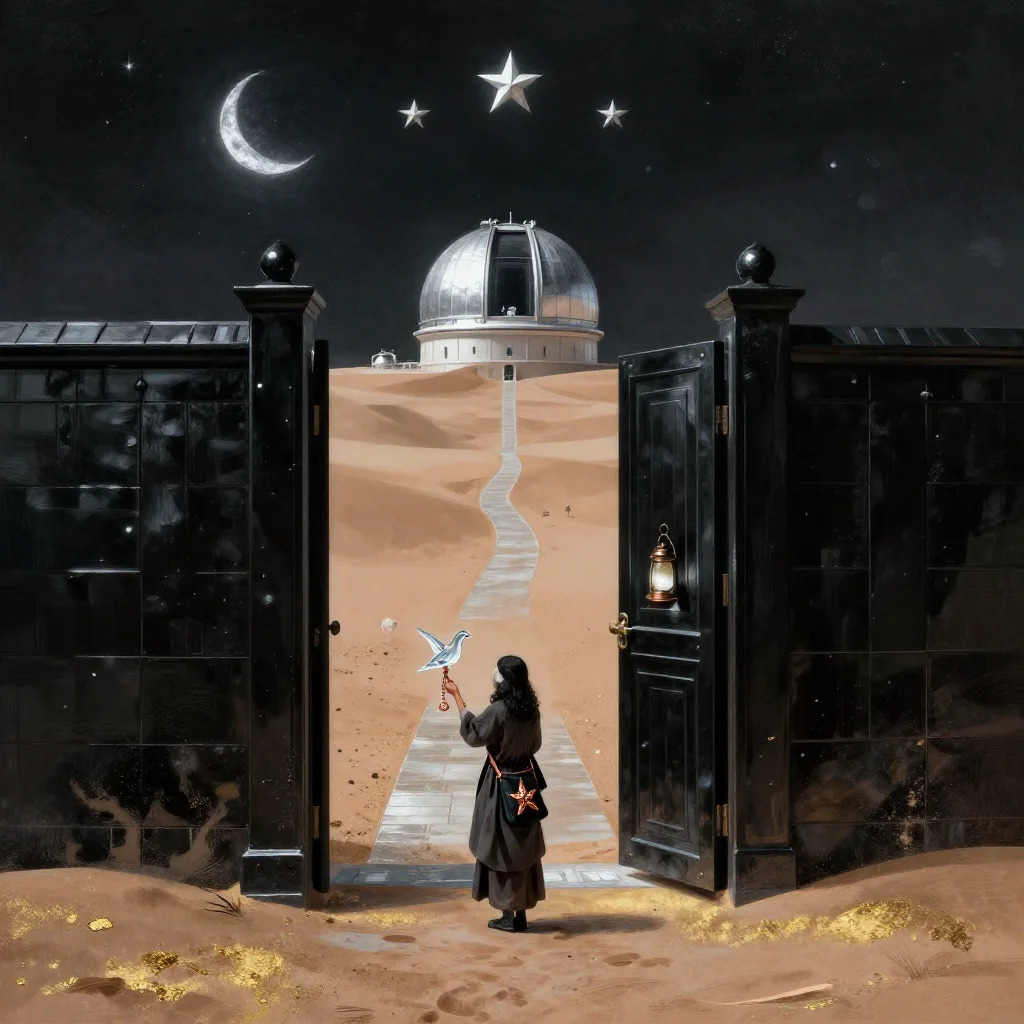
At the edge of the desert stood an observatory shaped like a broken sundial, its black lacquer walls polished by wind until they reflected the cold moonlight in long, silver seams.
Its astronomer had gone years ago. Still, every night the telescope turned by itself toward the dark, and every morning three stars appeared in the eastern sky, arranged like nails driven into a black board.
The stars sent messages. Not words, exactly. They sent arrangements: a cup beside a door, a road with no moon above it, a small bird descending toward a red line in the sand.
That was where the lantern maker found herself, carrying a glass bird beneath her coat and a copper star sewn into the lining of her satchel. She had made both things. The star was for the astronomer who had taught her to polish brass. The bird was for her mother, who had died before the border closed.
Her name was Sera, and she wanted to cross the western line without surrendering what she carried.
The Border Made of Wind
Beyond the observatory, the desert narrowed into a corridor of pale sand. At its far end stood the border fence, tall enough to divide the sky.
The guards had orders to search every satchel. They would take anything that shone, anything that flew, anything whose purpose could be named.
Sera had therefore hidden the bird inside her coat and the star inside the satchel. She intended to walk with the messages in plain sight and keep the true offerings close.
Before she reached the fence, she passed a low stone building. Its door stood open. Inside, a bronze bell hung from the rafters.
The bell was silent.
Sera looked at it. The smallest star in the eastern sky had shifted since dawn.
She entered. The bell gave a single, clear note.
Behind her, a guard called, “Declare what you are carrying.”
Sera said, “Nothing.”
The bell rang.
Its sound passed through the walls and into the desert. Sand lifted in a narrow line, pointing toward the border. The guard advanced.
“Then I will search you.”
What the Stars Refused to Hide
Sera ran.
She crossed the courtyard, passed the broken sundial, and reached the fence. The desert wind had erased the road behind her, but the copper star burned against the lining of her satchel.
The border guards opened the gate. Their captain wore a black lacquered helmet dusted with gold.
“Leave the bird,” he said. “Glass crosses more easily than memory.”
For a moment, Sera believed he knew about the offering. Then she saw the reflection in his visor: a glass bird, wings folded, held in a woman’s hidden hand.
He had not seen it. He had only seen what he expected to find.
“I made it for my mother,” Sera said.
The bell rang again, nearer than before.
The captain touched the gate. The three message stars appeared above it, their light falling on the sand. A cup. A door. A road without a moon.
Sera understood at last that the observatory was not asking where she had come from. It was asking whether she would leave her mother behind in order to be free.
She placed the glass bird on the black stone rail.
The captain lifted his hand to take it. Then the bird opened its wings. They were clear as winter air, and inside them the cold moonlight gathered into the shape of a path.
The path crossed the border.
The Choice That Rings
“You were not meant to surrender it,” Sera said. “You were meant to carry it across.”
She took the bird in both hands. Its glass body was cold, but the heartbeat inside it was steady.
Then the bell rang for the third time.
The sound was not above her now. It was inside the copper star.
The astronomer had hidden one final message there, not in the sky, but in the metal she had trusted enough to keep. The border could not take the star. It could not take the bird. It could only take the decision to become neither a daughter who stayed nor a fugitive who ran.
Sera stepped through the gate.
The captain let her pass.
Behind her, the observatory’s black walls fell silent. The desert closed over the road, and the stars sank one by one.
Far beyond the border, Sera found a small house with a roof repaired in gold dust. She placed the glass bird on the sill and set the copper star beside it.
In the morning, the bird flew once around the house, and the star shone in the window.
It was then that she understood why the bell had waited for her. It had not been ringing for a secret. It had been ringing for the moment she stopped hiding one.
Every road forward, she knew, would ask for something. She would carry the bird, and the memory of the bell, and the sound of her own unborrowed choice.
That was enough light to take the next step.





