 Netwrck
Historical Fantasy.
The Book of Arrivals
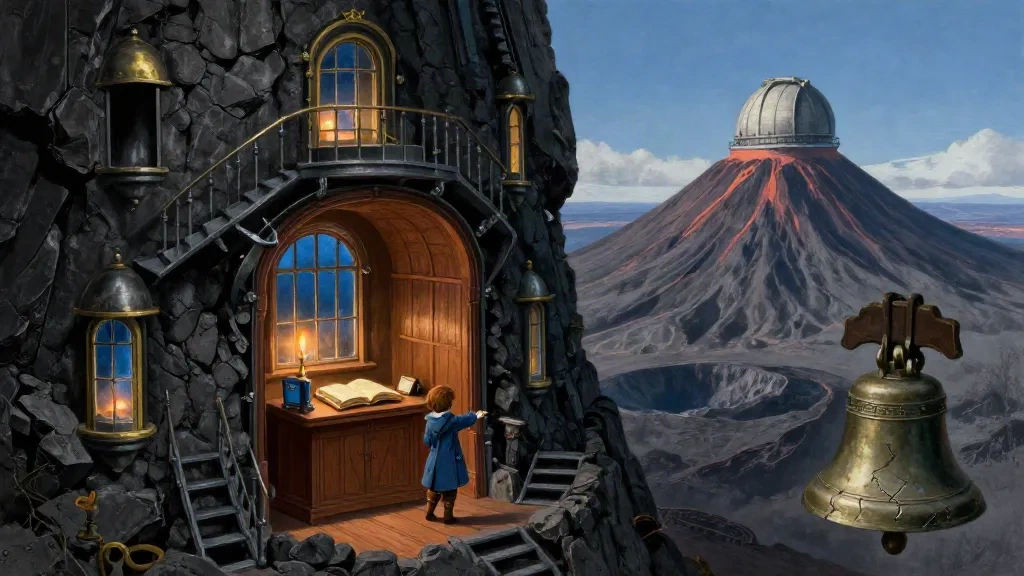
By the winter of 1873, the Ashfall Observatory had become a refuge for people the mainland had no room for. It was cut into the north wall of Mount Sere, a volcano sleeping beneath nine hundred fathoms of old stone. Iron stairs wound through its chambers, and brass instruments pointed toward a sky tinted steel blue by the endless ash.
Elian Vey kept the observatory’s library. The room smelled of tobacco, cedar, and the mineral cold that seeped from the walls. Above the desk waited an empty teacup, polished each morning though no one drank from it. Beside the western door hung a cracked bell, mute since the last eruption.
Every traveler who came to Elian asked for a book. He gave them the same one: a small blue volume bound in goatskin, its title written in letters that rearranged themselves when read aloud. The book contained the names of places that had vanished from every map.
“You cannot lend this to everyone,” his assistant had once said.
“That is why I do,” Elian replied. “A book that belongs to one person is only a possession.”
He wanted a home that accepted impossible residents: giants, ghosts, children with antlers, women whose shadows walked separately from their bodies. He did not care whether the world believed in them. He cared that they had somewhere to arrive.
The Child and the Missing Stair
The child came during the first thaw, carried by a woman who had walked from the lower village without speaking. The child was perhaps seven, dressed in a coat sewn with blue thread. She asked for the blue book.
Elian gave it to her. She opened it and immediately pointed beneath the floorboards.
“There is a stair there.”
Elian looked where she indicated. He saw only packed ash, a warped board, and the dark seam where the wall met the floor. Yet the child pulled away a small brass pin, and the board lifted.
Cold air rose from the opening. It smelled of candle smoke and wet iron.
Beyond the hidden stair was a passage no chart had recorded. Its walls were lined with doors. Behind one door came the clatter of dishes. Behind another came the lowing of cattle. Behind a third came a voice reciting names in a language Elian knew from the book.
“They are there,” the child said. “You can hear them.”
Then she looked upward. “And you can see the thing everybody agreed not to see.”
The Agreement of the Mountain
That night Elian climbed to the crater chamber. The cracked bell lay on the floor beneath a shaft of reflected candlelight. The mountain had a pulse, slow and immense, though no instrument recorded it. The pulse matched the turning of the book’s pages in Elian’s hands.
On the wall, scratched beneath centuries of soot, he found a declaration. Every generation had renewed it in a different hand. The observatory was to remain a refuge, but only so long as no one named what slept below.
The rule kept the doors closed. It also kept the residents unseen. Elian understood then that the mountain’s hospitality depended upon forgetting. The impossible people had been made safe by becoming absent.
He cut the bell with a miner’s chisel. The crack split wider, and a single note rolled through the chamber. It sounded like a kettle in a distant kitchen, a child calling from a field, a bell calling the dead by their childhood names.
Every hidden door opened at once.
The residents came up into the library. They filled it without crowding, because they knew how to share a room. A tall man folded himself beside the shelves. A translucent woman sat in the empty teacup’s reflection. Small antlered children peeked from behind the globe. They smelled of snow, tobacco, candle wax, and rain.
A Name for the Mountain
By dawn, the woman with the blue-thread coat was gone. The child remained, asleep beneath the desk with the book open on her knees.
Elian stood before the assembled residents and read the final line of the declaration aloud: “Let no arrival become a destination.”
He tore out the page.
“Then we make our own,” he said.
The cracked bell could not be mended, but it no longer needed to be. Its imperfect voice gave every impossible resident a warning and a welcome. At noon, the volcano stirred without erupting. A blue light rose from the crater, reflected in the glass instruments and the brass stair rails.
Years later, travelers still climbed to Ashfall. They came seeking books, food, or absolution. Elian lent them the blue volume when they asked, though the volume had grown many pages by then. Each borrower wrote a new name inside.
The child opened the first observatory, the one that had been hidden beneath the floor, and named it Home.
Outside, the sleeping mountain kept its secret. Inside, candlelight moved across steel-blue shadows, and the empty teacup held the warm reflection of a place no map had ever contained.





