 Netwrck
Speculative Fiction.
The Seed’s Winter
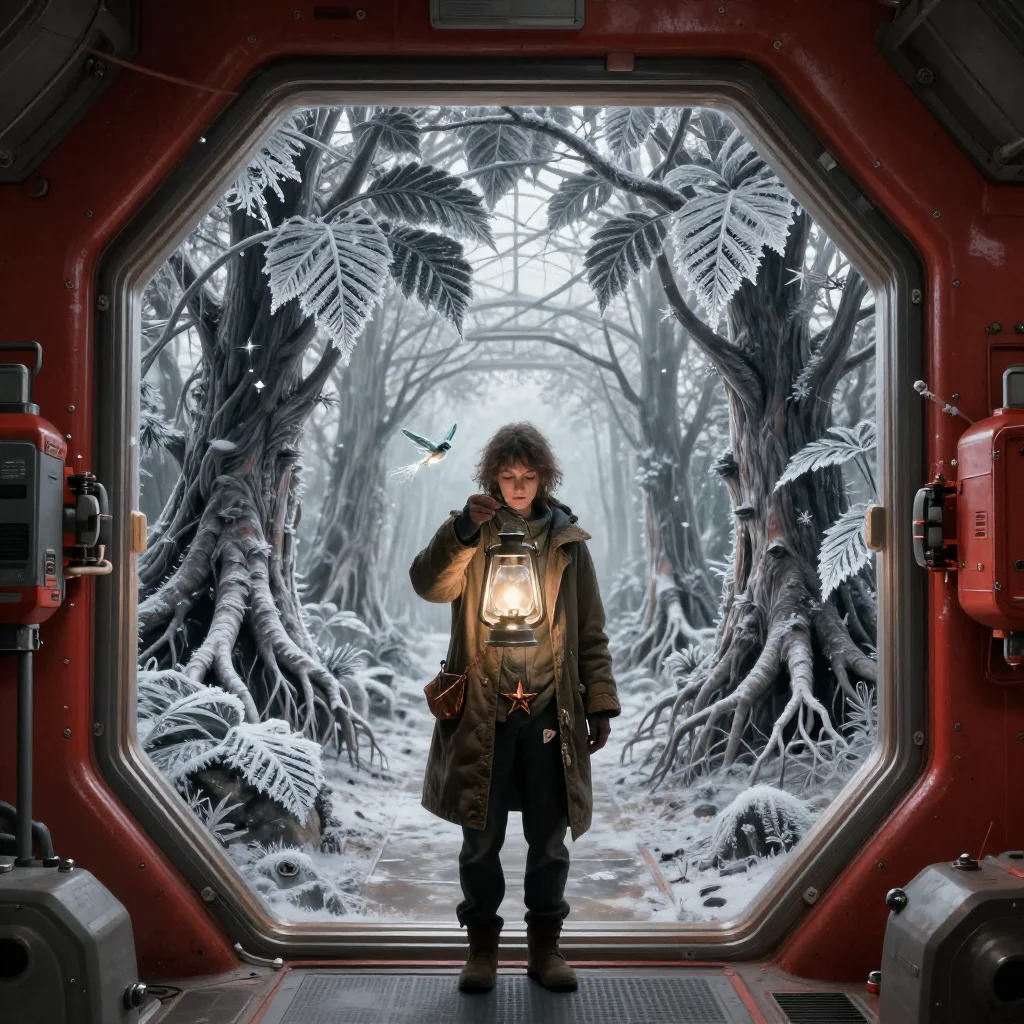
Mara entered the border archive carrying a lantern made from six panes of smoky glass and a copper star that had belonged to her mother. Beneath her coat the star pressed cold against her ribs, one arm of it flattened where her mother’s grip had closed on it for thirty years. In the other pocket lay a glass bird no larger than her thumb.
Above the orbital greenhouse, the seed turned against a pale sun. Its roots held the memory of forests that had burned, drowned, or been ploughed beneath cities on worlds nobody now governed. Each winter it released their vanished light through frost-rimed leaves, a slow leaking of the past that the horticulturists logged as phenology and Mara, at three in the morning on her worst nights, called haunting.
She had a permit to cultivate the eastern beds and nothing permitting her to cross into the seed’s protected hemisphere. What she had instead was a trade, and the trade was this: she made lanterns, and she drew the tunnels.
The lit tunnels were the station’s bones — irrigation, power, the tram spine, the hydroponics ladder. Their routes were painted yellow, and there was no shame in them. The dark tunnels were the ones the maps did not name, where the heat failed two seasons running and the walls wept a mineral smell like coins held in the mouth.
She drew the safe ones. People learned to trust the difference, which meant people came to her.
Request slips accumulated on a board outside her workshop under the maintenance ring. Two panes, please, my daughter walks the long way. One pane, I pay Friday. Do you still make them small.
Do you still make them small. Seno had been small. She had blown a three-pane lamp for him, and he had scratched his own name on the frame because he was sixteen and believed that this was what tools were for. She still had it. It sat under her bench with the wick trimmed and the glass unlit, waiting out a repair that had nothing to fix.
Her mother’s name was Vesna. She had gone into the locked hemisphere in the twelfth-season failure to survey a root chamber, and she had not come back, and the rolls had retired her name, and the archive had classified the loss as station failure, which was a phrase that meant we did not look.
Seno Vart, apprentice maintenance, sixteen, had gone into the same district in the same season. He had gone in carrying a map Mara had drawn at twenty-two, when she still believed a map was a promise.
The Case of Bells
At the border she showed her papers. The inspector was a narrow man with ink on the second knuckle of his right hand and an old lamp burn along the inside of his wrist that he did not offer to explain. His name was Ansel Mirek and he had held the post for eleven years, long enough to know everyone and short enough to still be surprised by them.
“Twelve years,” he said, reading her cultivation permit. “You filed a request for the eastern ladder twice and withdrew it once. Why the withdrawal.”
“The ladder was lit. I did not need it.”
“Everybody needs something. The question is whether you can admit which.”
Behind his shoulder, in a case lined with black felt, sat the bells.
She had heard of them and had never seen them. Not one bell but perhaps sixty, each the size of a plum, each on a short brass chain above a small engraved tag. Mirek said the case predated his post by a century. They were not alarms. They were instruments, struck by the intake clerk when a declaration was made, and each one was tuned to a different species of consent: a bell for property surrendered freely, a bell for a debt admitted before it was due, a bell for a person named aloud, a bell for a claim of need, a bell for the release of a lamp into a border locker.
He did not open the case. “It is not a cheerful instrument. People arrive already apologising.”
“Is that useful to you?”
“It is honest. Apology always arrives before the declaration. Apology is what we can put on the form.”
He wrote her name into the register and the pen made a dry, deliberate sound.
“The third corridor,” he said. “The maintenance spur past the root chamber. It appears on four maps in the light-tunnel archive. One of them is signed.”
“It was a survey.”
“It was signed. It was true that week. A boy went down it, and the station recorded no expedition, because an expedition requires a district, and a district requires a name, and the third corridor was not a district. It was a space between two lamps.” He closed the register. “The roll for that season is not damaged. It was never made.”
“Which lamp are you carrying across?”
“None. This one is for the tunnels.”
“Where have you taken this one?”
“Through the border.”
“Then you are carrying it across.”
She touched the copper star through her coat. “This one. And the bird. Declare the lamp, take the lantern in the locker, strike the bell for property, and I cross holding two things and the form says two and I am a woman who has paid her way in.”
“It is a reasonable offer.”
“It is a convenient one.”
“There is no such thing as an inconvenient truth at this desk. There is only a form.” He drew out a blank sheet. Across its head was the seal of the hemisphere: a seed inside a circle, its roots drawn downward into a small closed lock. “Write what you say you brought, and I have to act on the difference. Do you understand that you are not being honest? You are making me responsible for your honesty. I am not permitted to accept a thing that has no form.”
“Then give me the form for it.”
“There is no form. If there were a form, it would not be a problem.”
The Bell for Unspoken Choices
She set the glass bird on the counter.
“The bird was blown by my father in the shop under the horticultural arcade, for the dedication of the seed. My mother carried it. When her effects were forwarded, the bird came back with its wing scorched on the side that faced the hemisphere. The paint is decoration. The body is a capsule, and the capsule holds seed stock from before the burn, from a world that had already forgotten its own name.”
“You have known that for eleven years.”
“I have known it for eleven years. I have never declared it.”
“I have asked.”
“You have never once asked.”
“No,” Mirek said. “That is the second of my failures in this booth.”
He opened the felt. The bell for declarations no one admits making was the smallest of the case, no larger than a thumbnail, silver, with a hairline crack running through its shoulder. He struck it with a glass rod, the way a man tests a coin. It made no louder sound than a thumbnail striking porcelain, and every pane in the booth shivered, and the felt dented inward as though something had leaned on it from below.
“That bell answers decisions no one admits making,” he said.
“Then you know I decided to cross.”
“A decision is not an admission.”
“No. It is worse. It is an admission with the fingerprints left off.”
“Twelve years of maps, Mara. Twelve years of the safe route, the safe route, the safe route, and then one week in the twelfth season when you drew the third corridor open because a boy asked you for a map that went where the lights did not. You did not draw it to send him. You drew it because you were tired of the safe ones. He took it anyway. And you have spent every winter since making lamps for people who would be alive if you had been boring.”
“That is not true.”
“No. It is not.” He set the rod down. “You may object to the record, and the record may continue. Those are the two facts available to you. Now. One object.”
She looked at the star, at the bird, at the root drawn into its small lock.
“No,” she said. “I have not surrendered either.”
The Lantern Stays
Mirek took a map from the drawer and drew a line in thin ink. Three hours through the root chambers where the irrigation had failed, past a district the station maps still called Forest 4, though only the seed remembered trees.
“The lantern stays,” he said. “At the far gate you may take one object. It goes into the store, it is catalogued, and you are one possession lighter, and the border is satisfied that you are also honest.”
“That is surrender, not passage.”
“It is passage. The surrender happens at the near gate. Everything has a price, and the price of the protected hemisphere is one object.”
“Whose object?”
“That is the only question the form asks, and it is the only question you may not answer aloud.”
She lifted the lantern. Its six panes caught the winter light and stained his hands rust red, and the dormant leaves along the greenhouse wall turned on their stems as though touched.
“You want me to cross as someone who no longer knows what she carries.”
“I want your crossing to be true.”
“Then say the true thing yourself, out loud, where I can hear it. You do not want the lantern in the locker. You want it in your hands for three hours, because the third corridor has no power and no register and I am the only person alive who has drawn it twice.”
Mirek’s pen had stopped. It had stopped for four full seconds, which was four seconds longer than an inspector’s pen should ever stop in the presence of a blank form.
“That is not a small accusation,” he said.
“It is a small one. I am making it smaller by saying it to your face, where you may have it written down if you want it written down.”
He wanted it written down. She could see the wanting in the stillness of his hand.
Then the smallest bell rang, with no rod and no hand on it.
It was not loud. It filled the booth the way a dropped key fills a room. Mirek’s face did something she had not seen an official’s face do in eleven years of permits and petitions: it collapsed inward by a single degree, and the border caught his decision before he could.
“Two declarations,” he said, and his voice had gone flat. “You and the bell.”
“Three,” she said. “I counted yours.”
He stamped the form. The pen cracked across the nib and the ink ran through in a black vein, and the stamp came away with a fifth of its face missing.
“Damaged but valid,” he said. “Valid is the only property the border has.”
He opened the service door. Behind it the corridor breathed cold air smelling of wet mineral and old wood, which is the smell of the seed, which is the smell of a forest, which is the smell of nothing at all if you are honest about where the wood came from.
“One object,” he called after her.
“No,” she said, and went in.
What the Roots Remembered
The corridor climbed for an hour through cold that had a texture, fine and dry, like flour between the fingers. The seed’s roots came down through the ceiling in bundles as thick as a man’s arm, and the frost on them was the district’s only standing water. Mara had read that. She had read it and filed it, the way she filed everything, and now she set the lantern on the stone and understood what it meant: the white on this bark was the drinking water of two hundred people in Forest 4.
Leaves shaped like hands opened overhead. She walked under them and they did not close.
At the second chamber she found his pack, chewed through at one strap, and his gloves laid out on a root step, palm to palm, in the way a person arranges things they intend to come back for. His coat was not there. His boots were not there. Somewhere ahead there was nothing at all, which was a fact she would need to sit with for a long time.
Wedged in the fork of the root, at the height of a child’s reach, was the twin of the glass bird.
She took it out with the lantern hooked behind it, and the wing was uncracked, and the paint was whole, and the capsule inside it was empty. Not broken. Opened, and used, and sown somewhere further on.
Then she held her own bird to a dead vent, because she had carried it eleven years and there was nothing else left to do with it, and because the roots released their light through frost-rimed leaves and there were no leaves here, only glass, and glass was in her hand.
A memory of forest floor came out of the bird and stood in the chamber like a person.
Wet soil. A moth, real, small, beating at the edge of the lamp’s glow and gone. The flash of a fox crossing between birch trunks on a world with weather. The greenhouse had kept a world the registries had not, and now the world was pressing outward through the crown of a bird her father blew, instead of through leaves.
Then the memory reached the twelfth season, and there were two sets of boot prints going down, and a dropped lamp, and a voice, patient and grown and older than sixteen, counting.
Mara watched the frost come off the bark.
She watched it go, in a long grey retreat, the way a tide goes. The chamber did not warm. It only stopped being the reason anything in that district had water, and the light that was leaving the roots went into the bird and into her, and she stood in the wet dark holding both of them and understood exactly what she was taking and exactly who would drink the consequence of it, and she did not stop, because a name was already on a form in a booth behind her and a person who lets a name stay unwritten is the same person twice.
The Far Gate
The far gate was not a gate. It was a window, and beneath the window a clerk had set out a second case, smaller, with four bells in it, and the clerk was young and had been told to ring one.
“Declaration,” he said.
Mara set the lantern on the sill so the panes took the first green light of the seed above. She put the copper star into her palm where it could be seen. She set the empty twin beside it and kept her own bird in her fist, capsule drained, wing scorched on the wrong side.
“I chose to cross before I claimed to be searching for lost paths,” she said. “I carried all three because surrendering either would have made my choice convenient. The third corridor is on four maps in the light-tunnel archive and one of them is mine, signed, and the boy who carried it was sixteen, and his name was Seno Vart, and I drew that line open because I was tired of the safe ones, not because I sent him.”
“Next,” said the clerk.
“I knew the frost on those roots was their water. I took the memory out through glass instead of leaves. Two hundred people in Forest 4 will draw rationed water, and the repair will be paid out of the district’s own line, and the record will have my name at the top of it, and I did that on purpose, having been told.”
“Next.”
“Mirek ordered my lantern into the locker before I challenged him and I have no proof of that except that the smallest bell in his booth answered for it. Put it in the record as my word, and let him contradict me if he can.”
The clerk looked at the four bells. None of them was the right size. A bell for property freely surrendered, a bell for a debt admitted early, a bell for a person named aloud, a bell for need claimed. He lifted the rod and lowered it again.
“It did not ring,” he said, almost offended.
“No.”
The gate opened without a summons, the way a lock opens when the person on the other side has stopped trying to force it.
Mara stood a moment with her hand on nothing, understanding the whole instrument at last. Sixty bells, finely tuned, and every one of them calibrated for a better class of liar. The case was not an instrument for measuring consent. It was an instrument for measuring the shape of an omission, and a true sentence has no shape to measure, and so it arrives at a border and finds nothing to strike.
She stepped through holding the lantern high, the copper star sharp against her ribs and the twin bird warm in her palm, and behind her the old root split another winter bud.
What Entered the Register
It took a clerk, a form and an hour.
That was the whole mechanism. Her name, the district, the twelfth season, the survey she had signed, the third corridor, the boy. The owner of a map and the destination of a map, entered in one column, on the same line, which is the only place either of them had ever appeared together in eleven years.
A search of the protected hemisphere became lawful that afternoon. It had been lawful for eleven years, in the sense that Mirek had been able to request it any week he chose, and he had never chosen, and now he did not have to.
The consequences arrived in the order the station found convenient to feel them.
First, the dark tunnels became a subject of a record, and so they acquired a name, and a name put them on the register. Every soul who had ever gone off the lit routes — for smuggling, for truancy, for an affair, for hiding a debt, for a night they could not explain — was now standing in the same column as the expedition. Mara had spent twelve years being the woman who knew which way was safe, and she had turned out to be the woman who made the darkness a place with an address.
Second, the frost. She had taken the memory out through glass. The chamber’s bark was grey and running by morning, and the standing humidity of Forest 4 went into one lamp and one declaration, and the repair line had to be paid out of the district’s own allocation, and the clerk’s record had her name at the head of the entry. She received the ration notice at the same time as everybody else in the district, and she read it, and she did not put it down for a long time.
Third, Mirek. Two bells had rung in his booth and he had struck only one of them himself. He wrote the report on his own time, in the form reserved for officers who have exceeded their discretion, and submitted it, and then four days later he went down the third corridor with a borrowed one-pane lamp and came back with a district. An inspector of the border, out through his own unlit passage, because a border with no memory is not a border, it is a line.
Fourth, the boy. They found his pack, his gloves, his name scratched on a three-pane lamp still standing upright in the root chamber, and no coat, and no body, and the twin bird filed as unidentified personal effect, two until a girl in the records office matched the scorch pattern to the forwarded-effects box from the eleventh season and wrote the name in. His voice in the memory had been patient, and had been counting, and had not been sixteen.
Mara took the request board down from outside her workshop and gave the search party the lamp from under her bench, the one with the name scratched on the frame, and then she began drawing the dark corridors. All of them. The lines she had left out for twelve years, with the season and the reason written in the margin, and the years the lamps failed, and her own name at the bottom of each one. No charge. When people asked her why, she told them that a line drawn by a person is a debt with a name on it, and she had one name and twelve years, and it would take longer than that to pay, and she intended to be there for the arithmetic.
Above the orbital greenhouse the seed turned against a pale sun and gave up another winter of vanished light through frost-rimed leaves. The horticulturists logged it as phenology. The leaves were thinner this year, and below them a district was drinking from a repaired line, and in the archive a new column had been opened in the register of the protected hemisphere, and in the dark the lamp showed her a line that had never appeared on any official map.
She followed it without asking who had drawn it. She knew who had drawn it. She had drawn it in the twelfth season, in her own hand, for a boy who asked.





