 Netwrck
Science Fiction.
The Paths in the Dark
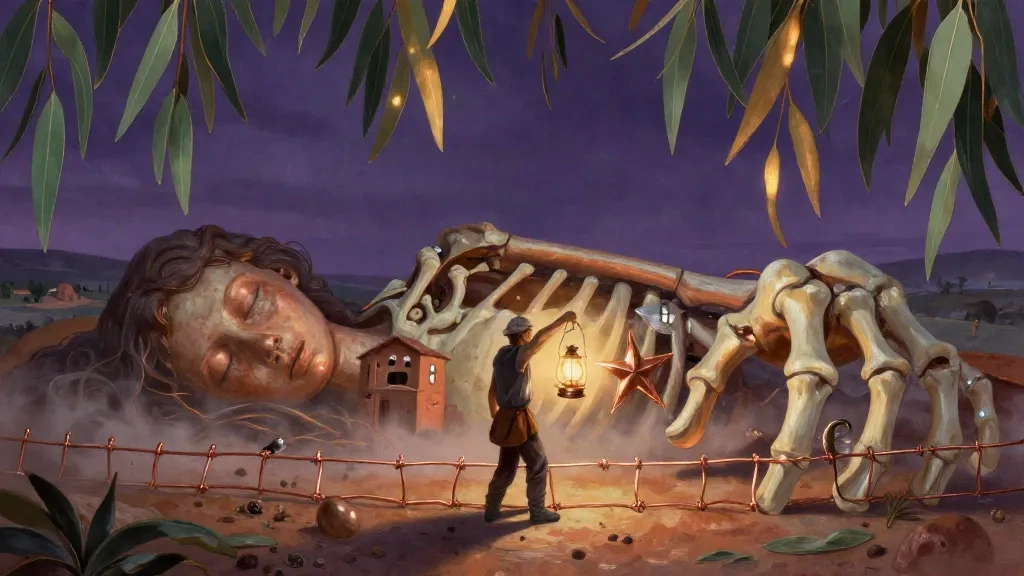
Mara made lanterns for the paths people avoided. Her house stood at knee height in the village built within the ribs of a sleeping giant, where the old bones rose around the terracotta roofs like the walls of a cathedral with no sky. Eucalyptus leaves ticked against the bone arches. Above them, the bruise-purple sky leaked dusk through cracks in the ribs.
Every evening she carried her light into the hollows. Mara climbed the ladders grown from the giant’s spinal plates. She crossed the places where rainwater gathered without draining and the narrow alleys where villagers pretended not to walk. A red lamp marked sudden drops. A blue one turned travelers away from loose steps. Her favorite lanterns were clear enough to reveal everything.
Inside her coat rested a copper star, forged small enough for her fist, and a glass bird with wings sealed shut. She did not remember choosing either object, but the villagers said both had been waiting in her workshop for years.
North of the village, beyond the knuckle of the giant’s right hand, lay the border. It was marked by a copper wire strung between two teeth. Mara had seen it only from afar. On the other side, people lived in straight houses with bright windows and roads that obeyed their names.
The Bell That Knew
The bell hung beneath the giant’s heart, where Mara’s lanterns were brightest. No rope reached it. No mouth pulled it. It had no clapper, only a bowl of black iron suspended in living tissue.
For as long as Mara could remember, it had remained silent. Then, on the morning she prepared to leave, it rang once beneath her feet.
People gathered in the clearing outside her door. The elder said the bell announced a decision.
“Not a spoken one,” he added. “It knows when we have chosen and merely failed to say so.”
Mara said she had chosen to cross the border.
The bell stayed quiet.
So she placed the copper star on a stone and promised never to return. The bell rang again.
She promised the giant was a coward for letting them build on his ribs. Nothing.
At last she wrapped the star in her scarf, but not before touching it to the bell. The sound traveled through the entire village, rattling cups and waking every dog.
By sunset, the border wire had tightened. It now crossed the hand bone at ankle height, and a message hung from it: Cross carrying what you have not confessed.
Mara understood. The border did not want the star or the bird. It wanted the decision attached to them.
A Truth the Road Could Bear
She left the glass bird on her windowsill.
The bell remained silent.
She wrapped the bird in her best shawl.
Still nothing.
Mara nearly abandoned both objects in the giant’s bowl. Yet when she lifted the copper star, the bird’s sealed wings gave a small, clear click.
Inside the glass body, a paper strip appeared.
It was the confession her mother had died before telling her: the copper star was not stolen. Mara had taken it from the border tower years before, as a child, with her mother’s assistance. They had used its maker’s mark to obtain papers naming their village on the far side. The papers had been rejected. Her mother had hidden the proof beneath the floor of their house, naming a daughter she could not bring across.
The bell rang when Mara understood that she had crossed once already. The border recognized her return.
She found the paper still folded beneath her sleeping mother’s hand, brittle but dry. The glass bird had carried its image back to her.
Now Mara had a choice no one could accuse her of hiding. Leave the star and prove herself a thief. Keep it and let every road she lit afterward mark her as one.
What the Giant Carried
At the border, the watchers had followed the bell’s sound. They waited beyond the wire with ledgers closed and accusations ready.
Mara stepped over without surrendering the copper star, the glass bird, or the confession.
The wire struck her shoulders but did not tighten. The border required a declaration, not abandonment.
On the plain below, the sky had darkened to the color of crushed mulberries. Mara raised her lantern. The path appeared, no longer the road the watchers expected. It curved east, into the giant’s open mouth and beyond it toward a country marked by pale stars.
Behind her, someone struck the bell. Its note followed her across the grass, low and relentless.
Mara walked on. At last the sound belonged neither to confession nor departure, but to the decision to become someone neither village had imagined.





