 Netwrck
Surrealism.
The Courtyard That Remembered Rain
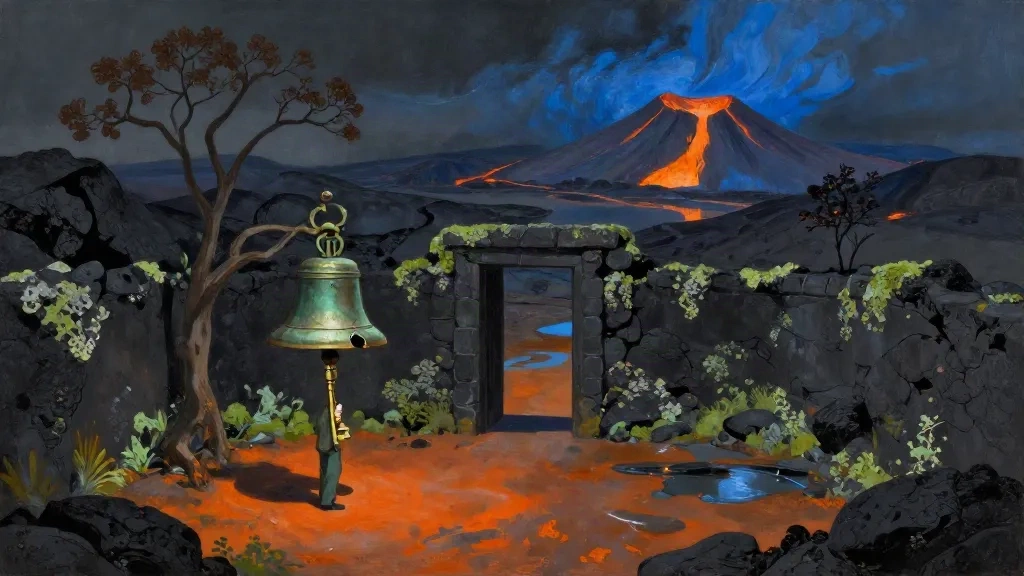
At the top of the dormant volcano, the observatory had one window facing inward and another facing the blue hour. Mara’s garden occupied the courtyard between them, where black lava stones rose through thin soil in rows no map recorded. She planted stories in neglected places: a story in a cracked basin, another beneath the stairs, a third threaded through the roots of a mountain ash.
Each story began as a sentence pressed into the soil. Water carried it downward. Roots divided it. By spring, the courtyard had become a place where a passerby might find a blue door, a wet mitten, or the smell of bread baking in a house that no longer existed. People came because they were tired, not because they believed. Mara had learned that belief disturbed the arrangement.
Her own family story was the only one she had never planted. It began with a cracked bell in her grandmother’s house, ringing whenever someone spoke a lie. Beneath the bell lay a brass key too large for any lock. Her grandmother claimed it opened a shelter for people who had lost their way, but the key had vanished during the night the volcano smoked.
A Machine Against the Mountain
Below the courtyard, the observatory contained a machine for measuring pressure in the mountain’s sleeping heart. It had no dial, only a brass tube descending through the floor. Mara had been told that it could turn measurements into shelter: heat the walls, draw fresh water from old seams, lock out the storm.
She carried the family story to the machine and placed the cracked bell beside its switch. The bell gave one exhausted note.
“It requires a narrative,” said the instrument manual, though Mara had never seen a manual. “The narrative must be doubted by everyone present.”
She laughed. The machine was absurd. She called the key an ornament and the bell a family superstition.
The brass tube began to glow.
Mara stopped laughing. When doubt became useful, it became a kind of faith. The machine opened a seam in the wall, revealing a narrow chamber lined with blue mineral. Her grandmother’s key hung above it, suspended in darkness, waiting for a hand that did not believe it was a key.
Strangers Under Blue Light
Travelers began arriving before Mara understood what the machine had built. They came from the observatory road during storms, leaving footprints full of blue light. She gave them soil and shelter, and they told her the stories they had carried from distant towns. The machine remained quiet whenever they praised it.
So Mara changed the sign above the courtyard.
It read: THIS IS PROBABLY USELESS.
That night, the machine drew water. In the morning, it had warmed the chamber and repaired the roof, though the roof had not been visibly damaged. Visitors laughed at the sign, argued about its grammar, and slept beneath the cracked bell. The bell’s note traveled through the walls, sounding less like a warning than a door being tested from the other side.
Then the volcano stirred.
Not an eruption. A long internal exhalation, lifting the observatory by several inches before settling it into a new position. The courtyard split. The blue storm-light outside turned hard and white, then burned orange through the ash.
Mara saw her grandmother standing in the fracture, untouched by wind. In her hand was the brass key.
The Door That Needed No One
“You told everyone it was false,” her grandmother said.
“You told everyone the bell lied.”
Mara looked at the machine. Its tube had gone dark. The shelter was collapsing inward, stone folding into stone.
She took the key from her grandmother. It was warm. For one irrational instant she believed it could open anything.
The machine shut down.
“There,” Mara said to the visitors gathered in the courtyard. “I was wrong. It is only a key.”
She planted the family story in the fracture: the bell, the key, the lie, the lost shelter. Then she waited for doubt. The storm-light shifted from white to deep blue, and the volcano’s pressure moved through the mountain with a sound like a held breath.
The cracked bell rang once.
The key turned in the hidden lock.
The wall became a doorway, and behind it stood not a room but a horizon full of orange fire, lichen forests, and blue weather. The machine woke. Mara’s visitors crossed the threshold carrying their own stories. Behind them, the courtyard filled with the green scent of growing things.
At dawn, the brass key was gone. Mara never found it. She kept the cracked bell hanging above the gate, where it sounded whenever someone began explaining too quickly.





