 Netwrck
Science Fiction.
The Market of Unclaimed Things
By noon, the floating market had folded itself around Sera’s boots. Platforms of woven cane hung above a violet gulf, their edges lashed with copper wire. Stalls drifted at different heights, connected by ramps that appeared only when someone decided to cross them.
Here, people sold what they had lost before they understood its value. A woman traded the sound of her mother’s laugh and received three seasons of rain. A boy offered a blue scarf that remembered being worn by someone brave, then bought back a memory of his own hands.
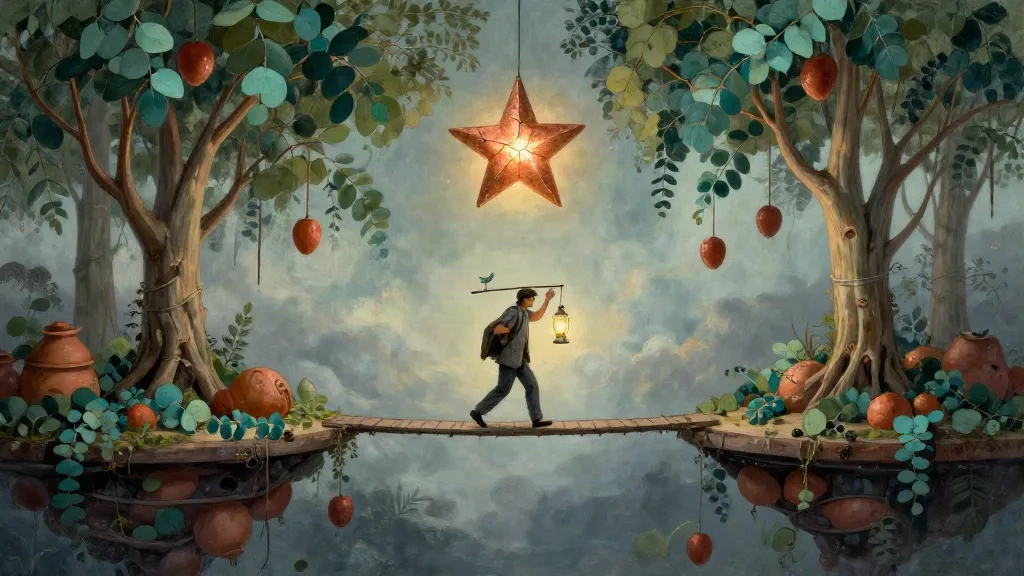
Sera moved between the stalls with a lantern in one hand and a copper star in the other. The star had belonged to a navigator who vanished beyond the eastern wall. It was warm even in the damp air, and when she held it beneath the market’s bruised-fruit sky, its five points cast a small constellation on the boards.
Her lantern was made of thin brass and old glass. Inside it burned no flame, only the pale glow of paths people had avoided. Sera made lanterns for people who wanted to see what lay beyond their fear, though they rarely thanked her afterward. A visible road is not always a kind invitation.
In her coat pocket, a glass bird knocked its beak against the lining. It had been her sister’s. The bird remembered a song, but not the sister who had taught it to her. Sera kept it because forgetting its voice felt worse than carrying its silence.
The Border That Would Not Open
The border lay beyond the market’s last platform, where eucalyptus trees grew upside down from a cloud of red soil. Beyond it waited the city of Vesper Reach, where unregistered memories were considered dangerous. Sera needed to cross before the market’s nightly wind tore the platforms loose.
She wanted to arrive carrying both objects. The copper star could buy passage. The glass bird could restore a piece of her sister, or at least prove that some part of her had survived the crossing.
At the gate stood a customs officer with a face made of varnished wood. He examined the star, then the bird, then Sera’s empty hands.
“Memories must be surrendered at the border,” he said.
“Then I surrender none,” she replied.
He stamped a form without ink. The bell hanging above the gate rang once.
Everyone nearby turned to look at Sera.
The Bell’s Verdict
The bell rang only for decisions no one admitted making. Sera had heard its voice in distant villages, always beneath the accusation of an unavoidable choice. It rang when a traveler stepped onto a road and pretended the road had chosen them. It rang when a city sealed its gates and called the choice inevitable.
She looked down at the copper star. Its glow had narrowed to a single point. The glass bird went still in her pocket.
“You intend to carry them both,” the officer said.
“Yes.”
“That is not an answer. That is a burden.”
“It is what I carry.”
The eucalyptus trees stirred without wind. Their leaves turned toward the market, revealing a narrow bridge hidden beneath the red soil. The bridge was made of dark boards, each one marked with a white footprint. It led straight across the gulf, but its far end disappeared into the low clouds.
Sera understood then. The border did not demand surrender; it demanded certainty. A memory carried with doubt could be taken. A memory carried with a divided heart could be registered as stolen property.
She opened her hand. The copper star was not a key, nor a talisman. It was the last thing her navigator had given her, a promise made without words: keep the light moving.
Sera set the star in the lantern’s cradle. The glass bird remained in her pocket.
What the Wind Could Not Take
When she stepped onto the hidden bridge, the bell rang a second time.
The sound moved through the market, through every platform and forgotten life, and into the clouds. Sera walked forward while the officer shouted that the crossing had not been approved. Behind her, the gate began to fill with terracotta dust.
Halfway across, the copper star cracked.
A bright line spilled from it and ran along the bridge, illuminating the footprints Sera had not taken. They belonged to all the people who had chosen a road while pretending they had chosen nothing. Their paths crossed, separated, and returned. The border had been built to contain decisions. She had brought it a decision it could not classify.
At the far side, the glass bird began to sing. Its voice was faint, imperfect, and unmistakably her sister’s. Sera did not stop to listen. She carried the broken star, the singing bird, and the memory of the market through the open gate.
Behind her, the officer lowered his blank form. He had finally heard the bell’s true answer: someone had chosen everything, and no one else could choose for her.





