 Netwrck
Historical Fantasy.
The Book That Remembered Borrowers
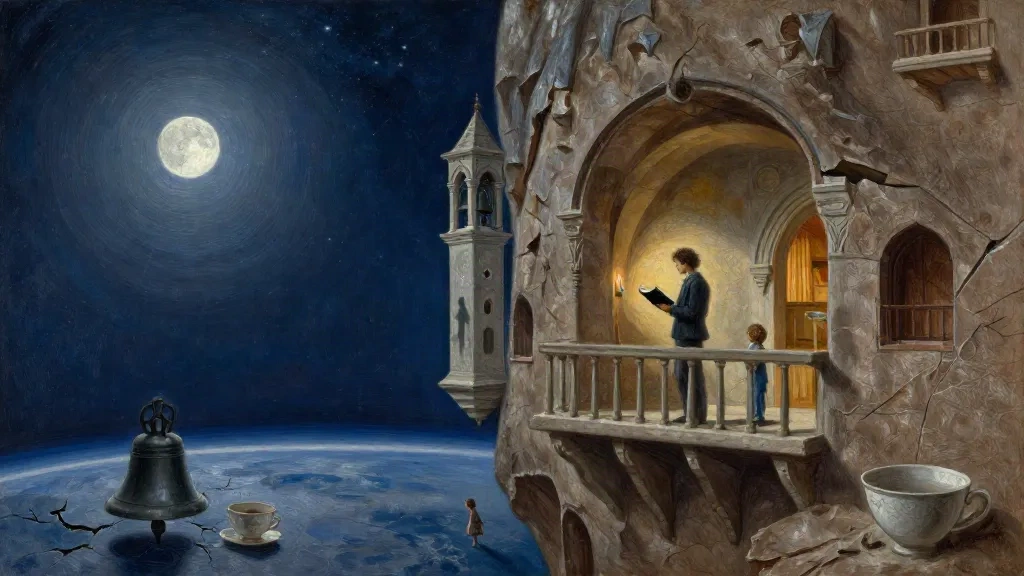
At the edge of the year 1847, Sister Orra became librarian of the Comet Monastery, a stone sanctuary driven through the winter sky like a splinter of ice. The monks said the comet had been falling for six hundred years. They kept their windows shuttered and their bells polished, though the smallest bell had cracked during the first winter and no one could remember hearing it ring.
Orra’s rooms lay beneath the archive, where blue steel moonlight gathered in the corners and tobacco-brown beams gave off the dry scent of old prayer. Her duty was simple: receive those who came seeking refuge, and lend them books suited to their need.
There was one book she did not understand.
It had no author, no spine, and a cover of black glass polished by countless hands. Every borrower described it differently. A soldier said it contained a map of battles never fought. A widow said it held the names of children who had not yet been born. A young cartographer claimed the pages showed roads that appeared only when forgotten.
Yet the book always returned to Orra’s desk before dawn, its cover warm, its pages blank except for a line of handwriting she recognized as her own.
Orra had no home outside the monastery. Her family had been removed from the valley by soldiers, and the order had forbidden her from following. She kept a list of every person who had come to the comet: fugitives, deserters, pregnant women, a magician whose shadow behaved independently, a retired executioner who could no longer lift his sword. Each had been given the book. Each had remained.
She wanted a place where a person did not have to become ordinary before being welcomed.
The Child Who Looked Behind the Sky
The child came in with an empty teacup balanced in both hands. She could not have been more than nine. Her shoes were wet, though no water had fallen for three months, and her eyes moved constantly toward the walls.
“The library is full,” Orra told her.
“Then the library is frightened,” the child said.
Orra showed her the book. The child opened it without reading and pointed beneath the table.
“There,” she said.
“What is there?”
“The man in the chimney.”
Orra looked. She saw soot, a nest of old straw, and a darkness shaped like folded wings. The other monks gathered behind her, all of them looking away.
“We do not speak of him,” Brother Vale said.
The child placed the teacup on the floor. “He says the bell is cracked all the way through.”
Vale’s face whitened. “That is impossible.”
“You agreed it was,” the child replied.
That night, Orra climbed into the bell tower with the black-glass book under her arm. The comet trembled beneath her boots. Below, the monastery’s lamps moved in the tunnels, reflected candlelight passing over stone like water over drowned coins.
The great bell had no clapper. Beside it stood a small wooden chair, and on the chair rested a cup of tea, still steaming.
The hidden man was there. He was made of smoke and old ash, thin as a scratched photograph, and when he spoke the air tasted of tobacco.
“You are the first librarian to look where the book points,” he said.
“Why are you hidden?”
“Because they decided I was not a person.”
The Agreement Made by Looking
Orra understood then that the monastery’s refuge was founded on a quiet bargain. Every impossible resident had been seen, named, and then denied aloud. The chimney man had been called a draft. The magician’s shadow had been called a stain. The executioner’s trembling hands had been called old age.
Agreement had become brick. Repetition had become belief.
“If I stop overlooking him,” Orra said, “what happens to the monastery?”
The hidden man glanced toward the cracked bell. “Perhaps nothing. Perhaps everything will remember itself at once.”
He told her the bell had been broken the night the first impossible resident arrived. Its fracture released a sound that could wake whatever the world had agreed to bury. The monks had silenced it by refusing to hear it.
Orra returned to the archive carrying the teacup. She placed it beside the black-glass book.
“Then we will hear it together,” she said.
At sunrise, the child rang the small bell. One stroke cracked the winter air. A second brought every hidden shape from every corridor: silver wings behind the chapel, a drowned man dripping from the refectory ceiling, the shadows of unbuilt houses.
Brother Vale covered his ears. The others did not.
Orra opened the book. Names appeared in rows: Ael, the cartographer of roads not taken; Miri, whose shadow had walked north; the child, unnamed; the man who lived inside the chimney. Beside them, one blank line waited.
Orra wrote her own name.
The comet monastery opened its doors wider. The impossible residents entered, not as guests to be corrected, but as witnesses to one another.
A Home With No Conditions
In the years afterward, the monastery became known by a new name: the House of the Unfinished Sky. Travelers arrived carrying objects they had been told were meaningless. The librarians lent each of them the black-glass book.
Orra never learned where it came from. She learned that it was not a book of answers, but a record of what someone had dared to recognize.
On her desk, the empty teacup remained. No one used it. The cracked bell hung silent in the tower, waiting for an hour when no one would look away.
Whenever the child asked who belonged there, Orra pointed toward the comet’s blue-black heart.
“Everyone who comes,” she said, “as long as the door remains wider than the doubt.”
Some homes are built from stone. The best are built from the refusal to abandon anyone inside them.





