 Netwrck
Fantasy.
The Market Below the Clouds
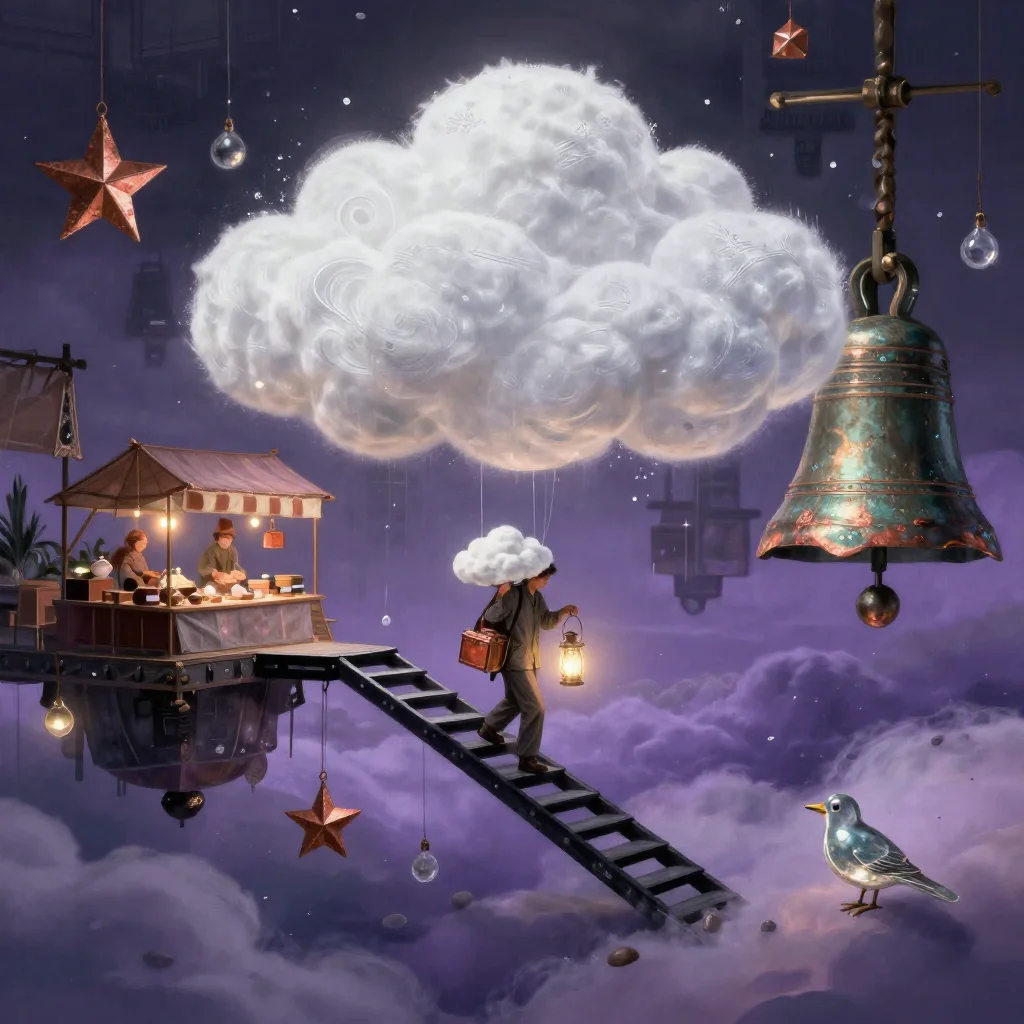
By violet dusk, the memory market had loosened its ropes and begun to drift. Stalls hung from one another in a chain above the cloud sea, their canvas roofs beating like pale wings. Merchants sold afternoons with no witnesses: a summer stripped of heat, a goodbye missing its first sentence, the exact blue of a door seen during war.
Orla Venn walked beneath the awnings with a lantern in her left hand and a sealed copper case in her right. She had made the lantern for herself. Its panes were cloud-white glass, clouded further by salt and use, and its wick burned without smoke.
The case contained her mother’s memories. Not the happy ones; those had gone willingly into jars along the northern shore. These were the cruel and inconvenient remnants: a hospital corridor, a pair of unlaced shoes, the instant before a betrayal. The border guards would accept neither grief nor proof. To cross into the country above, every traveler had to surrender one memory that might be used against them.
Orla intended to cross with all of them.
What the Bell Named
A copper star hung outside a stall selling unclaimed names. A glass bird slept beside it on a velvet cushion, one wing chipped, its hollow chest filled with rolled wishes. Orla had carried both objects since childhood, though she could no longer remember placing them in her case.
She stopped when the bronze bell beneath the stalls rang.
The sound arrived without vibration. Every lantern dimmed, every merchant went still. The bell rang again, and the glass bird lifted its head.
The border remembers nothing freely given.
“That is not a law,” said a stallholder behind her. “That is a bell.”
Orla knew. It rang only for decisions no one admitted making. Her father had once told her that the western crossing was safe for those who carried nothing. He had put her on a boat at the edge of the cloud sea. She remembered the boat, the smell of iron, the coin warming her palm. She did not remember handing over the copper star.
Now the star had returned, and the glass bird had returned with it.
Orla crossed the market until she found the border gate. It was only a row of white posts rising through the clouds, each marked with a memory someone had surrendered. The guards wore masks of polished silver.
“Open the case,” said the first guard.
“No.”
The bell rang beneath her feet.
The Path People Avoid
Orla lifted her lantern. The light did not illuminate the gate. It illuminated a narrow stair descending behind the stalls, its steps black and wet, winding down into the cloud-white dark.
“There,” the glass bird said.
Every head turned. The bird had never spoken. Orla had left its wish inside it when she was a child: Let me be brave enough to choose.
“That stair is not on the map,” said the guard.
“It is the map,” Orla answered.
She set the copper star at the first step. It spun, finding no north. At the second step, she placed the glass bird. The bird’s chipped wing pointed into the cloud. At the third, the bell rang a third time, and the market behind her began to disappear: stall, canvas, memory, all drawn downward like coins into a drain.
The stair was made from avoided decisions. It could be crossed only by admitting what they had cost.
Orla descended. At every turning, a ghost tried to take the case from her. One wore her father’s face. One wore her mother’s. One was the child she had been before the western boat, before the missing summer, before the copper star became a thing she carried because releasing it felt like dying twice.
“Give me the burden,” each said.
She kept both hands closed.
At the bottom stood a white door. Beyond it waited the upper country, bright with unclouded stars. Orla pressed the lantern to the wood. Her mother’s memories shone through the case, and the door opened onto the one day her mother had refused to surrender: the afternoon she chose to leave Orra with strangers so her child might escape the war.
The truth did not make the past kinder. It made it larger.
What the Border Carries
Behind her, the bell rang for the final time. Orla understood then that it had never named her father’s decision. It had named her own: to keep searching for a mother who had chosen departure, and to call that searching justice.
She opened the case.
The border demanded a memory. She gave it the fantasy that her mother had left willingly, wholly innocent, unable to imagine the cost. The false memory dissolved in the lantern’s flame. The true one remained: the corridor, the shoes, the instant before the choice. Not a weapon now. A fact she could carry without obeying.
The guards bowed. The glass bird flew upward, carrying the copper star in its beak.
Beyond the white door, Orla walked into the country above. At her back, the old stair remained visible for exactly one breath before cloud covered it. Then there was only the lantern, the case, and the road refusing to pretend that love and loss had ever been the same thing.





