 Netwrck
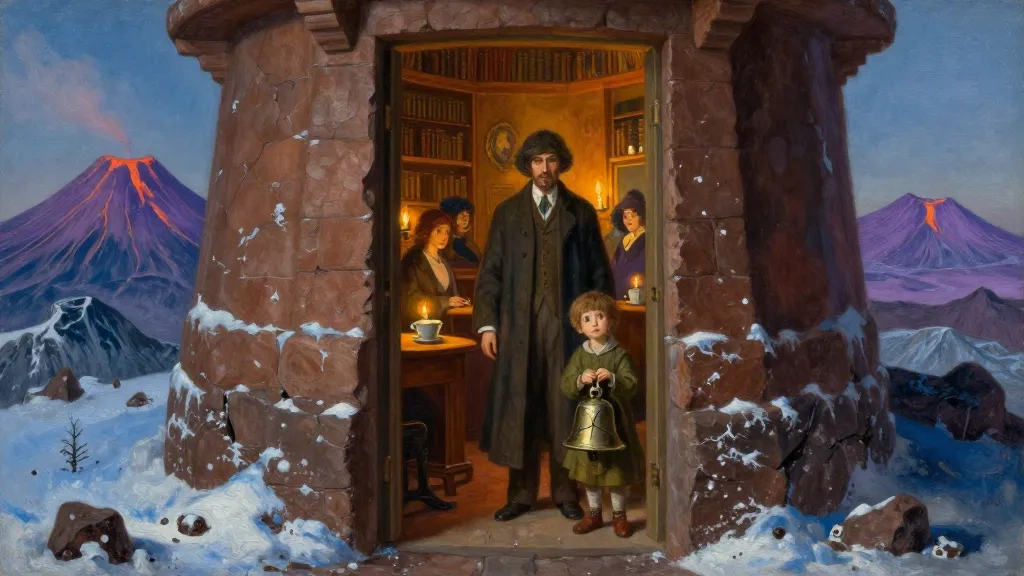
Historical Fantasy.
The Book That Refused a Name
The observatory stood inside the sleeping volcano as neatly as a watch inside a coat. Its brass instruments climbed the inner cliffs, their lenses aimed through narrow seams toward the sky. Below them, tunnels held the library, the weather room, and the kitchens where copper pots warmed the stone.
Elian Voss was its librarian. He kept the books in cedar cases, repaired their spines with paste, and wrote every borrower’s name in a ledger without asking for one. The book appeared on the lending desk in winter, 1887: a slim volume bound in blue leather, its cover unmarked except for a circle pressed into the grain.
It was impossible because no two copies could exist. A woman from the southern railway station borrowed it and returned it smelling of rain. A wounded mapmaker borrowed it and returned it with ash in its pages. A boy with a silver watch returned it three years later, older by only one winter.
Each borrower described the same room inside the book: a long table, an empty teacup, and a door that opened onto a house. Each said the house might be theirs if the librarian would read aloud the final sentence.
He never did. He wanted a home that accepted impossible residents. His own rooms were orderly, but the bed was too narrow, the windows overlooked the mountain, and the books refused to stay on their shelves. When he dreamed of the house in the blue book, someone was always standing behind him, breathing.
What the Mountain Overlooked
On the night of the first deep snow, a child came to the observatory with an empty teacup.
She was perhaps seven, barefoot despite the frost, and wore a coat stitched with yellow thread. She placed the cup on the desk with both hands.
“The mountain has a tenant,” she said.
Elian looked through the observation glass. Snow moved across the crater, but below the snow, in a chamber visible only when the candlelight burned low, someone was ringing a cracked bell.
The child pointed to the dark. “You can hear it.”
Everyone else had learned not to. The observatory’s instruments recorded tremors, pressure, and falling stone, yet the logbooks had no entry for the bell. The local guides called the sound wind in the chimney. The cooks said it was the mountain settling.
The child drew the hidden chamber on the desk, adding a small house beside the bell. “It lives there,” she said. “It has been waiting for you to stop looking away.”
Elian understood then that the overlooked thing was not a ghost. It was a person, or the last room of a person, forced into invisibility by agreement. Every keeper had protected the observatory by refusing to see what the mountain sheltered.
The Loan That Changed the House
He took the blue book from its case. When he opened it, the empty teacup on the child’s desk filled with hot tea. Steam rose through the page and smelled of tobacco, woodsmoke, and rain on hot stone.
“What is your name?” Elian asked.
The bell answered instead. One clear note, then a crack.
He read the final sentence.
The words entered the room without sound. The hidden chamber opened. A figure came down the tunnel carrying a lantern made from pale flame, its face hidden beneath a hood. Behind it stood a procession of people whose outlines had been blurred by years of neglect: miners, refugees, a cartographer, a woman in old-fashioned sleeves.
They had lived in the mountain’s hidden rooms, surviving on the books people borrowed and the promises they failed to finish. They were not dead. They were unacknowledged.
“We do not need a priest,” the figure said. “We need a ledger with our names.”
Elian looked at the child. “Will you help me?”
She picked up the cracked bell from beside the desk. It had not been there before.
A House That Saw
By dawn, he had written sixty-three names. The book grew heavier with each one, and the observatory filled with unfamiliar footsteps. The empty teacup remained on the desk, its tea gone cold.
The child asked whether they could stay.
“There are no impossible residents here,” Elian said.
He wrote her name next, then the names of the hidden ones. The cracked bell rang once. Outside, the volcano breathed without waking.
That night, the house in the book stood open, its rooms crowded with borrowed books, wet coats, and candlelight reflected from the steel-blue windows. On the table waited a fresh cup, steaming beside the bell. Someone had finally come home.





