 Netwrck
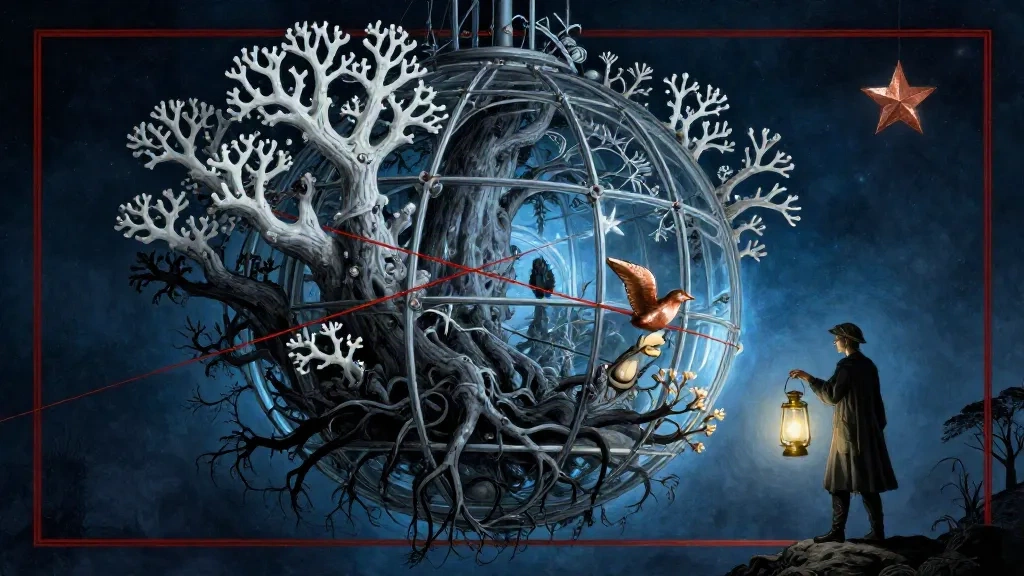
The Seed’s White Corals
Everything in the greenhouse was a shade of white that had never touched a sun. The dead moon turned beneath the hull, grey and pitted and patient, and the seed at the greenhouse’s center turned with it, larger than a house, its bark ridged like folded wings. The shell around it had grown white coral in eleven years, each branch glazed with frost, each fork lit from inside by blue veins that moved the way blood moves under a wrist.
People called it the Forest That Remembered. They came from the outer decks to press their palms to its casing, and they heard things: rain in rooms that had burned centuries ago, a dog barking down a stairwell, a woman saying a name twice. The station had a registry for the seed, four hundred and eleven entries, all of them the same entry. Extinct. Non-transferable. Referenced by grief.
I came to the greenhouse every shift for six years, because I make lanterns, and because a lantern is a thing that argues with dark. Mine were copper bodies, a star of polished metal at the crown to focus the flame, a glass chimney to keep the wind honest. People bought them for funerals. They set them on the step of a house and the flame burned steady in the vacuum of a room where no one was willing to feel afraid, and the star threw eleven points onto the ceiling, and for a while the room had a center.
Nobody bought a lantern to carry something forward. That was fine. Forward was not the trade.
The station’s paths avoided the seed’s shadow. They narrowed there, squeezed by roots that had lifted paving into pale knuckles, and everyone knew which turns led to the hydroponics decks and which to the mail lifts. No one spoke about the border corridor, and the silence around it had a texture, the way a held breath has a texture.
A Trade of Small Flames
The lantern I carried that season was my mother’s, and it was the worst thing I had ever made work. She had built it in the forest, in the years before, out of copper beaten thin as a leaf and a brass heart she had soldered shut. I found it in her workshop with a coat of ash still fused into the seam, and I spent four months learning to make it hold a flame. It is not a good lantern. It leans. When it burns, the light swings with the walker’s stride, so that the ground ahead of you is bright and the ground behind you is not.
Inside the brass heart was the seed. Small. No larger than my thumb joint, and dry, and light, and it was not on any manifest because it was not alive in the way the registry understood, and because the registry did not know I had it, and because my mother had told no one.
Here is what I know about my mother, Ilva Rest, and it is not enough. She was a plantwright in the forest, which meant she could talk to roots and this was not a metaphor, it was a job. She was loud in a trade where the work was patience. She had a scar on the left forearm in the shape of a hook, from a grafting knife, and she showed it to me once as a joke and never explained it.
She told me she had carried something precious across the border. She said it in the doorway of our room on the night the moon died, and the lights went, and the frost came up through the floor plates, and she was already kneeling to fasten my boots. I was five. I have heard that sentence perhaps four thousand times in nine years, always at the same volume, always in the same doorway, always with her hands on the straps instead of my feet.
I believed the something was the seed. I have organized nine years around that belief. I built a trade, a workshop, a name that meant something small and good in the outer decks, and I kept her seed in a lantern I could not fix, and every year I told myself that when the crossing opened, I would take it to the Forest That Remembered and set it down beside the one she planted, and then I would be a person who had returned something. That was the whole plan. It fits in a sentence. It has never once fit in my chest.
The Bell for Unspoken Things
The border was not a wall. It was a curtain of red thread, fine as spider silk, drawn between two coral columns and humming whenever a person passed through without a declared purpose. It hummed now, a low C, felt more in the teeth than heard. Behind the customs desk sat Warrant Officer Sepp, who had one eye and a scanner built to measure luggage, not lies.
On the desk between us, under a green glass dome, was a bell the size of a fist. Cast bronze. Mouth downward. The clapper was a loose piece of glass.
It rang as I came within arm’s reach of the thread.
The note was small. Almost eaten by the ventilation. Sepp looked at the dome, then at me, and did not pretend to be surprised, and I was grateful for that more than for anything else that day.
“Declare the decision,” she said.
“I have not made one.”
“You have made one. You have been making it for nine years.” She set the scanner down. “You merely postponed the sound. That is the only thing the bell measures. Not the truth. The delay.”
Behind her, a second shape resolved out of the corridor: Osin Vey, registry clerk, junior, with the stoop of someone who had spent nine years reading other people’s declarations. He had been my customer twice. He had never once looked at my face while buying a lantern.
“Warrant Officer,” Osin said. “I am filing under the Extinct Transfer Schedule. Provisional custody of the reference object, pending catalogue. The object is a seed. The seed is her mother’s. The seed is a component.” He said it gently. He was always gentle. “If you file, Miss Rest, the crossing takes ninety minutes and the registry carries the weight of it. And the registry keeps records that outlast people. That is not nothing.”
“That is a great deal of something,” Sepp said, and did not look away from the thread.
I set the lantern on the floor. Inside it the seed knocked against the brass — a dry tick, once, the sound of a fist in a pocket. In my coat the glass bird I had carried since my first year of work gave a thin cry, and it had no air in it and no mechanism in it and I had repaired it eleven times.
The bell rang again. Louder. Frost came off the nearest coral branch in a fine spray and settled on my shoulders, and where it landed it stayed, and I felt the temperature of my own back like a hand.
Then the thread showed me.
It always shows you, that is what the thread is for; it does not lie, it only trades. My mother, beneath the dead moon, kneeling in the crater with her sleeves rolled and the ground going white around her. The red fiber closing around her wrists, not cutting, gathering. Her face entirely calm, which I had never once been able to hold in my mind before, and which I now understood she had earned the way I had earned the calluses under my thumbs. Beside her, half-buried, a lantern on its side with the flame still lit. Beside her — and this is the part that took the floor out from under me — a child, five years old, standing in the crater’s rim with her hands fisted at her sides, not crying, watching, the way children watch when they have already understood that crying will not be answered.
That was the night the moon died. That was the night she said it. And I have spent nine years believing she knelt there to plant a seed, and she knelt there to be held, and the seed was only the smallest of the reasons.
What the Lantern Kept
“Declared cargo,” Sepp said, scanning. “Extinct forest sample, unlisted, growth present. Declared decision: return.”
“Return to what.”
“To the greenhouse, to the desk, to the bell.” She let that sit. “That is a valid shape. Many people find it sufficient. You would go back down the path with the thing you came for and nothing would be taken and nothing would be said, and in forty years the coral would be a thicker white wall, and the blue would be out of it, and the seed would be ash, and nobody would be able to prove what it had been, which is the only immortality the dead get here.”
The lantern’s glass chimney clouded from the inside. Something had grown out of the seed in the dark. I saw it against the brass: a single black root, an inch long, smooth, and bent at the tip into the shape of a hand closed hard around nothing. My hand, at five. Not hers. Mine.
“The seed preserved her,” I said. “That is what it is. It is not a sample. It is the part of her that could not fit inside her.”
“Yes,” Sepp said, and for the first time her voice was not a customs procedure. “That is why the bell will not let you pass holding it. A dead woman’s relief is not cargo. Cargo is a thing you can name at the door. You cannot name that at a door, Miss Rest. It has no border in it. So you must give me the border, and the border of that is the story, and the story is the thing that makes your carrying mean anything at all, and if you hand it over I will file it and it will be true and legible and yours no more.”
Osin said, “It would be a good death for a bad story.”
“Sepp.”
“Warrant Officer. I am aware of what I am doing. I have been the one eye on this desk for six years and the bell has not once rung for me, and I have come to think of that as a kind of shame.” She put her palm flat on the desk, on the glass, so the bell rang under her hand, softly, and she did not flinch. “I am the last of my crossing. Everyone behind my name is a line in a ledger and the ledger is the only family I have. If you declare, I stamp it and my record is clean and my record is all I have. If you do not declare, I choose for you, and choosing for you is the one thing this post exists to prevent, and I will have to live in the sound.”
“You could refuse to post me,” Osin said quietly. “I am a filing clerk. I could sign a hold and go to the deck and let the border hum.”
“You would lose the schedule,” Sepp said. “You would lose the standing. You would be a man who heard it and did not declare. That is a man the registries cannot use.”
I thought about my mother’s hands on the boot straps. I thought about the nine years, and the calluses, and the fact that I had built a whole trade out of the argument that a flame kept in a lantern is a flame that has chosen to stay. And I understood the thing the bell had been measuring all along: it had not been measuring my delay. It had been measuring the difference between carrying and keeping. You may carry a thing across a border. You may not carry it and also keep the reason it is yours. Those are two different weights and the thread can only feel one.
I opened the lantern.
The black root went over the rim and touched the deck. It did not go toward the greenhouse, where the Forest That Remembered leaned its folded bark, and it did not go toward the seed of its own making, which was under the floor of the workshop and had been for four months. It went toward the border. It lay down along the red thread and followed it, the way a hand follows a rail in the dark, and where it touched the thread the thread sang a fifth above the hum and the green glass over the bell fogged on the inside.
“I choose to cross,” I said, “carrying what my mother carried, and I do not surrender the story that it was mine to carry.”
“That is not an answer,” Sepp said. “That is a refusal with a shape. Try again.”
“Then declare it for me.” I put the copper star from my own pocket on the desk beside the bell — my best work, the one I had made the year I got the name Rest onto a manifest, the star that focused a flame so a dying person could read by it for as long as there was anything left to read. “You have a scanner for luggage. Use your eye, Warrant Officer. You have one and you have never once used it on me and I would like to live long enough to notice.”
The bell struck once, hard enough that the dome jumped on its base and a flake of frost fell from the coral behind her and did not melt but went sideways, drifting, the way things do in a station that has no more use for up and down.
The Path No One Kept
The curtain opened. It did not part; it went thin, and thin, and became a line of light the color of a scar, and behind it lay a passage I would have sworn was not there — a run of decking between the seed and the outer shell, barely wide enough for two, lit by lamps in a pattern I knew.
My lamps. My fixtures, my hand-bent copper, my eleven-point stars, going down the length of that path and up the other side, burning steadily in a vacuum that should have eaten them, every wick trimmed the same day of the same week, all of it the exact habit I had taught myself in the first year after she was gone, when I could still not sleep and the work was the only thing that kept a shape.
She had walked this path. She had set these lamps. She had put them down on the far side of a border and then gone back through, on her knees, in a crater, and let the fiber find her wrists, because the lamps were for the crossing and the crossing was for me and she had wanted the crossing to be possible later, for whoever came after with the seed and the story and the refusal. She had built me a road out of light and then refused to walk it, and I had spent nine years being angry at a woman for a sacrifice whose shape I had mistaken for a garden.
The red thread lay across everything. Across the glass, across the bark, across the black root that crawled ahead of me on its own errand, across my palms. When I closed my hand the line went taut and sang.
Halfway across it asked for the copper star.
Not my star. The other one, the one I had carried since I was six, the one I had been told was a gift and had kept in a drawer for nine years because I could not burn it and could not spend it and could not say why. I brought it out. It was the lens from her workshop — the same alloy, hand-raised, slightly off-round, warm the way old metal is warm in a station that runs cold. A tool. Just a tool, for pulling a flame tight when a wick was bad, for an hour, for one night, for a death.
I set it against the thread and it sang, and it warmed, and in its reflection the passage stopped being the passage.
The forest. The real one, under the moon, before the moon. Every trunk marked where it had been cut and healed and cut again, a small red seam at every scar, a map of the things that had survived by closing over their wounds. I had always been taught that a healed tree was a repaired tree. My mother had spent her life arguing the opposite, in a trade where the work was patience, loudly.
The glass bird went out of my coat. It did not fall; it climbed, on a current that came from somewhere under the deck, and it flew the length of the passage and over the seed, and when it came back it had a white leaf in its beak and the crack in its wing was a seam of the same red, drawn closed, not gone. I did not repair it. I do not know that it was repaired. I know that the bird had been carrying a piece of that leaf the whole time, in the broken place, the way a man carries a splinter he will not let anyone take out.
The bell did not ring.
That was the sign, and I have thought about the sign a great deal since. Not the absence of the toll but what was underneath it: a corridor of air with nothing in it, the way a room is quiet only after a decision has been made in it. I crossed without a sound, and behind me the thread went back to humming its single low note, and the passage closed, and I was on the far side, holding a lantern that leaned, in a place where the floor had never taken a foot.
What the Bell Rings Now
I planted the black root beside the white coral, in a crack in the hull where the frost had lifted the plating by two fingers. It went down and it did not come up. The old bell came with me in the other hand, bronze, the size of a fist, the clapper loose inside it, and I set it down in the hollow the root had made, and the root closed over it without hurry, and went quiet.
My mother’s seed opened one pale flower. Not the forest — one flower, four white petals, and a smell like the inside of a copper shell. The blue veins in the coral above me did something they had not done in eleven years. They brightened, and kept brightening, and for a while the whole greenhouse was the color of a struck match seen through ice, and people came down from the outer decks to look at it, and this time what they heard when they pressed their palms to the bark was not a woman saying a name. It was a forge hammer, and then rain, and then a boy laughing on a stairwell, and a hundred of them, none of them sad, and nobody could say where any of it had come from or whose it was, and two of the deckhands wept without explaining why.
It cost what it cost. The thread had a weight and I had not carried it; I had argued with it, and the argument is still being had somewhere, and here is where it landed.
The border has not rung since. That is the miracle the deck notices and the thing the growers do not say out loud, because a border that has never rung is a border that has never been crossed, and a border that has never been crossed is a wall, and the wall is holding the whole corridor of light in place by the specific absence of any sound in it. The passage is there. Anyone can walk it. Osin Vey walked it on the fourth day, carrying a folder he did not need, and came back an hour later with his name off the schedule and his hands steady, and he has not spoken to me since, and I have not asked, and he takes his tea without sugar now, which I know because I still make his.
Warrant Officer Sepp left the desk in the same week. She handed in the scanner, which measured luggage, and the ledger with her name at the top, and she was gone through the mail lift with a bag that was not heavy, and I watched it go and I did not say anything, because there was nothing I could have said that she would have been permitted to answer, and because she had made the decision for me in front of a witness and the least I owed her was to let it stand.
And the thing nobody will say plainly, the thing I have sat with in front of the crack in the plating for eleven months now with a lantern that leans and does not go out: the Forest That Remembered is coming back. That is not a comfort. A seed that has been argued back into growing does not stop at the hull. The root is under the deck, and the coral is thickening, and the blue is getting stronger every week, and the frost is going out of the branches now, and I have started finding the hull warm to the touch on the side where the root went down. There is a chart in the greenhouse, the old survey, and I looked at it properly for the first time in six years, and the dead moon is not where the charts say it is. It is closer than the charts say it is. It has been coming in for eleven years, quietly, while we argued about bells.
So the bell is quiet, and the coral is bright, and the moon is coming, and I stand under a tree that is remembering everyone, with a lantern in my hand that lights the ground ahead of me and never the ground behind.
My mother chose to stay and build the road. I chose to walk it and not pay for it. Between those two choices there is a green glass dome under a desk that no one sweeps, and a bell with a glass clapper, and a man who hears nothing in it now, and I do not know which of us bought anything and I have stopped looking for a way to call it a bargain.
What I do is this. I keep the stars lit. I keep the wicks trimmed on the same day of the same week, all the way down the corridor, for whoever comes after with a thing they cannot name at a door — and if that is a kindness, then it is a kindness with my name on it, in a hand like my mother’s, and it is not free, and it is not for me.





