 Netwrck
Fantasy.
The Market of Unclaimed Hours
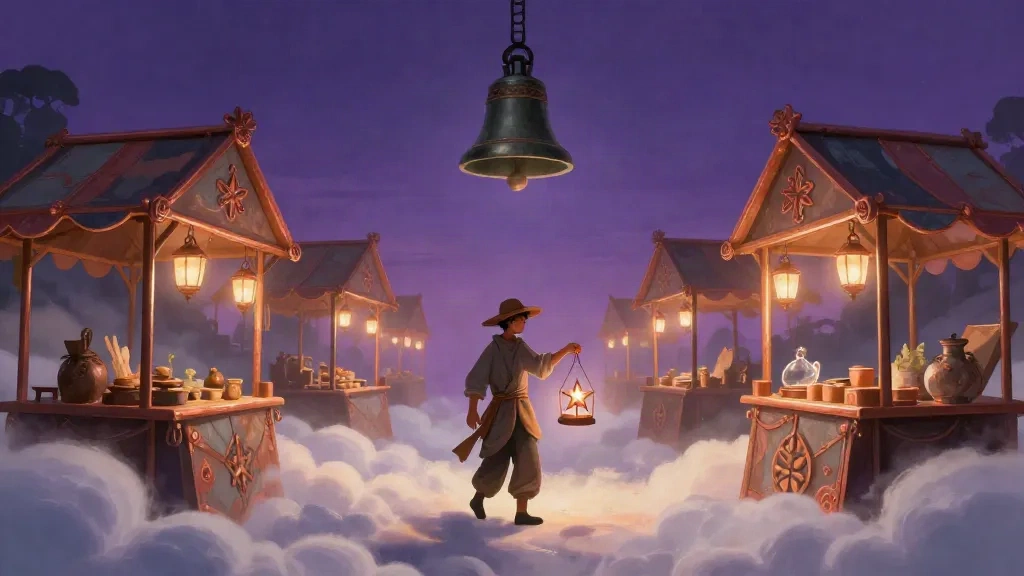
By violet dusk, the floating market had gathered above the cloud line, where the wind carried the scent of rain on warm stone. Stalls hung from chains of pale cloud, their awnings patched with old sails and moth-wing lanterns. On the counters lay memories without owners: a cough in a winter bedroom, the weight of a wedding ring, a childhood quarrel preserved in the shape of two clenched hands.
Every evening, someone tried to buy them. Most were too sharp to carry. Others had lost their names and could not remember which life had made them.
Oris walked between the stalls with her lantern in one hand and a small brass case in the other. Her light did not illuminate faces. It illuminated the paths people avoided: narrow bridges between two stalls, the gaps between hanging sheets, the dark spaces where a person had once made an unbearable decision.
Inside the case lay a copper star and a glass bird. She had carried them since the last market, when a woman with no face had pressed them into her hands and said, “Do not let them become souvenirs.”
The Border of Small Confessions
The northern border floated at the edge of the market, a wall of pale cloud with a gate cut through it. The gatekeeper, a thin man wearing several coats, examined every crossing.
“Name,” he said.
Oris gave the name she had used for seventeen years.
“Purpose.”
“Work.”
“Carried memories.”
She opened the brass case.
The copper star was bright with a night sky from a country no longer on any map. The glass bird contained a single wingbeat, frozen in clear air. Both belonged to a person who had vanished before the next dawn, leaving no explanation and no body.
The gatekeeper leaned closer. “Those cannot cross.”
“They are not mine.”
“Then they cannot be yours.”
“I am not surrendering them.”
He smiled without warmth. “Everyone crosses carrying something. The border only asks whether you are willing to leave it behind.”
Behind him, a line of silent travelers waited. None held anything visible. One clutched an empty sleeve. Another stared at his palms as if reading an invisible verdict.
A Bell for the Unsaid
Then Oris heard a bell.
It came from beneath the cloud floor, muffled and distant, yet clear enough to shake the stall chains. A small bronze bell had appeared beside the gate, without rope or clapper. It rang once.
Everyone at the border turned toward Oris.
The gatekeeper’s smile vanished. “That does not ring for accidents.”
“What does it ring for?”
“Decisions no one admits making.”
The bell struck again. Beneath the market, shutters flew open. Memories spilled from their stalls: a woman’s hands removing a ring from another woman’s finger; a man signing a form while his brother watched; a child choosing silence after hearing footsteps in the hall.
Oris felt the buried truth of her own life rise in her chest. She had not found the copper star and glass bird by accident. She had followed their light through a city of closed doors, knowing whose trail she was following, refusing to say the name because saying it would make her destination certain.
She had told herself she was carrying them back. In truth, she was carrying them toward the person who had left them.
The gatekeeper pointed to the case. “Surrender one, and the border opens.”
“Which one?”
“The one you cannot bear to keep.”
Her fingers tightened around the handle.
What the Light Keeps
The bell began to ring without pause. The market buckled. Clouds tore loose from the chain-stalls and drifted through the gate, carrying memories into the blank country beyond it.
Oris set the lantern down. For the first time, its light climbed over her shoulders and revealed the path she had chosen. It led through the gate, across the border, and toward a small house where a woman with no face was waiting.
Oris picked up the lantern. “I will not surrender them.”
“Then the border will close.”
“No. It will open.”
She raised the copper star above her head. Its lost night answered the lantern, blue-white along the edges. The glass bird stirred inside the case, its tiny wing beating once against the glass.
Oris stepped through the gate carrying both objects, both names, and the decision she had spent years pretending she had not made.
Behind her, the bell gave one final note. It did not close. The market unfolded into cloud-white light, and the avoided path became a road.





