 Netwrck
Surrealism.
The Book With No Shelfmark
By morning, the sea had brought back a blue shoe, a silver button, and a jar of sand from rooms no longer standing. The librarian, Mara Vale, wrote each arrival in the first book of the day: Received, unknown origin, temporary.
She worked in the old customs house, where the windows faced west and the shelves leaned toward the water. Every tide returned one forgotten object. Most were harmless: a glove without fingers, a key that opened nothing, a child’s drawing bleached blank.
But Mara also kept a book with no title. It appeared beneath the counter after the third storm of autumn, its cover stitched from strips of salt-stained sailcloth. Whoever opened it found a different story inside. A woman saw herself walking through a city under glass. A fisherman read the names of fish that had drowned in dreams. Mara read a house on a cliff where every room had a door, and behind every door was another resident who had been refused by the world.
She lent the book to the same person again and again. The baker, desperate to remember his daughter’s voice. The ferryman, who had stopped recognizing the sea. A widow who wanted one final argument with her husband. Each borrower returned it altered, its pages warm, its spine flexible. None asked where it came from. Some asked why the house in the book had a light in its attic.
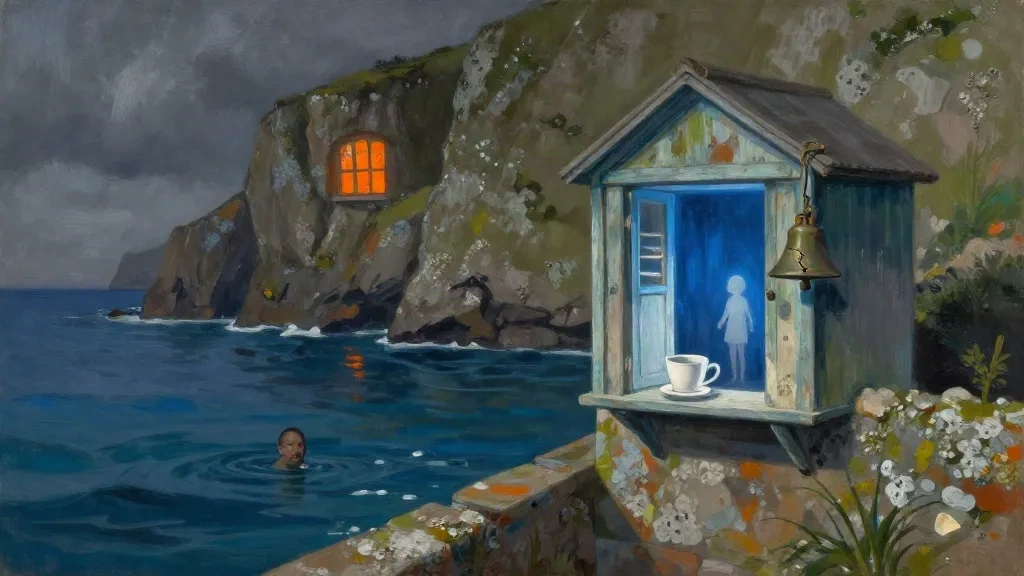
Mara knew. She had seen the light while reading. It was blue storm-light, falling over a kitchen table where a cracked bell sat beside an empty teacup.
The Child Who Counted Ripples
On the morning the bell returned, a girl named Iri came into the library without shoes.
She placed the bell on the desk. It was small enough to fit in her palm, though the crack inside it ran from rim to rim.
“You left this out,” she said.
“The tide brought it.”
“No.” Iri pointed toward the wall. “The tide brought the cup. The bell was already here.”
Mara looked. She had passed the wall a hundred times. The empty teacup stood on the windowsill, white inside and orange with rust around its rim. She had never noticed it leave.
“What is the bell hiding?” Iri asked.
Mara opened the impossible book. The house appeared again, brighter now. In its attic, a little girl stood beside a table. She was barefoot. She was pointing at a bell.
Iri looked over Mara’s shoulder. “That’s me.”
“You are here.”
“Not there.”
The girl in the page turned. Outside the house, something vast moved beneath the sea, slow as a continent turning in its sleep.
A House for the Uninvited
Mara had spent years believing the library was the only place that could accept what people discarded. Broken objects. Broken vows. Broken people. The town tolerated her collection because no one wished to examine it closely.
Iri pulled the bell from the desk. The crack inside it widened, and a low note moved through the room. Shelves shook. Outside, rain began striking the roof in a rhythm like footsteps climbing stairs.
“The bell is calling it,” Iri said.
“Calling what?”
“The thing everyone agreed to overlook.”
Mara looked at the cup. Its interior reflected not the library ceiling, but an open room. In the reflection stood the house from the book, its front door missing. Beyond it, dozens of figures waited in the water: a drowned giant, a woman made of mismatched shadows, a bird with a human name.
She understood. The impossible residents were not trying to enter the house. They were trying to return the house itself.
Mara took the empty teacup in one hand and the cracked bell in the other. “If I open the door,” she said, “I must let them in.”
Iri nodded. “That is the point.”
“And the town?”
“Will see.”
The Agreement Breaks
They walked to the sea wall. At low tide, the mud shone lichen-green beneath the blue storm-light. The missing door lay there, a rectangle of wet darkness.
Mara rang the cracked bell. The note was not loud. It went through the town like a rumor.
Doors opened along the waterfront. People stepped onto porches and stared at the sea. They saw the impossible residents waiting beneath the waves. They saw Iri beside Mara. They saw the house rising from the mud, every window lit.
Some screamed. Some wept. One man laughed until he had to lean on the wall. The town had agreed to overlook what it could not explain, but agreement was not the same as permission.
Mara placed the empty teacup on the threshold. The cup filled itself with warm water. The bell cracked once more, and its note became a door swinging open.
The drowned giant entered first. The woman of shadows followed. Then the bird, the nameless child, and all the others.
No one owned them. No one had chosen them. Still, the house made room.
At sunrise, Mara stood inside her library. The impossible book rested on the desk, open to a new page. It read: Residents accepted.
Iri poured tea into the empty cup. Outside, the tide went out carrying nothing home.





