 Netwrck
Fairy-Tale Fiction.
Shadows at Vesper Snow
At the Vesper Snow resort, the shadows arrived three days before the guests.
They slipped beneath black-lacquered doors and gathered along the frozen balconies, thin as cut paper. Each belonged to a person who had not yet come: the widowed queen, the mapmaker, the boy with the silver spoon, the woman who sold weather from a glass case.
Elian heard them before he saw them. He was the resort’s musician, though nobody hired him for melody. They hired him because his strange ear could find the hidden rhythm in a place. A loose tile sang. A mountain breathed. A guest could not leave until the floorboard under his heel agreed to.
That morning, while the shadows practiced being people, a bell rang beneath the black ice.
Elian’s mother had told him the sound was impossible. Bells do not ring beneath frozen lakes, and winter never listens.
He lowered himself to the shore and held one hand over the water. The note was new.
The Note of a True Thing
He had received that note before, though never this clearly. A truth made a sound inside him: a bright, clean tone that began behind the sternum and traveled through the teeth.
At the guesthouse, the concierge said, “The winter has lasted one generation.”
Elian heard a note.
“It began when my grandmother was a child,” she continued. “Every year since then, the snow has deepened. We planted trees indoors. We hung lamps from the ceiling and called them suns. My grandmother is dead, but the winter has not noticed.”
He heard another note, lower and steadier.
“What do you want to build?” she asked.
Every winter, Elian had built something small. A bridge for a paper boat. A clock that stopped when someone lied. A room where frightened guests could sleep without dreaming of thaw. They lasted until morning, and morning never came.
Now he placed his palm against the wall.
“Something that can survive the storyteller.”
The concierge’s face softened. “That sounds like a church.”
“It sounds worse,” Elian said.
He was thinking of the woman who sold weather. She told the resort that winter was a guest who had misplaced her departure. Elian had heard no note.
The White Feather and the Silver Spoon
At the north tower, he found the weather seller waiting inside a room full of winter.
Snow climbed the walls in neat crystalline shelves. A white feather rested on the sill, and beside it lay a silver spoon, polished until it reflected the black lacquer ceiling.
“You lied,” Elian said.
No note.
“I told the story you required.”
“That is still lying.”
She smiled. “I am the storyteller. In this place, the teller becomes the told.”
She picked up the feather and placed it in his hand. It was warmer than any living bird.
“A generation ago,” she said, “I wanted to build a summer. I made it from every truth I could find. I cut the truths into white pieces and buried them beneath the lake. When the first thaw came, the summer unfolded.”
Elian listened for the note.
None came.
Her smile vanished.
She lifted the silver spoon and struck the black ice beneath the floor.
The bell answered.
“The winter is not a season,” she whispered. “It is the last story. A child was born under this ice, and the world has been waiting for him to return.”
A Shelter Without a Narrator
Elian understood then. The resort’s shadows were not warnings. They were the parts of the storyteller who had escaped the book.
He carried the feather and spoon to the lakeshore. In one hand, truth. In the other, the only spoon that could feed a hungry winter.
He began to build.
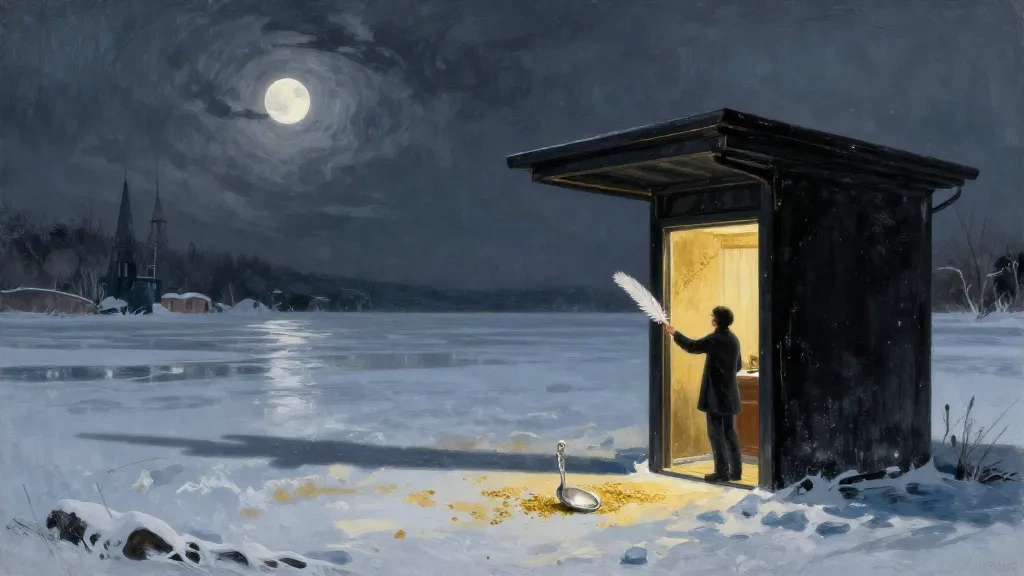
Not a palace and not a monument. He built a low shelter of black lacquer, gold dust, and boards pried from the ruined sun-lamps. He set the spoon at its center and the white feather above the doorway. Each plank received a fact: the names of the missing guests, the date of the first storm, the color of the sky before the lake froze.
The winter came for him in its oldest form.
It whispered that the shelter belonged to the storyteller. The wind called the gold dust ashes. Snow filled the threshold and tried to erase the truth written on the walls.
Elian played.
Every lie produced silence. Every truth became a note, and every note drove another nail into the shelter. The new sound was not melody. It was a foundation.
By dawn, the storm had exhausted itself against the walls. The lake remained frozen, but beneath the shelter the air smelled faintly of pine and wet earth.
Elian opened the door.
No child waited. No summer had returned. The white feather had blackened at its tip, and the spoon held a small pool of clear water.
Behind him, the storyteller knocked once.
Elian did not turn.
Some things cannot survive a storyteller. Others survive by becoming the story’s ground.
He had wanted a shelter that would outlast the telling. He built one that could tell him when to leave.





