 Netwrck
Folk Horror.
No Street Below the First Floor
Mara descended every evening by the freight stair behind Marrow Pharmacy, passing the first-floor windows where offices slept and the city’s upper chimneys rattled in the wind. Below them lay the Night Market: a iron-roofed cavern stitched from nine hundred doorways, each opening onto a room from a house that no longer stood.
Here the city kept what it had refused to name. Broken watches. Teeth found in church walls. A jar of thunder. Rain collected from the last day before every drowned year.
Mara rented stall thirty-one, where a blue lamp burned without heat. She called her trade Borrowed Room Registry. Each visitor described themselves as displaced. This was usually true. They wanted only somewhere to stay until morning, and Mara wanted a home that would accept her strange residents without asking whether they were people.
Her own family had called her the frost daughter. At twelve, she had walked through a wall and arrived in a kitchen three towns away. The woman there had set an empty teacup before Mara and said, Drink first, explain after.
Mara had never understood the mercy. She still remembered the cup.
The Same Book
The book arrived in autumn, wrapped in sailcloth and smelling of iron. Its leather cover bore no title. Whenever Mara opened it, the pages showed the same scene: a narrow house under a blue-white dawn, its windows full of figures whose faces had been carefully erased.
Inside the cover someone had written:
For all who are kept outside.
At dusk, a brick mason came. He had lost his wife to an illness the doctors insisted was imaginary. Mara lent him the book until dawn.
At midnight, a railway clerk came. His reflection had boarded the last northbound train while he remained behind. Mara lent him the same book until dawn.
Before sunrise came a woman carrying a child wrapped in frost. Mara lent her the same book until dawn.
Whenever a borrower opened it, the erased figures seemed to turn closer to the window. They never knocked. They did not need to. Outside the stall, the market’s noise softened whenever they stood nearby.
Mara began to believe the book was not bringing them home. It was showing the house they might build.
What the Child Saw
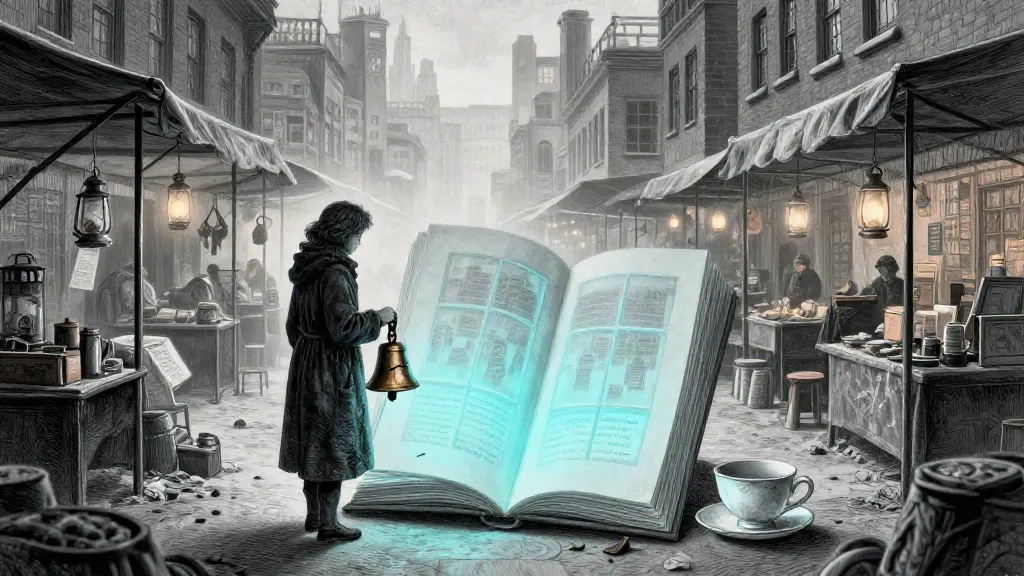
The child came on the coldest night, when frost silvered every iron hinge and the lanterns shone cyan against the dark. She led a man with a cracked bell, striking it at each stall entrance.
“He left me,” she said. “The man inside the bell.”
Mara looked at the empty teacup she kept beside the register. The bell’s sound had no visible source, but its rim trembled.
“Most people hear only the note,” the child said.
“What do you see?”
She pointed past Mara, not toward the market but through the blue-white light bleeding beneath the iron roof.
“A house,” the child said. “A very tall house. All its floors are above us. Something is sleeping in the basement, and everyone has agreed it is empty.”
Mara looked where the child pointed. For an instant she saw windows crowded with erased faces. Then the market’s usual sights returned: a fox selling bottled shadows, a nun with a seamstress’s hands, three old men drinking from a cup that never filled.
The child held out the bell. A small crack ran through its bronze belly.
“He is waking up,” she said.
Mara understood. The city had no street below the first floor because something beneath it had grown too large for streets. For centuries the market had overlooked it, trading away its cries as superstition. Every impossible resident Mara sheltered carried a fragment of that sleep, a noise that had escaped and become a person.
The House That Opens
She gave the child the book.
“Can we borrow the house too?” the child asked.
“Only if it opens.”
At midnight, the crack in the bell widened. From it came a voice like furniture dragging across stone.
“We are already inside,” Mara said.
She placed the empty teacup on the register and opened the impossible book. The erased figures pressed against the page. The market held its breath. Somewhere beneath nine hundred lanterns, the hidden thing turned in its sleep.
Mara did not close the book.
By dawn, the blue light had risen through the floor, revealing a staircase descending into frost-white air. At its foot waited a narrow house with every window lit.
Somewhere inside, a door opened.
The child rang the cracked bell once. Mara carried the teacup upstairs. The others followed.
This time, none of them needed a key.





