 Netwrck
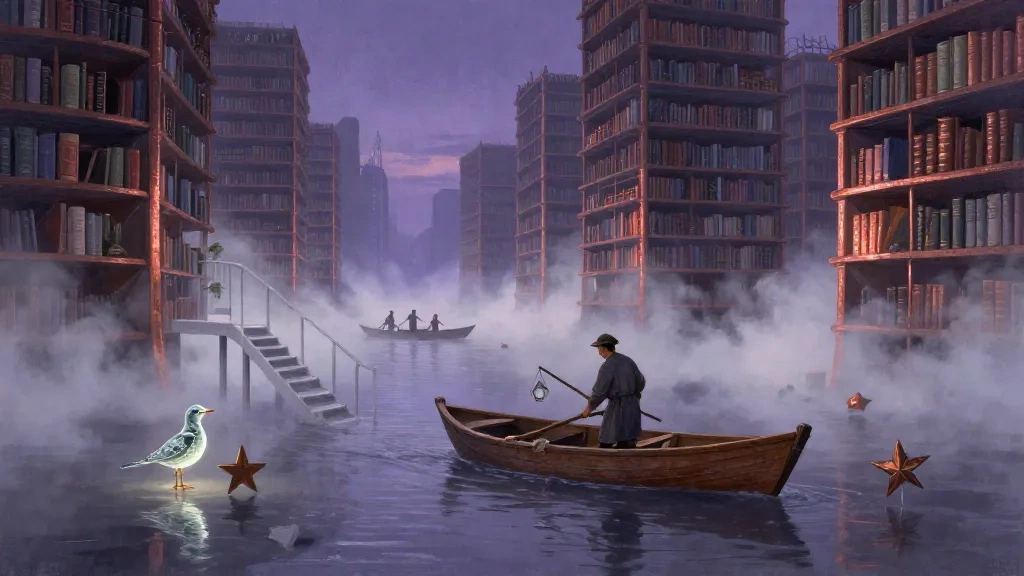
Fantasy.
The Drowned Stacks
At violet dusk, Mara rowed between shelves that vanished into cloud-white mist. The archive had drowned generations ago, yet its books floated in careful ranks, their spines turned toward the lamps of the librarians. They wore copper collars around their wrists and called the water home.
Mara sat low in her skiff, holding a lantern made from a cracked bell-glass and a narrow strip of oxidized copper. Her boat brushed a shelf of tide atlases. Each page resisted her oar, whispering in the voices of drowned clerks.
Beyond the archive lay the border, a pale seam beneath the water where the jurisdiction of the city ended. Mara had been told that crossing it would cost whatever she carried. She had also been told that the sentence was a warning rather than a law.
She intended to test it.
In her coat pocket lay a copper star, sharp at every point, and beneath that, wrapped in oilcloth, a glass bird. The star had belonged to the last librarian who crossed. The bird had belonged to no one at all.
A Bell for Unspoken Things
At the ninth stack, the water began to ring.
The sound was not loud. It traveled through the boat’s ribs, through Mara’s teeth, through the shelves, until every floating book faced the same direction: toward the border.
A librarian waited beside a reading desk mounted on a barrel. He was young, though his eyes had the gray polish of old salt.
“Bell for a decision,” he said.
“I have made none.”
“It rings for decisions no one admits making.”
He pointed toward a narrow stair rising from the water. Its steps were white with frost despite the warm dusk. “Cross there, and the archive will ask what you surrender. Answer honestly.”
“And if I don’t?”
“The bell rings again.”
He offered her a brass key. Mara looked at the stair, then at the objects in her pocket. The copper star had begun to glow through the cloth. The glass bird clicked softly against the star, as though its tiny beak were trying to wake.
“My mother crossed once,” Mara said. “She returned without her name.”
The librarian’s expression did not change. “Most people return with less.”
The Border of Unsaid Things
At the stair’s foot, Mara discovered the toll.
It was written in letters scratched into the first step: NINE HUNDRED TWENTY-TWO SILENCES.
“The archive counts them,” the librarian said. “Every decision denied. Every truth held back. Every door closed on purpose. The border accepts payment in confessions.”
“I have not made the decision.”
The bell sounded beneath the water. A book fell open across a shelf, displaying a drawing of a girl with a lantern standing at this exact stair.
Mara understood then that the border had been waiting for her. Her mother had left her a route, but not a choice. The route began with the glass bird.
She took it from her pocket. Cloud-white wings caught the lantern light. Inside its body, a small flame burned without fuel.
“Put it down,” the librarian said.
“That is the decision.”
“Put it down, and the bird will carry your mother’s name across. Keep it, and the border will take the memory of her face.”
The flame inside the bird bent toward the pale seam. Mara’s fingers tightened.
She had spent seven years searching for a way to cross while keeping the promise she had made beside a hospital bed: to carry something home. The promise was the bird. The bird was her mother’s last unfinished thought.
The Last Toll
Mara stepped onto the border.
Water surged beneath the skiff. The bell rang once, twice, three times. Nine hundred twenty-two silhouettes rose from the shelves: magistrates, lovers, children, founders. Each carried a sentence they had refused to speak.
“What do you surrender?” the archive asked.
“The belief that I crossed because I was brave,” Mara said.
The glass bird cracked along its breast.
“I crossed because I was afraid.”
Its flame widened. The bird flew, dragging a thread of light toward the opposite shore. In the distance, a small figure stood beneath a violet sky, her face hidden.
“What else?”
Mara looked at the copper star. She had kept it because it was proof her mother had once stood in the archive. She placed it on the step.
“The belief that carrying something preserves it.”
The star broke. Light poured from its center, joining the bird’s thread. The border withdrew, opening a channel of black water toward the far bank.
When the bell stopped, the librarians began to row between the shelves again.
Mara crossed without surrendering what she carried. She carried the memory of her mother’s face, the broken pieces of the star, and the knowledge that borders were not walls.
They were questions asked by the world.
On the far shore, the glass bird sang once. Mara followed its voice into the cloud-white fog.





