 Netwrck
The Memory Bell
Mara Venn was seventeen, and every bell in the apartment building rang for something that had not happened yet.
They began at sunrise, each apartment answering with a small brass note. A cough three rooms above. A slammed door in the year behind next year. The soft chime from a nursery that had stood empty since the building was raised. The tenants did not call them bells. They called them reminders, as if memory were weather.
She made them in the basement workshop, where the pipes ran beneath the floor and the walls sweated pale stone in summer and wept a fine cold mist in winter. Her mother, Isolde, had taught her to cast each clapper from old city metal: trolley rail, chapel screw, the brass rims of clocks from the pawnshop on Pell Street, which gave them a sound like a hinge deciding.
"Don't ring on an empty stomach," Isolde said, without looking up. "Brass takes a grudge."
She said it every morning for six years, and every morning Mara heard the rest of it: don't ask me what I gave up. Don't ask me whose name is in the box I don't open. Isolde's hands had begun to fail two winters ago. The tremor started in the left and moved rightward, slow as a date on a calendar. She gave Mara the molds, the tongs, the alloy, and then she gave the work over entirely, which was a different gift and a heavier one.
That morning Mara's newest bell rang beneath the floorboards.
The note was wrong. Not unfinished, not painful. Unowned. It sounded like someone holding a door open in an empty house and waiting to see whether anybody would come.
The Holiday Without a Name
The sound led her upstairs to the Hall of Common Sorrows, which was not a hall but a laundromat that had been declared a hall in a year nobody could date, and every year the declaration was renewed in a hand that changed.
That day the city observed its strangest public holiday: the Mourning of the Unnamed Grief.
NO BELL SHALL BE RUNG, CAST, SOLD, OR BROKEN FOR WHAT THE CITY HAS NOT YET DECIDED.
Municipal notice, affixed and re-affixed. Number illegible.
The custom began eighty-one years ago, when the Ninth Ward went silent during a storm the almanac calls the Sundering Rain. Its dead were counted. Its buildings were named. Its survivors were recorded, one hundred and forty pages, alphabetized, corrected, sworn to. And one absence remained outside every ledger: not a person, not a building, but a reason. The Ward had not merely suffered. It had suffered for something, and the something was struck from the record by a hand that signed its own name and then struck that too.
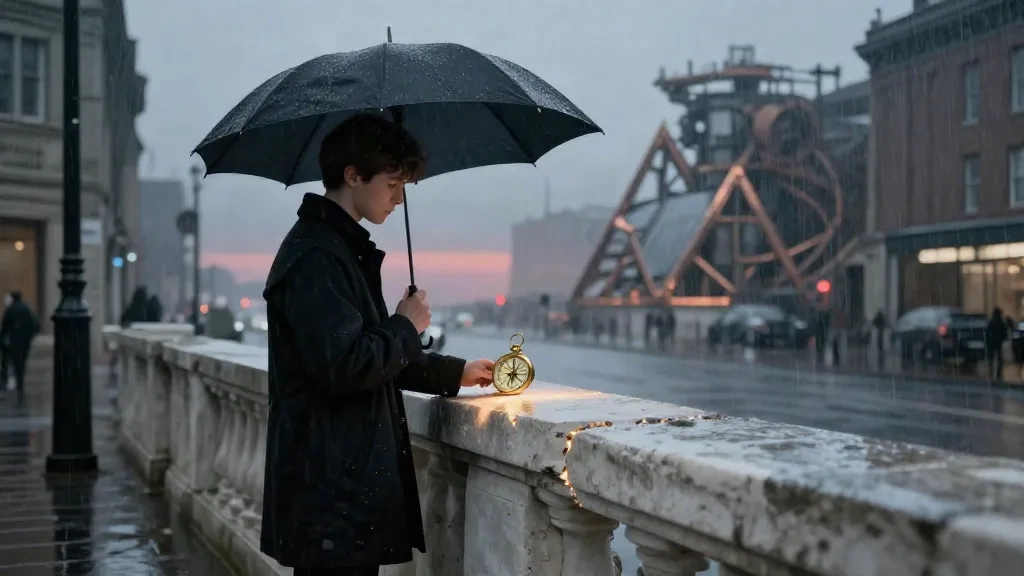
Each year, citizens carried black umbrellas through the rain and set them against the memorial wall. Beneath each umbrella they left one object they could not bear to explain. A wedding ring. A hospital bracelet. A child's shoe polished by a foot that walked on the other side of the year.
Mara's umbrella waited by the workshop door, black cherry wood polished until it gave her back her face in dark red. In its pocket lay a brass compass her mother had owned and never once used, its needle pointing not north but down.
"You could leave that here," Isolde said, still not looking up.
"I know."
"And if you go down, you come back up. Those are the two rules and I'm giving you both, so don't improvise a third."
Mara took the umbrella. Isolde let her go, which was its own kind of permission and its own kind of lock.
In the rain the streets seemed familiar because everyone had inherited the same memories of them: the bakery's blue awning, the missing step at number forty, the tram turning toward a hill no building occupied. But the compass trembled toward the pavement so hard the case clicked.
Under Meridian Street, she said, the city kept its first shape.
Seven Empty Floors
The entrance to the old utility tunnels was behind the laundromat, sealed by a municipal notice and three generations of paint. Mara had never been forbidden to enter. That was worse. The prohibition lived in a memory no living tenant possessed, which is the same as saying it lived in the walls, waiting for someone with the training to hear it.
She descended with the umbrella hooked over her wrist. Brass pipes crossed the low ceiling like roots. The walls changed from brick to wet limestone, then to pale stone veined with copper, each seam threaded with a wire the width of a hair. At each landing stood a door marked with a date in the future, the brass numerals still bright.
Behind the first door a newborn spoke in a language no parent in the city understood, and the room behind the second held an old man who said, over and over, "You're early, girl. Or I'm late. It's the same ledger either way." He had a face like a chair someone had sat in for sixty years. Behind the third, everyone in the room began to leave at exactly the same moment, and kept leaving, coats going on and on, the door swinging for nobody.
Behind the fourth door there was only a bell hanging in darkness. Her bell, cast six days ago, still on the mold she had left upstairs. It rang when she touched the clapper, and the sound opened her into a memory she had not owned: not a memory of the past. A memory of the city vanishing beneath the horizon, leaving only its true outline behind, the way a hand leaves a print in dust and then lifts.
The street was not a street. It was the spine of an immense machine built to carry memory from one century into the next, and Meridian Street had been laid over the machine's heart to hide it from people who could remember too much. Every bell in the building above was a regulator. Every unowned grief a valve. The city did not forget. It postponed.
Then the Unnamed Grief rang.
It came up through the pipes, heavy and human, the sound of a crowd breathing through a wet sheet. Every door on the landing slammed shut. The black umbrella snapped inside out though the wind had died decades ago.
What the Brass Said
At the bottom of the stairs waited a crowd made of silhouettes, each holding an object it could not explain. They turned toward her. Their faces were blank because they were the shape of people who had not yet chosen their grief.
"You know the shape," the compass said. Its needle had drawn up into a tiny key.
It spoke the way the city spoke on its forms: without a single word that could be held against it.
"The Ninth Ward is not lost. It is deferred," the compass said. "Deferred to a date no one has voted for. Six thousand and eleven people are in transit. They are not suffering. That is the point of them. They are held lightly."
Mara's mouth was dry. "Held lightly by what?"
"By the absence of a name. Grief must have a name or it cannot be carried. Grief that is carried loosely passes through a person. Grief that is named lands."
"So the holiday."
"The holiday is a bearing wall," said the compass. "Six thousand people leaning on nothing, and the city pretending the nothing is a tradition. Do you understand what you are holding? If you name it, the wall comes down and the sorrow arrives. All of it. In one street, in one afternoon, in a language no one speaks."
"And if nobody ever names it?"
"Then the machine keeps correcting the world, and the city stays a city that has not happened yet, and everyone in it stays a draft." A pause. The crowd did not move, but the quality of their not moving changed, the way a crowd changes when a rumor reaches the back. "There is no third option. I would have written one if there were. I write all of them."
The Name Beneath the World
Mara thought of her mother's locked box. She thought of the tremor moving rightward through those hands, a deadline nobody had set.
Then she understood what the compass had not said, because the compass only reported: the machine did not merely postpone sorrow. It postponed choice. Everything the city had not yet decided was held in draft, and drafts can be revised, and a city that can revise itself never has to be accountable for a single one of its decisions. The Umbrellas were not grief. They were the sound of a city declining to choose, held up once a year so that no one would have to look at what the not-choosing cost.
She struck the bell.
The note did not bring the past back. It made a place for the absent, the way a name makes a place for a person in a room where everyone has been talking about them without looking at the chair.
The Afternoon It Landed
Across the silent city, black umbrellas lifted off walls and sidewalk and the shoulders of the recently bereaved. People stepped into the rain carrying the objects they had left beneath them, and they began, haltingly, to speak.
At the memorial wall a man in a wet coat said, "Corin," and sat down in the road. A woman two streets over said a name and laughed, once, the way people laugh when the roof finally comes off. The tram that turned toward the empty hill began to announce, in a voice three passengers recognized and had been waiting their whole lives to hear, the names of the stops along the line. Every bell in Mara's building rang once, together, and then went quiet except hers.
At seven minutes past three, the Ward came up.
It did not arrive as a haunting. The pavement along Meridian Street opened like a seam, and six thousand and eleven people walked out of it, dry, unhurried, in the clothes of the day they had been deferred. They were legally alive. They had families eighty-one years advanced past them. They wanted their houses, and their names back out of the alphabetized record where they had been filed under pending, and they wanted to know, in voices that shook and voices that did not, what had been done with the eighty-one years they had not been charged for.
The bells went silent all the way to the river. Whatever the machine had been correcting, it had stopped correcting. The city was now a city that had happened, with all the freight of that.
The Ledger of Umbrellas
The cost arrived in instalments, which is how costs always arrive.
A viaduct that had been scheduled to fail in 2044 stood, sagging, condemned, un-repairable, and could not be made to fail sooner: the future could no longer be revised in either direction. A hospital wing that had been designed to burn in a particular year was built, and did not burn, and had to house, for the next forty years, the patients the design had been counting on dying. On the hill, where the tram now ran hourly, windows lit up in buildings that no one had built yet, rented in the memories of people who had already moved in and could not now afford to be wrong. The city would have to build the future it had finally agreed to have.
And Isolde Venn stopped shaking.
Her hands went flat and quiet on the bench in the workshop, and Mara understood with a lurch that the tremor had been the machine's insurance, keeping the one woman in the district slow and self-contained so that she never rose fast enough to name anything. The machine had protected its own silence in the most efficient instrument it had: a mother who could not hold a hammer straight, arguing with her daughter over an empty stomach.
Isolde opened the box that afternoon, the one she did not open, and she said a name out loud for the first time in thirty-one years, and it was Cael, and she said it the way you set down something you have been holding up a mountain.
"He was your uncle," she said. "He went down the stairs in 1994. I never told you because you were three and because I could still hear the machine, and I wanted to hear it."
"You taught me to cast."
"I taught you to cast because casting is the only thing a bell does before it knows what it is for." She looked at her hands, flat and useless and finally honest. "It's quiet now. I don't like it. Don't let that make you sorry."
The Answer by Name
They buried the compass-key in the Hall of Common Sorrows, under the notice no one could read the number on. Mara kept the bell. Not upstairs. She left it hanging in the fourth room beneath Meridian Street, where the machine's heart had been, in the space the machine had vacated, because a regulator is only honest when the thing it regulates is gone.
She was not thanked. Nobody thanked her. The Ward people asked her questions she could not answer about their own lives, the old man behind the second door never got out, and the city had lost the one habit that had kept it soft.
What she got instead was the bill, arriving on schedule, in the only currency the machinery had ever accepted.
On the last night she climbed out with her hand wet from the tunnel walls, and the street above was ordinary, and beneath it she could hear the great dark turning over, patiently, and she understood that the machine had not been broken. It had been released, the way a debt is released when someone finally signs the ledger. It was turning over now with nothing in it but her name, held loosely, held in draft, waiting for a future that had not been voted for.
She put her palm on the bell and rang it once more, because she was seventeen, and because that was the job.
The future answered by name. It said hers, in her mother's cadence, in a voice from the hill, patient as a hinge deciding.





