 Netwrck
Mythic Fiction.
The Tide’s Small Returning
Saltmere kept its secrets below the pavement. Not in cellars, not beneath the chapel, but under Gull Street, where the old houses leaned together against the sea and the stones shone green when the moon was low. Each tide returned one forgotten object. A child’s red shoe. A ferry ticket softened to pulp. A spoon bearing the mark of a house no longer standing.
Mara Venn was sixteen and made bells in a workshop behind the chandlery. Her bells rang for memories not yet owned. When she struck one at dawn, it answered with her first winter. When she struck another at midnight, it trembled with a goodbye she had not suffered. She had learned never to sell the small silver bell. It rang whenever the town forgot something important.
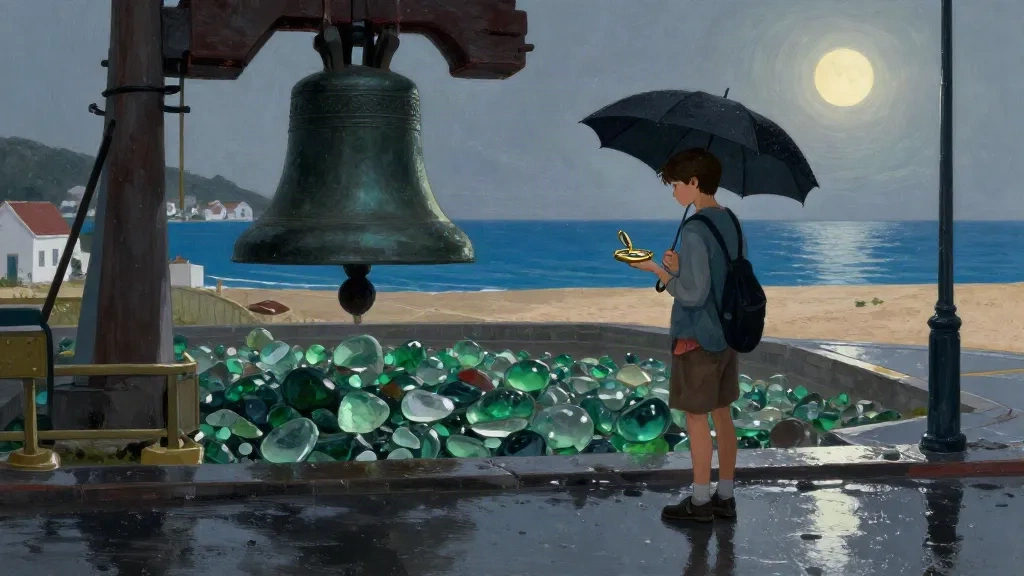
That morning, the tide left a brass compass on the seawall. Its needle pointed inland. Mara wrapped it in her coat and walked home, but the black umbrella found her first.
It stood upright in the road, its ribs shining wetly. No one stood beneath it. Mara recognized it from the old stories: the umbrella belonged to whoever Saltmere had failed to mourn. She opened it, and rain began inside its black canopy, falling upward into the clouds.
The Street That Would Not Open
At noon, Mara returned to Gull Street with hammer, chisel, and compass. The needle swung toward a flat stone outside the abandoned bathhouse. The street was familiar: the baker’s cracked window, the blue door of the tax office, the salt-white step where old women sold embroidered sea birds. Yet beneath it, she sensed another arrangement, a second town laid out beneath the first.
She drove the chisel into the stone. Every bell in her satchel rang at once. Their voices formed a map, not of roads, but of footsteps. Mara struck the silver bell. The sound traveled left, then right, then downward.
The stone shifted. A stair descended into cobalt shadow. Along its walls were names carved in green glass. Some had been worn blank. Others glowed when Mara touched them. She read her own name near the third step, followed by a date three years ahead.
Every forgotten thing returns because something below refuses to be forgotten.
At the bottom stood a bell larger than her workshop. Its bronze surface was crowded with images: a mother holding a sealed letter, a boy running from the sea, a town gathered around an empty grave. Mara could not see the face of the person they had buried.
The Holiday Without a Name
The bell summoned her above ground. Saltmere had decorated every doorway with white cloth. At the square, the mayor raised his cup to the Grief Holiday, an annual observance whose origin no one remembered. Families brought bowls of rice and cups of salt. They spoke to those they had lost, but never named the loss itself.
“We remember,” the mayor said, “what we can bear.”
Mara looked at the black umbrella leaning beside the speaker. It had followed her from the stair. A drop of seawater slid from its handle and darkened the speaker’s paper.
“You remember an event,” she said. “Not the person.”
The crowd turned. Some faces hardened. Others emptied. The mayor told her the holiday had existed before the town, before the sea had built the seawall. He said grief needed a shape, and naming it would make it permanent.
Mara placed the brass compass on the platform. Its needle swung toward the bell beneath Gull Street. She struck the silver bell, releasing every borrowed memory at once. The square filled with cries no one recognized: a husband calling from a drowned road, a daughter singing beneath a closed door, a child asking when the tide would return.
The black umbrella opened over the crowd. Its rain fell upward. For one breath, the dead stood among the living, translucent and patient.
The Shape Under the Street
Only a woman in a green shawl looked at Mara. Her face was calm, almost familiar.
“My daughter,” she said.
Then the vision vanished. The holiday crowd knelt before the empty stage, weeping without shame. Mara took the brass compass and walked down to the hidden stair. The needle now pointed toward a single blue door at the end of the passage.
Behind it, the world beneath the town was not a kingdom of ghosts, nor a place of answers. It was a workshop. Unfinished bells hung from the ceiling, each waiting for the memory that would give it a voice. In the center stood a child Mara’s age, turning a blank bell in both hands.
“You came to learn the shape of the world,” the child said.
Mara looked back through the door. Above her, Gull Street continued its ordinary life. She understood then that the town had not buried its sorrow. It had buried the courage to call sorrow by its name.
She took up the hammer.
“Then we begin with the truth,” she said.
The first strike sent a clear note through Saltmere. Not grief. Not forgetting. Recognition. The tide withdrew, carrying away the last thing the town had chosen not to know.





