 Netwrck
Science Fiction.
The Lamplighters’ Shelf
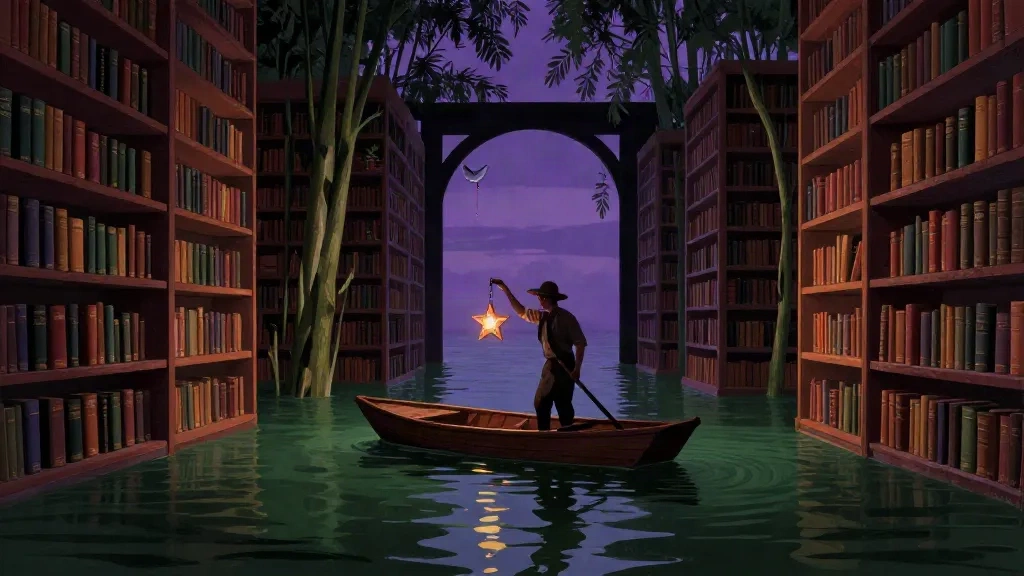
At dusk, when the water rose over the reading rooms and swallowed the stairways, Mara Venn began making lanterns for the paths people avoided.
She worked beneath the seventh shelf, a copper room above the old map department, where the flood had stopped climbing and left the air smelling of tar, wet paper, and the iron rot of drowned nails. Her bench was bolted to the ceiling joists, so that on the bad nights it swung a little, and the flame swung with it, and the amber glass she drew against the light threw a small warm room onto shelves that had no business having a warm room. She annealed the wire ribs in a lamp of her own making, bent them with her teeth, sealed the amber panes with a paste of beeswax and lampblack, and filled the reservoir with oil skimmed from the drowned ceremonial lamps of the west gallery. Her lanterns burned without smoke. That was the whole of their virtue and it was a large one: in a library where every honest flame gave off a grey tongue of soot that settled on the page you were trying to read, a clean light told you that the object in your hand was the only warm thing in the room.
Between shelves the librarians rowed their long cedar boats. They called the aisles canals and the galleries rooms, though every room now ended at the same drowned horizon, and they went about in pale onion-white lamps, careful as nurses, saying little. Mara’s were small suns. She made them for the paths people avoided: the returns corridor where the shelving leaned, the map department’s back stair, the eleven feet of aisle beside the collapsed card catalogue where the water moved wrong.
All afternoon she watched the eastern shelves. Beyond them lay the border, a black seam of water under an archway whose stone carried an alphabet no one in the drowned archive could read. The Archivists on the far side permitted passage only to those who surrendered whatever they carried most, and they took payment in a brass lock set into the water, and they gave the thing back emptied. Mara had crossed twice. Once for her sister Nessa’s birth record, which came back a sheet of clean paper with the stamp on it and nothing else. Once for a seed catalog, which came back with every page cut to frames around blank squares. Each time the lock had taken the meaning and left her the shape, so that she could hold her life in her hands and be unable to read it.
In her left pocket lay a copper star no larger than a thumbnail, its six points bent outward as though something heavy had struck it. That was the night her mother Ilsa Venn had gone down to the lower vaults and not come back up. In her right pocket lay a glass bird, bright as a held breath, its wings sealed shut with a bead of lead. Mara carried both because leaving either felt impossible, and because crossing meant surrendering one, and because for eleven years she had not admitted to herself which of the two she would choose, and she had therefore never gone back.
What the Water Confessed
On the third evening the bell rang.
It hung beneath the foreign stacks, where no keeper could reach it, and its note entered Mara’s teeth and tightened there, a low iron wire drawn through the roots. Every librarian stopped rowing at once. Their boats creaked against the shelves. Somewhere overhead a shelf let go of a shelf, and the sound went on for a long time.
The bell rang only for decisions no one admitted making. Her father had told her that when he was still a man who told her things, before he took the night boat west and did not return either. It sounded once, he said, when the city abandoned its north wall. Twice when a queen ordered the forest cleared. Eleven times during the drowning of this archive, and then, for thirty years, nothing at all, which the old ones had come to take for a conscience.
Now it began again.
One peal. Two.
A whisper crossed the water, thin as a page turning: I decided to let the river take the eastern wing.
An older librarian stared down into her lap and did not move. Another covered her mouth with a wet sleeve. A child librarian near the west canal said, in a voice pitched to carry exactly as far as it had to, “I decided my mother was already dead,” and the boats recoiled against the shelves as though struck from below. The lamps swung. The onion-white ones guttered; Mara’s did not.
Then a voice Mara knew as well as her own hands, low, level, and ashamed, said from a boat she could not see: I decided the eastern wing was the only door wide enough.
Mara’s mother had not been dead. Mara understood that now with a clarity that felt like a nail, and understood also the older thing, the thing she had been carrying in both pockets for eleven years: that the night her mother went down, Mara had been eleven, and had been given a tally stone, and had been told it was a game.
They had all voted. Every librarian, every copyist, every child old enough to hold a stone. Ilsa Venn had stood in the register line with the water already at her ribs and counted the wards that could be sealed and the wards that could not, and had said the number aloud, and had let it be a number, and then had put her name at the bottom of it and given the paper to a keeper and made the keepers put theirs beneath that, all of them agreeing afterward never to speak of it, because a shared choice is a shared debt, and a shared debt is a thing you can all be told you were only part of.
Mara pressed her hand flat over the copper star in her pocket. It had gone hot. The bell did not stop.
The Packet in the Rowboat
Then the glass bird cracked.
Not shattered. Cracked, the way a thing cracks when it has been carrying more than it was sealed to hold, and a line of pale light came out of the join at its shoulder and lay across the water toward the black seam. Mara followed it with her lamp held low, rowing past shelves whose upper ledgers floated like black canoes, past the drowned card catalogue, past the place where the returns corridor leaned into the current and had to be rowed in a crouch.
At the end of the light an unmarked rowboat waited, its oarlocks furred with eelgrass, green hair trailing. On its bench lay a sealed packet in her mother’s handwriting, the loops of the letters leaning hard to the right the way they did when Ilsa Venn was writing fast and frightened.
She knew the seal before touching it. The six-pointed star had been pressed into red wax, not as a device but as a puncture, a deliberate hole in a solid stamp.
Inside were two sheets. The first was a declaration, dated the night of the flood, written in the register hand:
We, the undersigned, having counted the wards at the second bell, agree to unbolt the eastern wing and admit the water. The wing holds no person. The lower vaults hold three hundred and nine. We will not reopen the wing to retrieve. We are agreed, and we ask that our agreement not be spoken of, that the record be sealed entire rather than read entire, so that no one must choose again alone.
The second sheet was a name list. Not the librarians. The people left behind in the eastern wing: readers, copyists, a bookbinder’s apprentice, eleven children in the reading room during the evening class, their names and their wards and the hour they were last seen, and at the bottom, in the same fast right-leaning hand, a line that Mara read three times:
Ilsa Venn, keeper of the lamplighters’ shelf, surrenders her name to the lock in exchange for the vault count. Do not open the packet. If you are reading this, we have decided to let you remember.
“If we admit it,” said the eldest librarian, Sarn, from the far end of the aisle, “the bell will tell us which of us was lying.”
“It will tell the river,” Mara said. “The river was there.”
No one contradicted her. Sarn put down her oar and sat with her hands loose in her lap, and the terrible thing — the thing Mara had been waiting eleven years to see, the thing that made the confession worth the ringing — was that the old woman looked relieved.
A Border Made of Reasons
Mara rowed alone. The shelves narrowed as she came to the seam, their upper ledgers floating, their lower decks thick with green. The border-lamp showed no face, only a pale hand beneath the surface, palm upward, and the water above it stayed flat as hammered tin.
“What do you carry?” it asked.
“Proof,” Mara said.
“Proof is not a thing. It is a reason people call a thing.”
The glass bird trembled in her pocket. Through it she saw the opening night whole again, and it was nothing like the story she had grown up inside. Her mother shutting a valve with both hands and a boat hooking her sleeve. Librarians wading with children lifted over their heads, water breaking the children’s legs, children still holding their slates. The lower vault doors coming off their hinges and swinging like a man falling into a grave. And then, last, in the balcony above the old order, a fire nobody had ever named, burning the wet final report as it dried — the report that listed every missing book, and beneath the list, in a second column, every missing person the books had been shelved under.
The report had been drying, and someone had struck a light to it, and that someone had not been the river.
“Give me the reason,” the lamp said, “and I will let you and the proof cross.”
And Mara understood the shape of it at last, the way you understand a stair in the dark by the number of your own falls. The star was evidence: a thing bent on the worst night, proof of an injury with a date. The bird was the copy: the last intact impression of the report, the column of names, the fact that the list had been burned and not lost. Surrender either and the border would hold the other, because archives — drowned ones especially — could not conceive of two truths crossing at once. One reason at a time. That was not cruelty. That was how they were built.
She held out the copper star.
At once the water struck the boat. Hundreds of voices whispered the word yes, and under the whisper, right at the bottom of it, a small flat voice said yes in the register hand, the way an eleven-year-old says a thing to be permitted to go home.
Then she drew it back.
The bell answered with a furious clang that she felt in the fillings of her teeth and in the bones of her ankles. The eastern shelves began to come down inward, slow at first, the way a library comes down: one shelf, then the shelf above it leaning into the gap, then a hundred tons of soaked paper deciding all at once to move. A librarian screamed somewhere behind her. A boat took the beam across its gunwale and split. The border-lamp seized her coat between two fingers of pale light and drew her toward the black seam with a patience that was worse than violence.
Mara drove a thumb into the lead bead at the bird’s shoulder.
The bird broke. It went out of her hand as a shower of clear splinters, and each splinter was carrying something, and Mara could read them as they turned in the lamp-light: a name, a date, a page number, a child’s fingerprint, a column headed SECOND, a single word — struck — and the room where it had been struck, and the hand, and
“Evidence can be shared,” she said, and threw the glass into the black.
The Water Carrying Two Lights
She dropped the copper star into the border-lamp after it.
It did not vanish. It turned beneath the water, slowly, catching the falling splinters until they stopped being pieces of a bird and became a single burning constellation laid flat across the black, star and glass together, which the water had no rule against, because it was two things at once.
The archive answered. Shelves groaned apart. Doors opened that had been shut with paper and paste and politeness. Pages came out of their bindings and streamed along the current like pale fish, thousands of them, and beneath them came the heavier things: ledgers, tide tables, the seed catalog with its frames of blank squares, a drawer of brass tallies, one wet boot.
The border-lamp withdrew its hand, and the black seam opened the width of a boat.
Mara took the packet. She did not take time to read the names again, and she thought about that later, and it was the worst thing she had done, worse than the vote.
Behind her the librarians began to gather what floated. They worked fast and without speaking, and none of them looked innocent, and most of them looked relieved. Sarn came alongside in a boat with a broken gunwale and two sheaves of soaked pages under her coat.
“You let it take the wing,” Sarn said.
“I let it take the wing,” Mara agreed.
“The roll of the second bell was in the wing. The evening class. The children.”
“Yes.”
“Then you have drowned the evidence of what you drowned.”
Mara thought of the attendance ledger on its shelf: her own hand on the stone, in a column of children’s names, when the register had still been a record and not a confession. She thought of Nessa’s birth page, which had already been surrendered once, and had come back clean, and which was under nine feet of green water at this moment, with the eleven children’s roll, and would in the morning be nothing but pulp and a spine and a bright rectangle of glue where the printing had been.
“Yes,” she said.
Sarn nodded and kept gathering pages, because there was nothing else in the world to do with a truth that had already been paid for.
What the Flood Kept
They worked until the light came back, which in the drowned archive was not sunlight but a paleness that filtered down through nine feet of water and made everything the colour of an old tooth.
The recovered record was enormous and it was not the record. What came up out of the eastern wing was mostly stock: the working index, the accession books, forty years of shelf lists naming books no one alive had read. The names — the people — were what had been stored at the front, on the two long tables by the stair, in ledgers bound in a soft grey board that the flood had turned to felt. The felt could be lifted. It could not be read. It could be dried, and it could be weighed, and it could be assigned a number, and it could never again be searched for a single name without destroying the four thousand around it.
So the archive learned to trade. That was the shape of the next year, and the shape of the twenty years after it.
Pell, the child librarian who had said I decided my mother was already dead, was the only one who did not seem to consider the bargain shameful, and this frightened the elders more than the bell had. Pell’s method was to read the softened felt under a lamp, low and slow, following the ghost of impressions in the fibres, and to enter every name that could still be read into a roll of new paper. Nine out of ten pages gave her nothing but the shape of a sentence. On the tenth she found a full name, and the next day a full line, and by the end of the season she had a sheet with forty-one names on it in her own careful capitals, and she carried it everywhere, and she read it to the new hands at the ration boat, and she did not hide it when they asked what it was.
“The one we were given,” she said, when Mara asked her why she was not ashamed. “The one we were allowed to keep.”
Mara understood, then, that this was what the border had actually purchased with a sunken wing and a glass bird: a way for the drowned to live with what they had done, by making it into a service. They swept the felt. They dried the stock. They drew a new boundary a hundred paces west, where the shelving leaned too badly, and built the brass lock themselves, and put a Keeper’s hand in the water, and began, after a while, to let people cross — small things, mostly. A seed. A name. Never the thing they carried most, and never twice.
And every page of the new roll they signed began the same way, because a record is only honest if it says what it is missing:
Names omitted: the six drowned wards, the eastern wing, the second bell. Witnesses living. The omission is ours. — M. Venn, keeper
Mara Venn, keeper. She had asked for the title on the fourth day, when it became clear that somebody had to stand at the new lock and be the one who decided what was most, and she had asked for it because it was the only post that gave her a lawful reason to say no to people, and because she could not bear to be a woman in a boat again with a reason in her hands and no way to use it.
Her mother she did not find. But the bell stopped ringing in the eighth month, and the note it left behind was not relief, exactly; it was the sound a room makes after something has been moved out of it. The clapper, when they raised it at last on a chain of spliced cords, was wet. Not river-wet. Wet the way a thing is wet that has been somewhere else and come back, and it was the clapper of the lamplighters’ shelf bell, which had not hung in the water until the flood, and which Mara had not seen since the night her mother carried it down.
So her mother was below, or her mother was a record of a woman below, or the archive had needed a voice with her mother’s cadence and had taken the trouble to learn it. Mara did not decide. She kept the wax seal, and she never melted it, and she set it on her bench at the corner nearest the water, where the light would find it first in the morning.
The Sealed Wing
She reached the white stone platform above the waterline near dawn, out of three days of rowing, with a packet in her coat and nothing else that was hers.
No copper star. No glass bird. Only the red wax in her pocket, warm from the bell’s final ringing, and printed through with a six-pointed hole that was not a stamp but a puncture, a hole made on purpose by somebody who had wanted a thing to pass through rather than be held.
She sat down on the stone. Behind her the whole flooded archive lay flat and green and enormous, every lantern in it a small clean star that did not smoke, and the shelves drifting loose, and the boats going out along the aisles with their lamps up, gathering.
Then, from the sealed wing of her coat — the pocket she had sewn shut in the second year, and never opened again — something chimed.
Not glass. Not copper. The sound had a throat in it.
“Mara,” her mother said, and the voice was steady, and low, and leaning a little hard to the right. “We decided to let you remember.”





